Should you drop your Integrated Shield Plan? This health scare offers insights

A HEALTH scare that my husband suffered last month surfaced some perspectives on why a significant number of people, particularly seniors, may consider giving up their Integrated Shield Plans (IPs).
After the experience, I myself wondered – should we drop IPs altogether? We already downgraded from a private hospital plan some years ago to a Class A restructured hospital IP. We did not purchase riders.
At that point, escalating premiums at older ages were a factor. But private hospitals’ sky-high charges, the overconsumption of health services among policyholders, plus overservicing by private specialists also did not sit well with me.
The Ministry of Health (MOH) recently announced changes to IP riders that will take effect in 2026, in yet another effort to rein in IP premiums and boost financial sustainability. New riders will cease to cover the deductible and raise the minimum co-payment cap.
These changes mean smaller bills may not be covered by your IP. On the brighter side, new rider premiums are expected to be 30 per cent lower.
Our recent experience highlights the importance of periodically revisiting the question of need and affordability, with or without riders. Ultimately, though, some structural limitations in the healthcare system could well narrow your options if you have a public hospital plan.
Until this incident, my husband has not made a major claim, apart from a cataract procedure earlier this year, for which the IP payout was minimal.
But last month, he suddenly collapsed while on a brief run at the East Coast Park. A kind-hearted jogger called the ambulance and waited with us until it arrived. My husband was taken to Changi General Hospital (CGH).
Attention was immediate, but he stayed at the accident and emergency (A&E) ward for two nights before being admitted to Class C, despite having a Class A plan. He was finally discharged after a four-night stay.
I have often written that the choice of IP cover will depend on your ward preference – ranging from private hospital for more luxurious care to Class B1 or B2 if you don’t mind fewer frills. That remains true.
Bed crunch
But I had not reckoned with the scarcity of beds in public hospitals.
While waiting at the CGH holding area, we were told Singapore’s eastern region has more than 700,000 residents; CGH itself has around 1,000 beds.
A new hospital is under construction, the Eastern General Hospital at Bedok North, with 1,000 beds. It is expected to begin serving patients virtually in 2026, ahead of its completion in 2029 or 2030.
The bed crunch is set to ease. MOH announced in March that there are currently more than 12,000 public hospital beds. Between 2025 and 2030, another 13,600 beds will be added to the healthcare system, including 2,800 public acute and community hospital beds.
On the number of beds by ward class, Parliament was told in 2021 that there were a total of 9,408 beds in 10 acute public hospitals. Of these, 84 per cent were in B2/B2+/C wards; 9 per cent in B1 wards; and 7 per cent in Class A.
The distribution of beds is based on principles set out in the 1993 White Paper on Affordable Health Care, where at least 65 per cent of beds were to be Class B2/C beds. Class A beds were to comprise no more than 13 per cent.
Recently, Health Minister Ong Ye Kung said about 100,000 people have either downgraded or dropped their IPs altogether. Those who drop their IPs will rely only on MediShield Life.
Is this sufficient? Based on our experience, the short answer is yes.
Greater burden on public hospitals
Here are some factors that ran through my mind.
- More opt for B2/C wards.
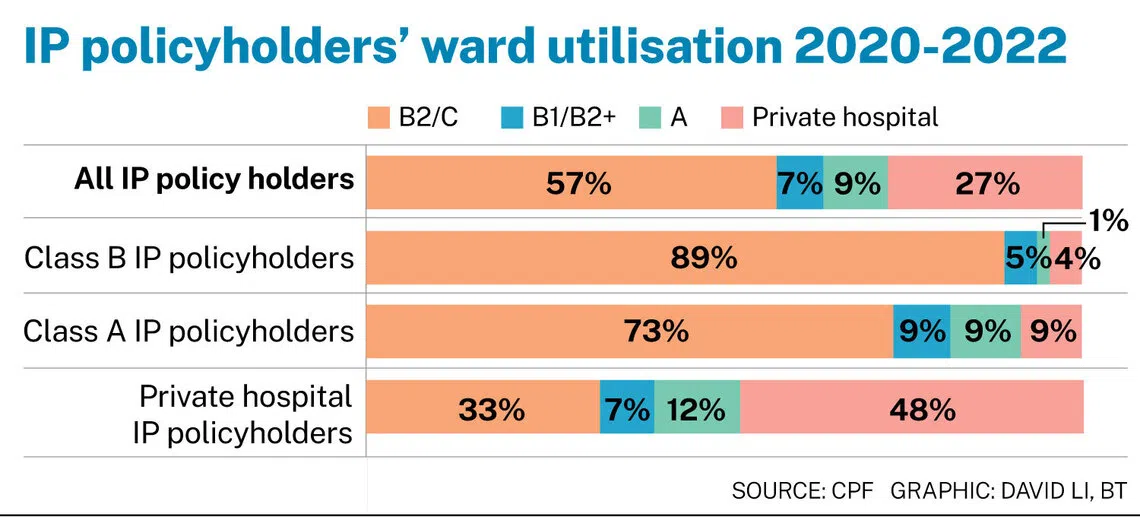
The Central Provident Fund (CPF) web page on healthcare financing showed that between 2020 and 2022, seven in 10 hospitalisations occurred in Class B2/C wards.
In that period, 57 per cent of IP policyholders stayed in B2/C wards. Of those with costly private hospital plans, about a third opted for public hospitals in B2/C wards despite paying high premiums.
CPF noted that those with private plans likely purchased them “because they want to preserve the flexibility of seeking private care”. Interestingly, 73 per cent of those with Class A IPs also stayed in B2/C wards.
Private hospital plans are typically purchased when policyholders are younger and the premiums more affordable. But as they hit their 60s and cease working, they may think twice, especially as the total premiums including riders can exceed S$10,000 a year.
A compilation by MOH shows that for those aged 61 to 80, the cost of private hospital IPs plus riders ranges from S$5,311 to S$11,743.
This suggests that more may downgrade their IPs. Clearly, the burden on public hospitals will only grow, as we age and suffer more chronic diseases.
- Silver lining: In public hospitals, beds are assigned according to urgency and need.
Since there are fewer beds in higher-class wards, it is more likely that one will be assigned to a Class C bed, where you get “natural ventilation” and share space among eight beds.
The most obvious downside is the noise. But as far as we could tell, once my husband was out of the A&E area, attention levels were good. The ratio of staff to patients appeared high, particularly at the close of visiting hours.
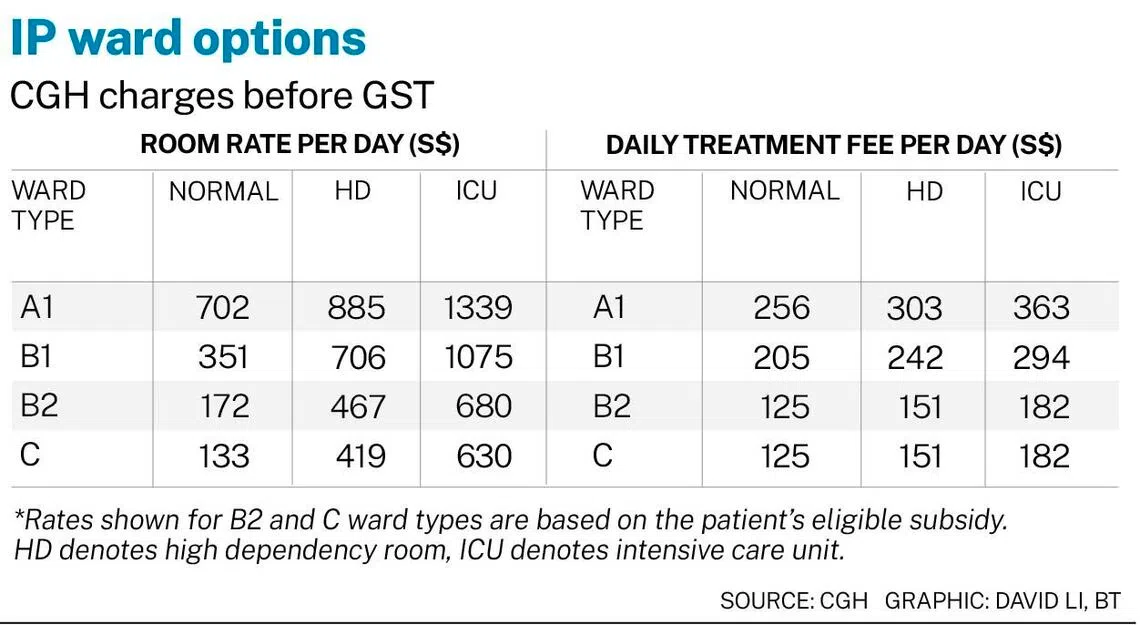
The silver lining is that in the final calculation, the out-of-pocket cost was zero. Had he been warded in Class A, the likely cash outgo would have been more than S$3,000. The portion of the bill paid by the IP was modest – less than S$500.
- Weighing premium costs.
It is often advised that in insurance, you should simply pay for what you need – that is, an IP commensurate with the type of care, environment or attention you desire.
Based on lifetime premiums, as compiled by Havend in June, the base plan premium for a Class A IP for one of the larger insurers was around S$75,000, based on cash payment after MediSave use. The lifetime cost of a Class B1 IP was around 57 per cent less.
The rub is that you may not be able to insist on your ward entitlement or preference, because of capacity constraints.
Why, then, pay higher premiums? This is quite distinct from someone with a private hospital IP who voluntarily opts to stay in Class C.
In the east, the bed crunch may last four to five more years, until the new hospital comes on stream. Is it worth maintaining a Class A plan when we’re likely to end up in a lower-class ward anyway?
To be sure, the premium buys peace of mind – an option that’s good to have should you need it. The best case, of course, is that we don’t need to be hospitalised – until late in our senior years.
Still, after this experience, I have fresh appreciation for Singapore’s public healthcare system, where attention and treatment were comprehensive and subsidies generous.
For now, I’m sticking with our IPs as long as premiums remain affordable. Should we drop them, staying in a Class C ward isn’t the hurdle I expected it to be.