A tale of two Chinas
China’s economy is split between world-leading innovation and structural weakness


IT WAS the best of times; it was the worst of times.
Charles Dickens, writing of revolutionary France, could scarcely have imagined how neatly his words would one day describe the Middle Kingdom.
China today presents a striking duality: pockets of technological excellence and global leadership, alongside a broader landscape of economic stress, weak domestic demand and slowing momentum.
For investors, the question is not whether this duality exists – manifestly it does – but whether it is possible to navigate both “Chinas” at once: capturing exposure to genuine opportunity while avoiding the structural traps that sit alongside.
New vs old
“New China” – dynamic sectors such as electric vehicles, renewables, high-tech manufacturing and advanced digital industries – continues to show extraordinary strength and global ambition.
In 2025, the country produced around 16 million EVs, substantially outpacing Europe’s roughly 3.2 million and the United States’ one million units.
Similar dominance is visible in solar and battery production, where China accounts for most of global output and exports.
The “new three” industries continued to post robust export growth into 2026, with notable records set in the early months.
Industrial output rose 4.5 per cent year on year in May 2026, accelerating from April and underscoring manufacturing resilience, particularly in coastal innovation hubs like Shenzhen and Shanghai.
Equity markets reflect this divide. New energy, technology and innovation-related sectors have posted gains of 25 per cent year to date, while the broader Shanghai Composite, which includes more old-economy exposure, has delivered only modest returns, up roughly 2 per cent year to date.
In Lombard Odier’s view, sharply accelerating high-tech and clean-tech exports should continue to anchor China’s growth outlook in 2026 despite domestic fragilities.
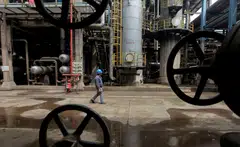
In contrast, “Old China” – think smokestack industries, property and legacy sectors – faces ongoing pressure, especially in inland and rural regions where development lags the coastal mega-cities.
The property market remains the clearest expression of that weakness. This matters because property and related construction activity once accounted for 20 to 30 per cent of the economy.
In May 2026, new home prices fell 3.5 per cent year on year, while property development investment contracted 16.2 per cent. Domestic consumption also remained weak in H1 2026, with the boost from earlier consumer trade-in programmes fading.
Offshore vs onshore
The “two Chinas” metaphor also extends to the external sector.
China’s export machine remains formidable. A record US$1.2 trillion trade surplus for 2025, with exports showing resilience and double-digit gains in various periods into 2026, particularly to non-US markets.
These surpluses have helped offset weaker domestic activity, but also provoked international pushback in the form of tariffs and restrictions.
Onshore, the picture is less compelling. Retail sales fell 0.6 per cent year on year in May 2026 – the first decline since December 2022 – driven by weakness in big-ticket and discretionary items such as automobiles.
Youth unemployment, measured among 16 to 24-year-olds excluding students, stood at 15.6 per cent, down from 16.3 per cent in April but still elevated compared with prior years.
Many households, particularly outside digital communities in tech hubs, continue to face balance-sheet pressure from the property downturn, while cautious sentiment and limited broad-based support have kept spending soft.
Structural divide
China’s domestic weaknesses are not merely cyclical; they are compounded by deeper structural issues. High leverage across the economy creates ongoing financial risks and limits policy flexibility.
Official general government debt sits just below 70 per cent of gross domestic product, but broader measures including local government financing vehicles and hidden liabilities push estimates significantly higher, often to over 100 per cent of GDP.
Demographics add another long-term drag. Births fell to a historic low of about 7.9 million in 2025; the population is shrinking.
Roughly 16 per cent is aged 65 and over, and about 23 per cent is aged 60 or above. Meanwhile, the working-age population continues to contract.
Nominal GDP per capita in the US$13,000 to US$14,000 range underscores the difficulty of escaping middle-income-trap dynamics.
China is still trying to move fully towards innovation-driven and consumption-led growth, but that transition remains complicated by tensions between state-dominated priorities and private-sector vitality.
The same tension is visible in the currency. Renminbi internationalisation has progressed steadily, with the currency accounting for around 3 per cent of global payments.
But its lack of full convertibility, capital controls and other constraints continue to limit its role as a true global reserve currency.
Policy priorities
Policy priorities reinforce this divide. Authorities have focused on industrial upgrading, technological self-reliance and national security.
Lombard Odier highlights that the 15th Five-Year Plan continues to emphasise tech self-reliance, innovation and investment-led demand creation.
These priorities have strengthened China’s position in EVs, renewables and advanced manufacturing.
Yet they have also contributed to overcapacity in some areas, heightened global trade friction, and slowed the broader rebalancing towards consumption and private enterprise.
To be clear, China will not face sudden collapse or sweeping political upheaval.
A more plausible trajectory is closer to Japan’s balance-sheet recession of 1990 to 2023, characterised by prolonged deceleration and a lengthy plateau, with islands of excellence in strategic technologies coexisting alongside structural drags from legacy sectors, debt pressures and demographics.
In that environment, export reliance is likely to persist, even as it generates external tensions.
Owning the right China
Lombard Odier’s investment roadmap follows from this divide. New China – EVs, batteries, solar, chips, AI technology and related areas – remains eminently investable, supported by real market share, strong export potential and policy tailwinds from the 15th Five-Year Plan.
Old China, by contrast – property and legacy industrials – seems more like a value trap. A state-financed rescue is unlikely to change that reality. As Beijing learned in 2009, stimulus can create overcapacity rather than prosperity.
We prefer China exposure via the tech-dominated MSCI China Index. Our view is not avoiding China, but being selective.
Own the future-facing parts of the economy; remain wary of legacy balance-sheet traps; and recognise that both realities will continue to coexist for some time.
The writer is chief investment officer, Asia, Lombard Odier
Decoding Asia newsletter: your guide to navigating Asia in a new global order. Sign up here to get Decoding Asia newsletter. Delivered to your inbox. Free.
Share with us your feedback on BT's products and services