

Why mixing business and politics can be a powerful force for peace
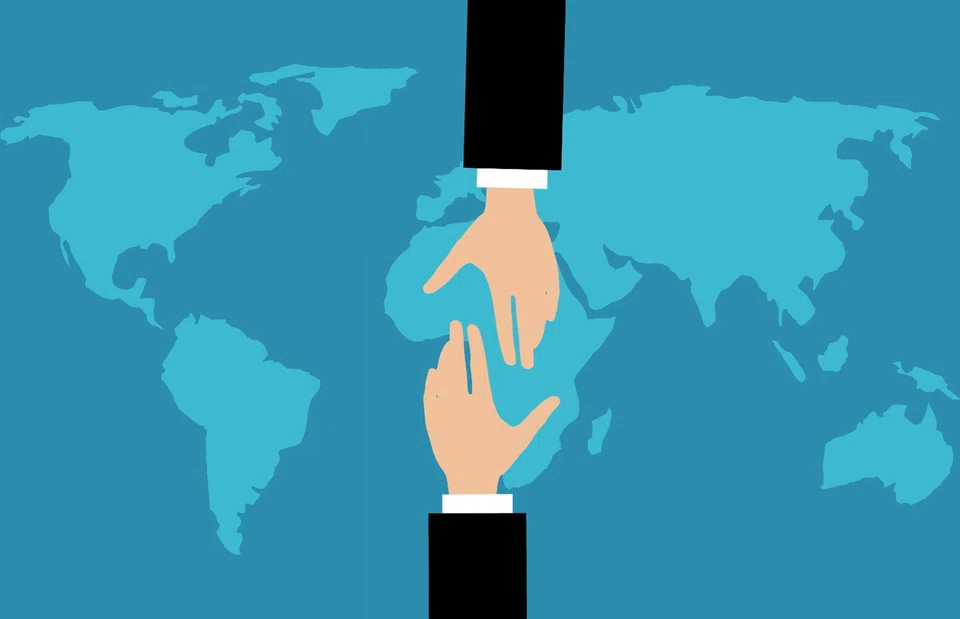
BUSINESS managers did not equip themselves to be politicians except, perhaps, to be able to deal with the petty politics of everyday workplace living.
Their expertise is discovery of potential needs, production, marketing and selling, all at a good enough profit to make the investment and effort worthwhile. International trade has now become such an important part of every economy that cross-border negotiating has developed into a political as well as a commercial responsibility.
Business has always been involved in politics
Empires were built on trade as much as on land acquisition, conquest and slavery. Civilisation has been the discovery and adoption of other people’s ways of life and of assets and fruits of strangers’ countries.
Initially, this was all done for exploration and discovery. Today it is also done out of necessity. The overpopulation of earth produces scarcity of life’s essentials in some countries. It is mind-stretching to think that South Africa is now short of water.
The development of high technology demands a supply of rare earth and other specialised products which are only available in limited places. The oceans are soon to be mined for some of these needs, with what must be a considerable risk to the ecological balance of the planet.
From carrier pigeon to nanosecond
The relationship between business and politics has been changed fundamentally by the availability of information, in speed and volume unthought of even 30 years ago.
In the first place, banking magnate Nathan Rothschild flew his carrier pigeons from continental Europe to Britain to tell of the prices there before the stock exchange opened in London. It might have been called outsider trading. It made the Rothschild family very rich. Today, cloud storage is built strategically close to the financial centres it serves in order to save nanoseconds of time – a sort of next-door trading.
Faster communication impacted all aspects of life. It put financial information speed ahead of more nuanced diplomatic exchanges. The commercialisation and growth of artificial intelligence (AI) has already far outpaced any government’s ability to control it. The strengthening relationship between finance and militarisation has made decisions about defence more urgent than debates about relationships. Every government’s responsibility is first to the safety of its people.
Thus, it is better to be safely equipped earlier rather than clearer about your neighbours’ possibly predatory intentions later. Unpredictability is what drives the expansion of Nato and other defence bodies.
Coupling and uncoupling
Raw materials were sought by business largely on the basis of cost, until political needs required sanctions on supply and demand as part of the war between Russia and Ukraine. Political posing as allies and enemies quickly disrupted the “lowest-cost” suppliers, and a pandemic made distribution so distorted that businesses had to think of diverse sources for their needs to reduce the risk of failure.
Amid the talk of diversified raw material sources and decoupling from some suppliers, the business world is reflecting these erratic political trends.
Local vulnerabilities, such as climate extremes, make a larger number of supply points logical. Where only recently much production was concentrated in China, political ambiguity and lack of relevant information now make other countries more accessible and more dependable sources of raw materials and part-finished products.
“Eggs and baskets” turns out to have been a wise advisory.
Political sense of diversity
Fixed-asset investment in different countries makes good sense politically as well as defensively. Societies cooperate when they know – and interact with – each other. Political judgement, however autocratic, has to reflect, at least to some extent, what the people will put up with. Better, and often inaccurately, informed societies in both the East and West are demanding higher standards of living and a bigger share of the available pie.
In practice, the world’s capitalist system is now making a tiny proportion of the population grossly rich, while leaving a huge number of people close to starvation. To its credit, it has also grown many middle classes.
Politicians are well aware of the growing role businesses must play in governance. The British Labour shadow foreign secretary has already declared that, if Labour becomes the next British government, he will convene a new council of business leaders to ensure that the needs of companies are part of the government’s diplomatic thinking.
His purpose is more than that. Every political party sees the growing need for international commerce. Sanctions, politically necessary as they may at times appear to be, are the antithesis of smooth supply and market dealings.
Good supplier-customer relationships are already a contribution to peace, a word we seem to be using less and less as a desirable objective and more and more as a reason for arming. Business is a useful stabiliser when international tensions overheat.
All this is a far step from the expletive uttered by one of the recent British prime ministers dismissing business as irrelevant to politics. Politicians would be wise to collaborate with business leaders. Business deals are concluded largely on the basis of what makes the best financial sense. Not all politics is finance-based but, as former US president Bill Clinton pointed out, the economy determines the outcome of most elections. He put it as a more fruity expression.
Big companies have gotten much bigger in the last two decades
Managing world services requires high-class, interconnected communications with, often, massive plants to produce and service customers. These “harbours of employment” find themselves with the benefits of cooperating groups of workers and the potential for organised dissension and opposition to management.
Their workforces are international, which provides opportunity for learning the reasons for the different and changing cultures. Their manager-worker relationships are determining the pattern of employment for the future, though this will again be disrupted when the full application of AI and robotics are jointly harnessed.
Well placed to help with the business end of politics are the chambers of commerce. They can enhance the relationships between politicians and business managers in a positive and constructive way – as some of them are already doing – rather than simply as makers of money and takers of taxes. Chambers’ roles are changing, and their purpose needs redefining to help them be the societal force for good that they have been and certainly can be again.
A good business-politics combination is not only fruitful for the world’s economy. It is a powerful force for political stability for a world seeking peace.
The writer is founder and chair at Terrific Mentors International
TRENDING NOW

Easy to rent out, hard to sell: Are buyers losing interest in Singapore’s one-bedroom condos?

GovTech retrenches another 38 staff in second round of layoffs
Stocks to watch: Seatrium, CapitaLand Investment, Keppel DC Reit, Suntec Reit, CLCT, TSH Resources
World’s largest offshore wind platform by Seatrium consortium on track to be completed by 2028

