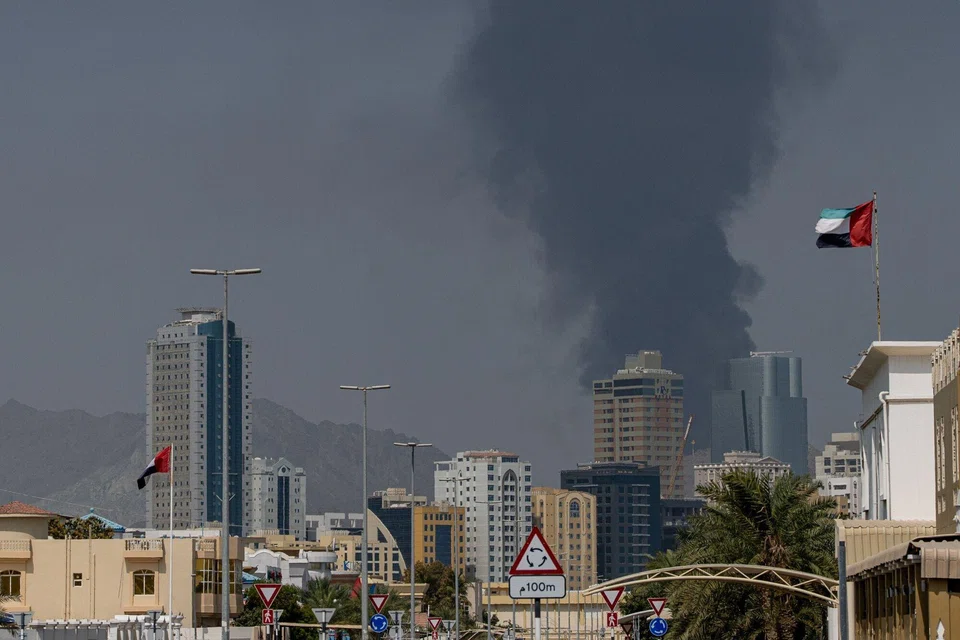
Smoke rising after an explosion due to drone debris in the industrial zone in Fujairah, United Arab Emirates, on Mar 3. Security and safety precautions are the topmost priority for South-east Asian companies with teams in the region. PHOTO: BLOOMBERG
Dear BT reader,
Halfway across the world, military strikes in the Middle East are spilling into the Gulf, while their impact reverberates into South-east Asia.
Slowing oil supply from the Middle East prompts the Indonesian government to step up its imports from the US, while electricity prices in Singapore could spike as gas prices remain elevated. BT’s energy correspondent Sharanya Pillai looks into how conflict in Iran could shock Asia’s energy players, with oil prices threatening to breach US$100 a barrel.
But businesses with exposure to the Gulf could take a more direct blow, hunkering down as they prepare for prolonged disruption to their business operations. My story looks into the impact that South-east Asia’s businesses could feel.
Meanwhile, the region struggles to shake off structural weakness and the effects of US trade policy.
Tariffs, Middle East tensions and slower growth in China could all continue to weigh on Indonesia’s trade performance, with the country reporting a trade surplus for January well below economists’ expectations. BT’s Indonesia correspondent Elisa Valenta speaks to analysts about whether the country can reverse the slowdown amid geopolitical strife.
The country’s creditors are also watching its policymaking with increasing scrutiny, as Fitch Ratings cuts Indonesia’s sovereign credit outlook from stable to negative, Elisa reports.
This comes after a US Supreme Court ruling invalidated much of US President Donald Trump’s “Liberation Day” tariffs, but the latest US trade policy agenda suggests that the country still expects its trading partners to abide by reciprocal trade agreements. Lionel Lim speaks to experts about what this means for South-east Asia’s economies.
Strategic sectors like Malaysia’s rare-earths industry will be under scrutiny in these trade agreements, but producers are not slowing down. Australian rare-earths supplier Lynas has received a renewed operating license in Malaysia for 10 years, reports BT’s Chuah Bee Kim.
Meanwhile, Singapore-listed miner Southern Alliance Mining looks to shift its focus to rare-earths, in a bid to diversify from its main iron ore mining operations. BT’s Malaysia correspondent Tan Ai Leng speaks to the company’s chief operating officer Lim Wei Hung about the move.
Those are the highlights for the week, with plenty more stories to read below! See you again next Friday.
Trending
Failed reform vote raises questions over Malaysia’s coalition discipline
Malaysian prime minister Anwar Ibrahim and his administration may be under increased scrutiny following a failed constitutional vote to limit the prime minister’s term, with the proposed amendment – a key part of Anwar’s reform agenda – missing by two votes. Analysts tell Bee Kim that this could cast doubt on Anwar’s ability to execute on his campaign promises, though such uncertainty is nothing new to investors.
The proposed amendment, which sought to limit any individual’s service as prime minister to 10 years, was part of the reform agenda of Prime Minister Anwar Ibrahim’s ruling coalition.


 EvanSee