

China’s central bank warns on imported inflation from higher oil prices, focuses on policy transmission
Many economists have already scrapped their forecasts for a rate cut this year
 Add BT as a preferred source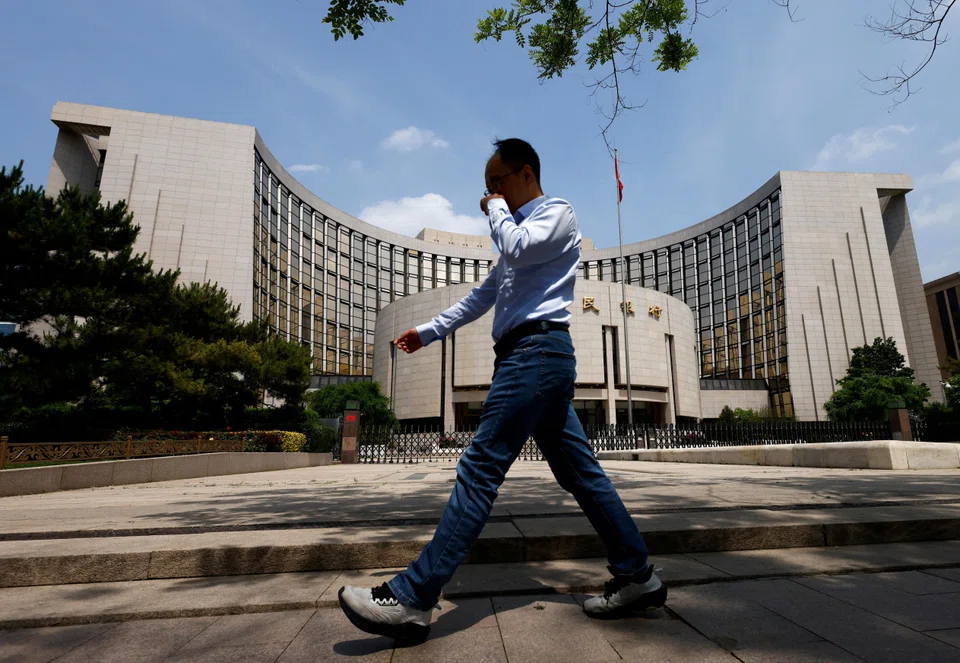
[BEIJING] China’s central bank has warned on the risks of imported inflation from higher oil prices stemming from the war in Iran, offering no hint of preparing to ease policy as it looks to ensure that its interest rates reach the economy.
“Recent geopolitical events in the Middle East have driven up prices of international crude oil and some commodities, which has contributed to the rebound of China’s price indicators,” the People’s Bank of China (PBOC) said in its quarterly monetary policy report released on Monday (May 11). “But the impact of imported inflation on the domestic economy needs to be closely monitored.”
With policy interest rates on hold for a year, the PBOC’s focus now is on the transmission of low financing costs, after factory inflation hit the highest in nearly four years. In the latest report, it reiterated a pledge to adopt “moderately loose” monetary policy and keep liquidity ample to support growth.
The central bank vowed to regulate market practices that weaken the implementation of its policy. It also reaffirmed a vow to set the timing and magnitude of policy measures based on economic and financial conditions at home and abroad, as well as to keep the yuan basically stable.
“Rate cuts remain unlikely near-term,” Citigroup economists said in a report on Tuesday. “The current policy focus has shifted squarely towards improving transmission rather than further easing.”
The PBOC said that key inflation indicators continued a moderate rebound recently, with consumer prices rising 0.9 per cent from a year earlier in the first quarter. While the economy grew 5 per cent in the period, the challenge of weak demand and strong supply persists, the central bank said.
China had been trapped in a deflationary spiral since late 2022, as a manufacturing glut and sluggish domestic demand led to intense price wars. But with the Iran war pushing up costs, producer prices climbed 2.8 per cent in April from a year earlier, the fastest since July 2022, with consumer inflation also picking up.
Brent crude traded near US$105 a barrel on Tuesday after advancing 2.9 per cent in the previous session, as US President Donald Trump cast doubt over the ceasefire with Iran after rejecting Teheran’s latest peace offer.
The jamming of traffic through the Strait of Hormuz has choked off shipments of crude, natural gas and fuels, with the International Energy Agency saying the war is causing the biggest supply shock in history.
SEE ALSO


“Imported inflation usually results in higher costs and that affects downstream industries,” Zhong Linnan, an analyst at GF Securities, wrote in a report on Tuesday. “Perhaps that’s why monetary policy has not shown an obvious change and liquidity has stayed ample.”
In the past, the PBOC has responded to supply-driven inflation by cutting the reserve requirement ratio (RRR) for commercial lenders, he wrote. The central bank also maintained ample liquidity during those episodes in 2015 to 2016 and 2021, showing a proactive policy to address higher raw material costs, he said.
Still, many economists have already scrapped their forecasts for a rate cut this year, as inflation expectations rose and policymakers showed little urgency to step up support to growth.
The PBOC’s latest “wording changes suggest greater emphasis on risk management and policy transmission, rather than stepping up broad-based policy easing”, Goldman Sachs economists, including Xinquan Chen, said in a report. “This supports our baseline of no policy rate or RRR cuts in 2026.”
The PBOC dedicated a special section of the report to the evolution of loan rates in various economies, concluding that most countries transitioned to using multiple benchmarks to price credit from a single anchor.
That may be laying the groundwork for future reforms, where loan costs no longer just reference the loan prime rate, according to analysts led by Duan Chao at Industrial Securities.
The central bank also confirmed that the overnight money market rate is the new policy target by pledging to “guide overnight interest rates to operate near policy interest rates”. BLOOMBERG
Decoding Asia newsletter: your guide to navigating Asia in a new global order. Sign up here to get Decoding Asia newsletter. Delivered to your inbox. Free.
Share with us your feedback on BT's products and services
TRENDING NOW

Firm loses wrongful dismissal case despite following termination clause

Vietnam seeks US$76 billion a year from capital markets to ease reliance on banks

Citi, OCBC downgrade UOB post-Q2 results; RHB upgrades on valuation

Soilbuild’s Lim Chap Huat sues Brookfield, claims it reneged on joint venture: WSJ

