

Asia shares bound for weekly fall as bond yields, oil stay high
Chinese blue chips dip 0.1%, while MSCI’s broadest index of Asia-Pacific shares outside Japan adds 0.6%
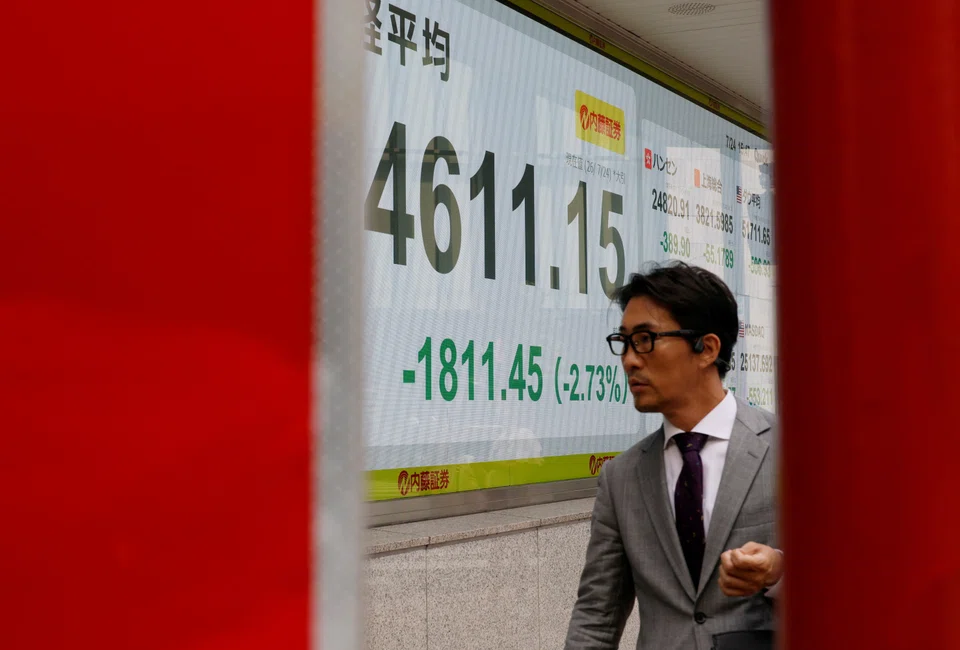
[SYDNEY] Most Asian share indices were heading for weekly falls on Friday (Aug 21) as stress in global bond markets showed little sign of abating, while diplomatic deadlock in the Gulf lifted oil prices to one-month highs and kept inflation risks to the fore.
Yields on US Treasuries had resumed their climb after Wednesday’s surprise intervention by Treasury brought barely a day of relief from selling.
The rise came even as US Treasury Secretary Scott Bessent said he could further increase the government’s repurchases of Treasuries, and floated the idea of fiscal consolidation.
Analysts were sceptical he could find enough spending cuts to seriously curb a budget deficit of more than 6 per cent of gross domestic product, with interest charges alone this year running at US$1.2 trillion.
“Historically, markets have pushed back when they believe fundamentals – like record debt level and historically large deficits – are on their side, and further interventions could become too costly to bear,” cautioned Steven Zeng, a strategist at Deutsche Bank.
“There is also the potential cost to Treasury’s institutional credibility if its activist approach erodes some of the goodwill and benefits that have been built over the years by adhering to a regular and predictable framework,” he added.
Investors showed their scepticism by nudging 30-year bond yields back up to 5.25 per cent, while the 10-year hit 4.71 per cent. Markets assume 5.3 per cent is now a pain threshold for Treasury, much like the 160 yen level has become for Japanese policymakers.
Higher yields lift debt costs globally, just as tech giants are borrowing heavily to fund artificial intelligence capex, while raising the discount on corporate earnings and challenging stock valuations.
The strain was evident in the Nikkei, which slipped 0.8 per cent, bringing losses for the week so far to 4 per cent. South Korea and Taiwan both edged higher, but again were down on the week.



Chinese blue chips dipped 0.1 per cent, while MSCI’s broadest index of Asia-Pacific shares outside Japan added 0.6 per cent.
In Europe, Euro Stoxx 50 futures and DAX futures were a fraction lower, while FTSE futures dipped 0.1 per cent. On Wall Street, a bumper earnings season has provided some support with S&P 500 futures up 0.1 per cent, while Nasdaq futures gained 0.2 per cent.
The entire AI trade faces a huge hurdle next week when Nvidia reports, with much riding on its outlook for infrastructure demand and data centre revenue.
Walmart on Thursday showed what happens when high expectations are disappointed, sliding 9 per cent on a sales miss.
Warfare and debasement
Bessent also made news by expanding on US President Donald Trump’s pledge of economic warfare against Iran, saying the US would impose “the toughest sanctions in history” on the country.
The threats further dimmed hopes for a deal that would fully open the vital Strait of Hormuz and pushed Brent to a one-month top of US$94.71, before profit taking set in.
Brent futures were last off 0.7 per cent at US$93.12 a barrel, but still up more than 5 per cent for the week, while US crude eased 0.7 per cent to US$86.18 a barrel.
In currency markets, the US dollar was nursing broad losses for the week amid worries ever-growing US debt and policy uncertainties will erode the purchasing power of the currency, driving investors to scarce assets including gold.
The yellow metal was steady at US$4,513 an ounce, having climbed 3.1 per cent for the week so far.
“The dollar has come under renewed pressure, in part due to a resurgent ‘debasement’ narrative,” said Jonas Goltermann, chief markets economist at Capital Economics.
“While we continue to think such concerns are somewhat overblown, and that the economic backdrop overall will point to a stronger US dollar over the coming months, continued surprises from US policymakers may well matter more in the near term.”
The US dollar index was off almost 0.9 per cent for the week at 98.802 , having hit a three-month trough overnight.
The euro was up 1 per cent on the week at US$1.1686, after touching a 14-week peak. Against the safe-haven Swiss franc, the dollar slid 1.7 per cent in its biggest weekly loss since January at 0.7995 francs (US$1.00).
US the greenback fared a little better on the yen, which has plenty of problems of its own, and held at 159.07.
Data showed Japan’s core consumer inflation accelerated in July as firms passed on rising import costs, while a survey of manufacturing showed a surge in new orders.
Both added to the case for a September rate hike from the Bank of Japan.
Markets, however, are already priced for a quarter-point rise to 1.25 per cent and would really like a commitment to faster and more aggressive tightening from policymakers. REUTERS
Decoding Asia newsletter: your guide to navigating Asia in a new global order. Sign up here to get Decoding Asia newsletter. Delivered to your inbox. Free.
Share with us your feedback on BT's products and services
TRENDING NOW

DBS, OCBC, UOB rout lops billions off STI as inflation, rate concerns spook investors

Grab CEO’s wife Chloe Tong on life with Anthony Tan and finding her purpose

OCBC sheds S$8 billion in value as shares close nearly 6% down; analysts cautious on banks

Deal between tycoon friends sparks scrutiny of Philippine power sector

