Chilli crab Ritz? How AI is shaking up Mondelez’s Singapore snack lab
Researchers are exploring new ways to keep products relevant to changing consumer tastes

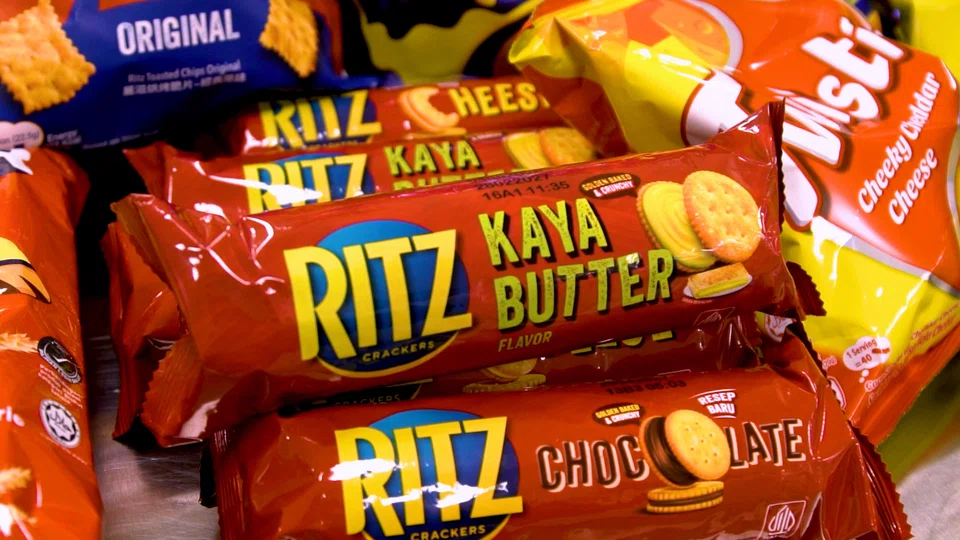
[SINGAPORE] Singaporeans are used to seeing Ritz crackers in the iconic red boxes on supermarket shelves, with their familiar cheesy, lightly salted flavour. But chilli crab, satay and laksa could offer a distinctly local twist on the classic snack in future.
These flavours are being prototyped at US confectionery maker Mondelez International’s technical centre in Singapore, where researchers are exploring new ways to keep the company’s products relevant to changing consumer tastes.
Two decades after its establishment, the centre is incorporating artificial intelligence into its R&D process to identify emerging food trends and develop new flavour combinations.
While some of these innovations may stay experiments forever, others have already made it to market in the region. A kaya butter-flavoured Ritz variant, for instance, hit Indonesian stores in May.
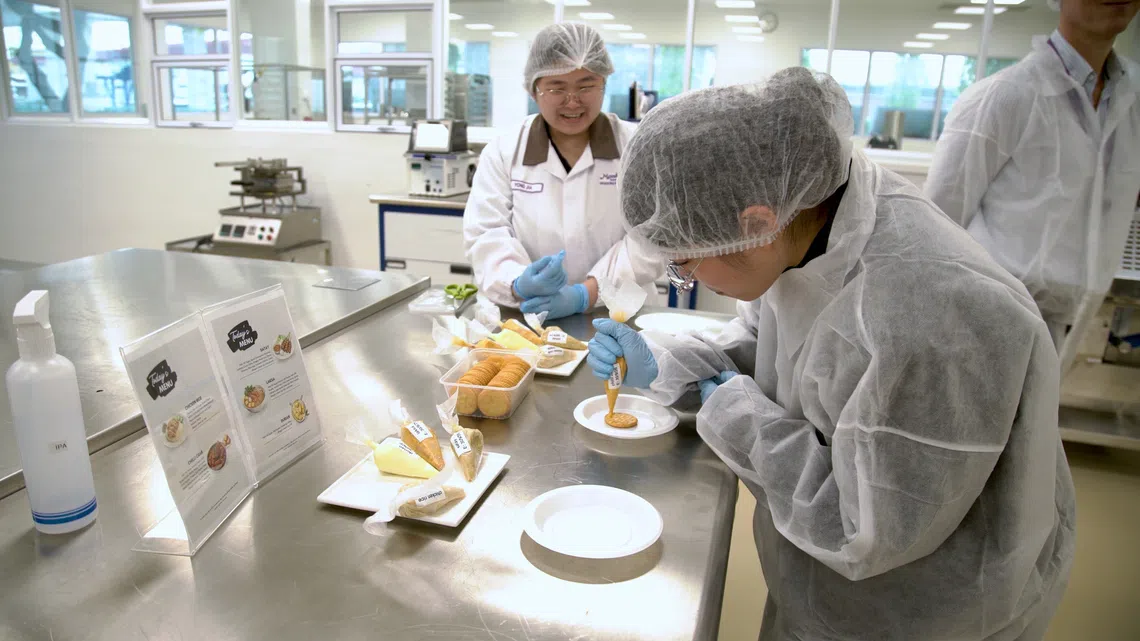
For the Nasdaq-listed manufacturer behind global staples such as Oreo and Cadbury, developing and commercialising new products is a core function of its Singapore Technical Centre in Jurong.
The centre is one of Mondelez’s 12 global technical hubs. Established in 2006 and expanded in 2018, it focuses on innovation in gum, candy, biscuits and other baked products, serving markets across the Asia-Pacific, the Middle East and Africa (Amea).
During The Business Times’ media tour of the centre, Marco Michielsen, regional R&D vice-president for Amea, said: “Singapore as a country ranks very high on the global innovation index, and that’s the main reason why we’re actually located here as an R&D centre.”
The firm has 61 people working at the local R&D site.
Product innovation plays a role in the company’s efforts to grow sales.


Mondelez reported a net revenue of US$10 billion in the third quarter of 2026, supported by 2.1 per cent organic net revenue growth despite macroeconomic headwinds, driven by broad-based volume growth.
Its Amea segment recorded net revenue growth of 8.2 per cent in the quarter.
AI-to-oven pipeline
In the past, developing new flavours relied heavily on manual market research and repeated baking trials. Mondelez is now using digital tools to help identify promising ideas and streamline the development process.
For instance, the company has an in-house research platform that monitors shifts in consumer behaviour and identifies emerging local flavours. It also uses AI to analyse product sentiment and “make smarter flavour choices”.
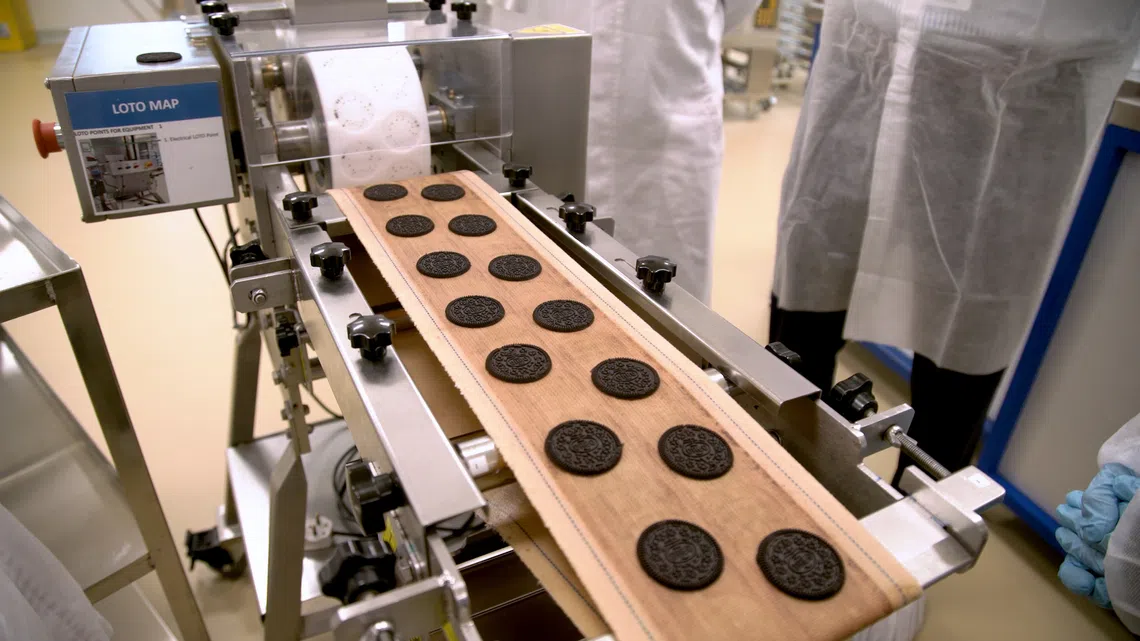
In August, the Singapore centre also introduced an AI-powered Oreo-specific tool that enabled engineers to design and test virtual two-dimensional prototypes of the Oreo biscuit, before producing physical samples.
The Oreo tool was first introduced to North America in the fourth quarter of 2025. Since the introduction to its Singapore centre, it has helped reduce the number of design iterations by about 20 per cent, Mondelez added.
However, Michielsen emphasised that AI serves as a support tool rather than the final decision-maker.
“What AI can do is provide predictions and patterns, but our scientists and sensory experts understand relationships between our products more than AI can at this moment,” he said.
Human expertise therefore remains central to the process, with digital tools helping researchers identify possibilities that they can then test and refine.
This collaboration is evident in Mondelez’s in-house innovation kitchen, where Harry Gui, R&D bakery chef for biscuits and baked snacks, uses trend data to develop complex flavour combinations.
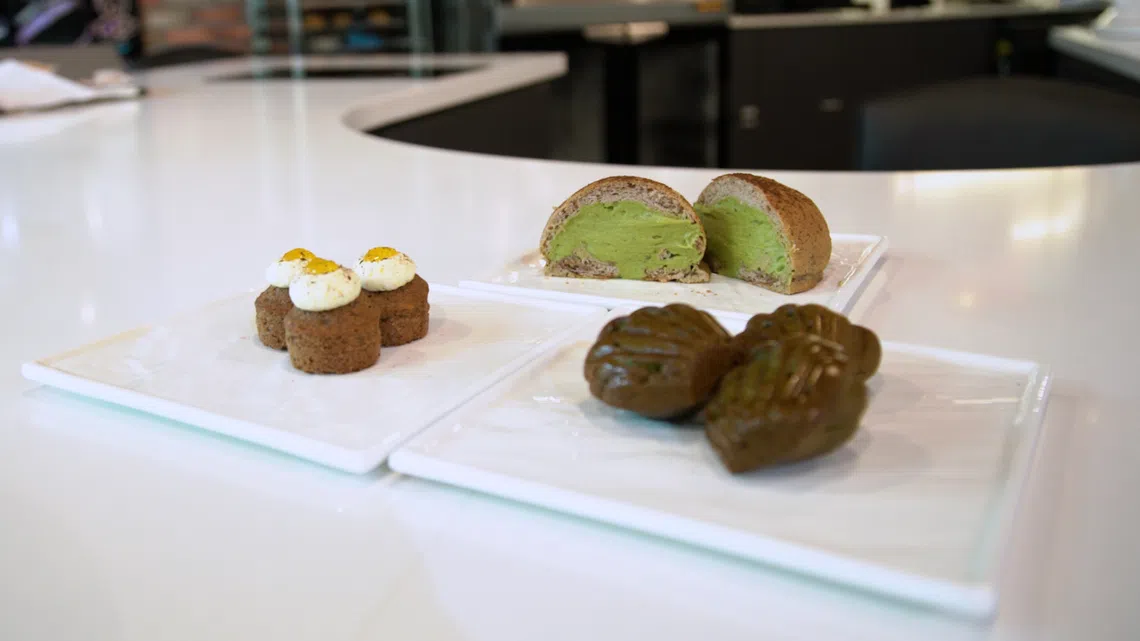
“Then we translate (his flavours) into the lab, and eventually into manufacturing,” Michielsen explained.
Consumer shifts and commodity volatility
Beyond developing new flavours, Mondelez is adapting its Amea portfolio to address evolving health preferences and a fragmenting retail landscape.
The company aims to reformulate its snacks to reduce sodium, sugar and saturated fats, while incorporating whole grains and seeds such as quinoa and chia into its products.
At the same time, regional sales channels are shifting away from traditional supermarkets towards digital commerce and specialised chains, Michielsen told BT.
These changes come as the company grapples with supply chain disruptions and volatile commodity prices.
Mondelez’s gross profit for FY2025 fell 23.3 per cent year on year, largely due to an unprecedented increase in cocoa costs.
The company’s R&D team must therefore do more than respond to changing consumer tastes. It also has to find ways to adapt products and production processes as ingredient costs and availability fluctuate.
Michielsen noted: “One of the tasks that we need to do is to provide solutions for these supply chain disturbances, and we do that by assessing on a continuous basis our ingredients, processes, technologies and formulations.
“Our large-scale processes need to adapt – and they need to be adapted to (these) realities.”
Decoding Asia newsletter: your guide to navigating Asia in a new global order. Sign up here to get Decoding Asia newsletter. Delivered to your inbox. Free.
Copyright SPH Media. All rights reserved.