

China remains MPACT’s ‘biggest pain’ as divestment hurdles persist
Manager looks to extract further value from its Singapore properties, with two VivoCity upgrades planned

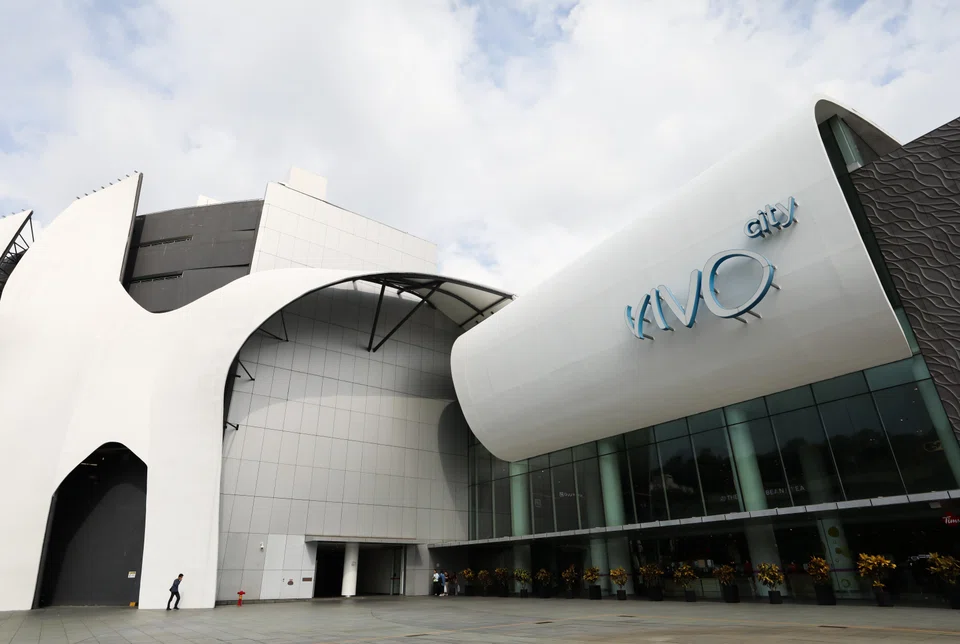
[SINGAPORE] Mapletree Pan Asia Commercial Trust (MPACT) expects continued pressure on its China properties over the next year or so, but faces hurdles in divesting weaker assets at prices it considers acceptable.
“China is our biggest pain,” said Sharon Lim, CEO of the real estate investment trust’s (Reit) manager, at an earnings briefing on Friday (Oct 30). “I will acknowledge that China will continue to go down in the next year or so.”
“You ask me, ‘Would you like to sell certain parts of the China portfolio?’, I will tell you yes. But...I think we all have to be realistic that China is a long-term focus.”
MPACT owns two properties in China – Gateway Plaza, an office development in Beijing’s Lufthansa district, and Sandhill Plaza, a business park in Shanghai’s Zhangjiang Science City.
The properties, which account for about 9 per cent of the Reit’s assets under management (AUM), contributed S$26 million in net property income (NPI) for the first half ended September, down about 15.9 per cent from S$30.9 million a year ago.
While committed occupancy was 84.5 per cent and tenant retention rate was 78.7 per cent, rental reversion came in at minus 29.9 per cent for the half-year period.
New supply has outpaced demand in Beijing and Shanghai, keeping rents under pressure.
In Beijing, overall office rents fell 4.1 per cent on the quarter in Q3 2026, while occupancy declined to 80.3 per cent. In Shanghai, business park rents fell 1 per cent over the same period, although occupancy improved to 70.5 per cent, said the manager.
Both cities also face substantial new supply, with about 700,000 square metres (sq m) of office space expected in Beijing and 2.8 million sq m of business park space in Shanghai over the rest of 2026 till 2028, it added.

The challenging conditions have weighed on property valuations. Gateway Plaza’s valuation fell 8.5 per cent year on year in local-currency terms to 5.3 billion yuan (US$795.8 million) as at end-March 2026, while Sandhill Plaza’s declined 4.7 per cent to 2.1 billion yuan.
For Q2 ended September, MPACT posted a 3.5 per cent decline in distribution per unit (DPU) to S$0.0194 from S$0.0201 a year earlier.
The fall was mainly due to weaker contributions from its overseas properties and absence of contributions from divested assets. The decline was partially offset by lower finance expenses and stronger performance at VivoCity mall in Singapore, following the completion of its refurbishment works at Basement 2 and sustained rental growth.
Divestment challenges
MPACT has divested about S$1.2 billion worth of properties over the past two years.
Lim said the disposals were undertaken for various reasons, including attractive offers and anticipated tenancy challenges that management sought to address before they affected the properties’ performance.
But the manager faces a more difficult investment environment for further sales, particularly in markets where higher financing costs and subdued buyer interest have made transactions harder to close.
While MPACT remains keen to divest weaker-performing assets, Lim said the manager would rather hold on to certain properties than accept “huge haircuts” on their sale prices.
She added that the manager would continue working to improve the performance of its properties while exploring opportunities for divestments, rather than committing to a fixed disposal timeline.
In Japan, the previously disclosed non-renewal of a lease at Fujitsu Makuhari Building has weighed on rental contributions.
Committed occupancy across MPACT’s Japan properties stood at 57.5 per cent as at end-September, down from 73.9 per cent a year earlier. Tenant retention rate was 70.6 per cent, while rental reversion was 2.4 per cent.
MPACT owns seven assets in Japan, of which three are located in the Makuhari area. The manager noted that leasing inquiries in Makuhari had picked up compared with one or two years ago, as rising rents in central Tokyo prompted more companies to consider relocating to lower-cost locations.
While previous inquiries were largely for smaller spaces, prospective tenants are now considering areas of 50,000 to 100,000 square feet.
The manager is in preliminary discussions with several potential tenants, including one for Fujitsu Makuhari Building. Lim noted that successfully backfilling the vacant space could improve the property’s prospects for a future divestment.
For now, Lim said Singapore continues to provide support to the wider portfolio, even as weaker overseas contributions weigh on earnings.
Singapore accounted for 61 per cent of MPACT’s portfolio AUM of S$15.3 billion and contributed 68 per cent of NPI in the first half.
Further VivoCity enhancements
Two significant asset enhancement initiatives (AEIs) at VivoCity are in advanced planning stages, although no firm implementation timeline has been announced.
She pointed to transforming spaces near the mall’s drop-off point into a new retail cluster, including areas connected to the hypermarket and H&M premises, and reclaiming underutilised gross floor area and redeploying it to higher-yielding retail uses.
“The AEI that we (carry out) in Vivo is not small and next year I’m (carrying out) more because we are very confident of the output. I am not going to hold back on what we think is good, just because we want to even out the pain.”
They follow the completion of VivoCity’s Basement 2 AEI, with the mall’s NPI rising 6.9 per cent on the year for H1. VivoCity recorded positive rental reversions of 15 per cent and maintained full committed occupancy, while tenant sales grew 4.1 per cent year on year.
MPACT expects additional rental contributions from Mapletree Business City, where committed occupancy rose to 95.4 per cent at end-September, from 94.3 per cent three months earlier.
Around 6 per cent of the property’s space was newly committed but had yet to commence rental contributions, with the bulk of these leases expected to start generating income from Nov 1.
In Hong Kong, MPACT is looking to reposition Festival Walk. The property saw negative rental reversions of 15.6 per cent for H1, although tenant sales rose 3.9 per cent on the year and committed occupancy remained near full.
The manager is planning to downsize Festival Walk’s existing cinema and convert part of the space into F&B offerings, and subdivide other larger retail units to accommodate tenants seeking smaller spaces.
“We’re expecting a positive return on investment…there will be a bit of downtime next year, but I think it’s a good change,” said Lim.
Asked whether DPU could continue to slip over the next two years, Lim did not provide a forecast. She pointed to continued weakness in China, the impact of Fujitsu’s departure on year-on-year NPI comparisons, and potential disruptions from further enhancements at VivoCity.
She added that management had to continue improving the performance of individual properties rather than attributing all the weakness to broader market conditions.
Decoding Asia newsletter: your guide to navigating Asia in a new global order. Sign up here to get Decoding Asia newsletter. Delivered to your inbox. Free.
Copyright SPH Media. All rights reserved.
TRENDING NOW

If Europe goes to war, the fallout will be felt in East Asia

Indonesia stocks suffer worst plunge in nearly 30 years as MSCI proposes standalone status

China’s market is tougher than ever. Where can Singapore firms still find room to grow?

Nvidia CEO says ties to Singapore firm under spying probe were ‘normal’

