

Nasdaq listing awaits Singapore’s US$1.5 billion AI drug-discovery biotech Nanyang Biologics
Its valuation is driven by a proprietary agentic AI platform and potential first-in-class cancer treatment
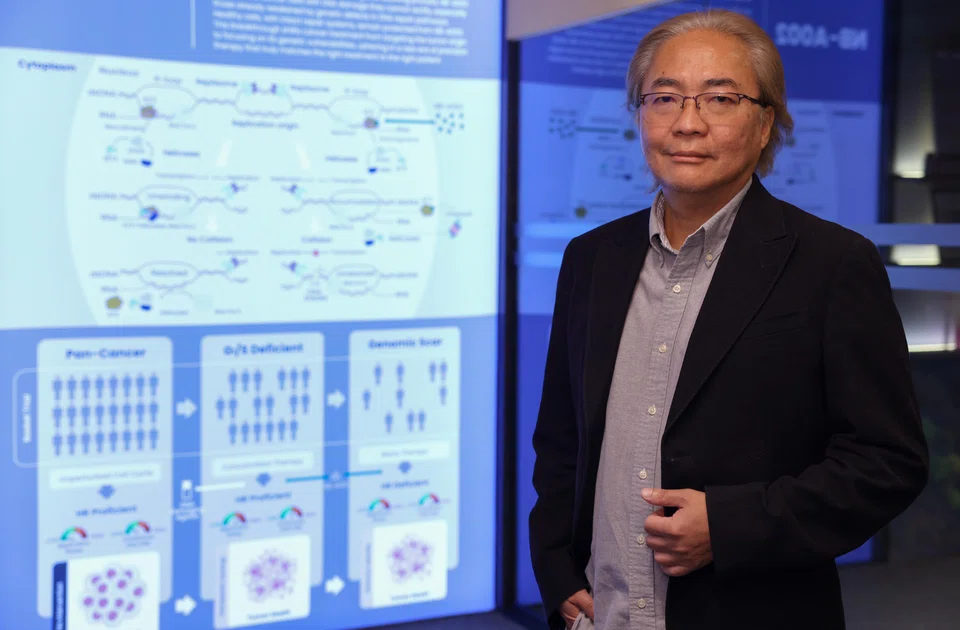
[SINGAPORE] Singapore-based biotech startup Nanyang Biologics (NYB) is preparing to make its Nasdaq debut through a special purpose acquisition company merger.
This comes as it seeks to raise capital to take an artificial intelligence-driven drug-discovery platform developed in the Republic to global markets.
The proposed business combination with RF Acquisition Corp II values NYB at between US$1.5 billion and US$2.2 billion, after shareholders of the Nasdaq-listed blank-cheque company approved the transaction in August.
The deal is now subject to final closing conditions, including Nasdaq approval, before NYB can begin trading as a listed entity.
It is just the latest Singapore-founded company to seek a US listing, amid growing interest among local companies in American capital markets.
Speaking with The Business Times ahead of the upcoming listing, NYB co-founder and executive chairman Dr Roland Ong said the company is now entering a more capital-intensive stage, as it prepares potential drug candidates for clinical trials and expands its AI platform.
Clinical trials could require “double-digit millions”, while the computing infrastructure for its AI platform – such as graphics processing units – could cost hundreds of millions, he added.
NYB’s journey to the Nasdaq started seven years ago, not in a laboratory, but in a herb garden.
As a volunteer and donor to Nanyang Technological University’s (NTU) community herb garden, Dr Ong had been harvesting medicinal herbs for a relative with a terminal illness.
He wondered if medicinal plants – some of which had “quite potent” medical uses – could be used to discover modern pharmaceutical drugs.
After speaking with an NTU cancer biologist, he started NYB as a research project largely funded by himself and a business partner.
But finding active compounds within traditional herb formulations proved to be difficult.
“One herb could contain a few thousand different molecules, but a drug is just one molecule,” he said.
This prompted NYB to turn to AI, developing models to help scientists identify promising molecules for testing, while reducing the time and cost.
It has since developed Vecura, an AI platform which routes scientific tasks such as identifying and assessing potential drug candidates to more than 340 proprietary and external models, using an agentic layer.
“Traditionally, finding promising molecules in a plant source and working through the chemistry can take years,” he noted. “Vecura’s AI screens and prioritises a plant’s entire chemical space in days.”
First in class
RF Acquisition’s board cited NYB’s AI technology, intellectual property, drug pipeline and potential in therapeutics and nutraceuticals among the factors supporting the proposed combination.
While the company is generating some revenue from health supplements and licence fees from commercial arrangements involving its AI models, NYB’s US$1.5 billion valuation rests largely on expectations of future commercialisation, rather than its current revenue base.
The biggest opportunity lies in its drug pipeline, the company having engineered a potential anti-cancer drug candidate known as NB-A002, which it isolated from Elephantopus, a genus of plants used in traditional medicine in parts of South-east Asia.
NB-A002 is designed to treat cancers with homologous recombination deficiency (HRD), a defect in cells’ ability to repair damaged DNA.
HRD is commonly seen in ovarian, breast, pancreatic and prostate cancers. Currently, oral medications known as Parp inhibitors are the only approved drugs that target the deficiency, but patients can develop a resistance over time.
“This is a potentially first-in-class drug candidate,” Dr Ong said, adding that it targets a therapeutic mechanism which no other approved drugs currently use.
Commercialising such a drug would mean huge global revenue, he noted.
“We want to bring proof of the drug molecule’s worth, then work with a large pharmaceutical company or distributor to offer it commercially,” he said.
Vecura itself also offers potential upside as a revenue driver.
“If our AI platform is well-accepted and popular, it could be used by scientists in universities, or the pharmaceutical and food industries around the world,” he said.
Investor interest
Dr Ong believes the company’s listing rides a wave of investor interest that has returned to the biotech industry, in part due to the rise of AI.
In the past, investors were often hesitant about drug-discovery companies due to long time horizons, as it would sometimes take a decade or two before returns could be seen.
Meanwhile, a shift in the US policy environment has brought greater attention to the role of AI in drug development.
Dr Ong indicated the focus by US President Donald Trump’s administration on lowering drug prices, which he believes is now drawing attention to technologies that could reduce the cost and time needed to develop new medicines.
Beyond NB-A002, NYB is developing several other preclinical candidates targeting solid tumours, cardiovascular conditions and mental health disorders.
Dr Ong hopes AI can improve the quality of molecules entering trials by better predicting factors such as toxicity and side effects.
He acknowledged that risks remain in a drug’s ability to reach the market – if at all, with clinical trials potentially taking more than three years with no guarantee of success.
For NYB, however, the promise remains long term.
“It’s not easy and it takes time,” he said. “But when you are successful, the rewards can be large multiples.”
TRENDING NOW

Once staunchly pro-China, Malaysian Chinese businesses are now distancing themselves from Beijing

Looking beyond looming CEO succession, should UOB potentially pursue a transformative merger?

Could stablecoins be the future of money?

Grab CEO’s wife Chloe Tong on life with Anthony Tan and finding her purpose

