

PacificLight to pair new gas power plant with giant batteries in Singapore first
Battery usage allows for a larger gas turbine and addresses intermittency issues from solar power, says CEO

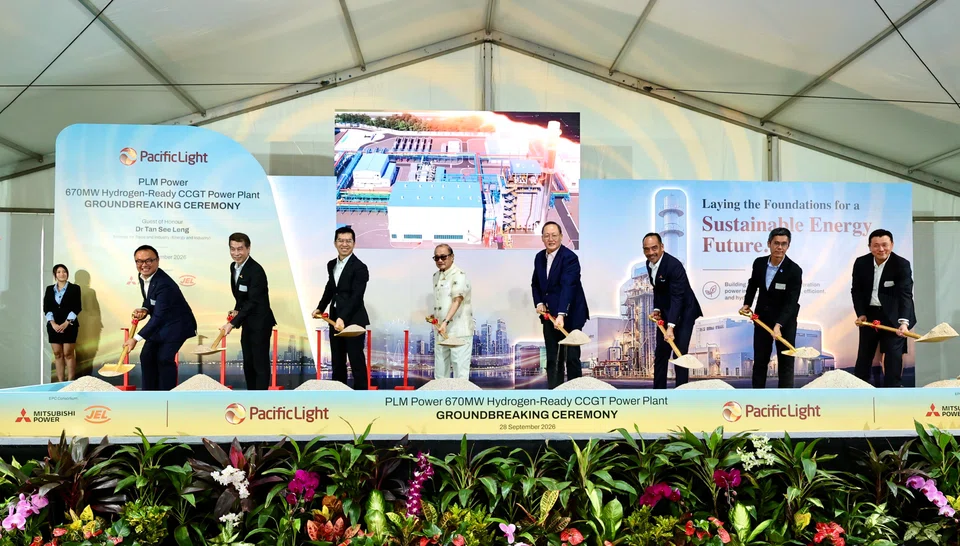
[SINGAPORE] PLM Power, a unit of PacificLight Power, has started construction on the first gas-fired power plant in Singapore to be paired with a large-scale battery energy storage system (Bess).
The S$1.2 billion facility on Jurong Island has a capacity of 670 megawatts (MW) and is set to commence operations in 2029, the company announced at a ground-breaking ceremony on Monday (Sep 28).
The plant will feature Singapore’s largest and most efficient single power generation unit, and can meet the power needs of up to 1.2 million four-room flats.
The accompanying 80 MW lithium-ion Bess will enhance the plant’s operational resilience and ability to respond to contingencies, said Minister for Trade and Industry (Energy and Industry) Tan See Leng.
Speaking at the ground-breaking ceremony, he noted that Singapore’s electricity demand is set to accelerate, due to advanced manufacturing, the digital economy and electric vehicles.
The Republic’s peak electricity demand is expected to grow by between 2.9 and 6.5 per cent annually until 2034, according to the Energy Market Authority (EMA).
As energy increasingly shapes critical investment decisions, “it will be important to provide power at the scale and speed” that businesses require, noted Dr Tan.
“We must therefore continue investing in new generation capacity to ensure that Singapore can provide reliable and competitively priced energy for our future growth,” the minister added.
Bess enhances grid resilience by allowing response times within two seconds, PacificLight CEO Yu Tat Ming told The Business Times.
“The fast-response Bess allows us to install a larger gas turbine plant to harness its full potential in efficiency, without impacting system stability,” he said.
Bess also supports other system needs that arise from intermittency, as Singapore deploys more solar power, he said.
Intermittency refers to how the output of solar-power systems fluctuate with the time of day and weather, presenting new technical challenges in maintaining overall stability of the power grid.
Hydrogen still expensive
The new plant is able to operate on hydrogen, should the clean fuel be available in future.
The turbine can operate on fuels with up to 30 per cent of hydrogen content by volume from the outset.
This is in line with EMA’s requirement that all new and repowered gas plants from 2024 will need to be at least 30 per cent hydrogen-compatible by volume.
Singapore’s first hydrogen-ready combined-cycle gas plant, the Keppel Sakra Cogen plant, began operations in May.
PacificLight aims to transition to fully using hydrogen in the future, but Yu acknowledged that many commercial and logistical challenges lie ahead for use of the fuel.
“(The) costs of producing green hydrogen remain high and the necessary infrastructure to support large-scale adoption still needs to be developed,” he said. “While I cannot predict when these matters will be resolved, my commitment is to ensure we are ready to adopt hydrogen when it becomes feasible.”
Yu expects that natural gas “will continue to be a cornerstone of Singapore’s electricity system in the foreseeable future, providing secure, sustainable and affordable energy”.
The project marks PacificLight’s third gas power plant on Jurong Island. It already has an 830 MW gas plant, operating since 2014, and a 100 MW fast-start ancillary plant, commissioned in 2025.
Construction of the new plant will be undertaken by Mitsubishi Power, which is also supplying the hydrogen-ready gas turbine, and Jurong Engineering.
Mitsubishi Power on Sep 11 concluded a roughly 13-year long-term service agreement with PLM Power, but will ensure “stable operation” even after the plant commences operation, said the Japanese company’s executive vice-president for global sales and marketing, Daichi Nakajima.
The facility is a “significant milestone in Jurong Island’s transformation towards a more sustainable and resilient energy future”, said Jacqueline Poh, CEO of industrial landlord JTC Corp.
Puah Kok Keong, CEO of EMA, welcomed PacificLight’s new generation facility to meet Singapore’s growing energy needs, and the use of Bess as a complementary solution.
Other green projects
PacificLight is owned by the Philippines’ Meralco PowerGen and First Pacific, a Hong Kong-based investment holding company.
Beyond gas power, the company is also involved in a project to import solar power into Singapore from Indonesia, via a dedicated high-voltage subsea cable.
It is developing a 600 MW solar-power import project from Bulan Island in a consortium with Indonesia’s Medco Power Global and Gallant Venture, a commercial developer in the Riau archipelago.
The consortium is among six players granted a conditional licence by EMA to collectively import 3 GW of clean power from Indonesia.
Separately, PacificLight is an investor in the Rexus Waste Wood-to-Energy Plant, Singapore’s first such facility on a large scale.
It is also working on a smart microgrid for the Punggol Digital District, in collaboration with JTC and intelligence platform operator Univers.
Decoding Asia newsletter: your guide to navigating Asia in a new global order. Sign up here to get Decoding Asia newsletter. Delivered to your inbox. Free.
Copyright SPH Media. All rights reserved.
TRENDING NOW

Once staunchly pro-China, Malaysian Chinese businesses are now distancing themselves from Beijing

Looking beyond looming CEO succession, should UOB potentially pursue a transformative merger?

Could stablecoins be the future of money?

Grab CEO’s wife Chloe Tong on life with Anthony Tan and finding her purpose

