South-east Asia’s LNG hunger sparks caution over volatile prices, infra gaps

Observers call for faster shift away from ‘roller coaster’ fuel after major supply disruptions

Summarise
Sharanya Pillai
Published Mon, Oct 5, 2026 · 07:00 AM
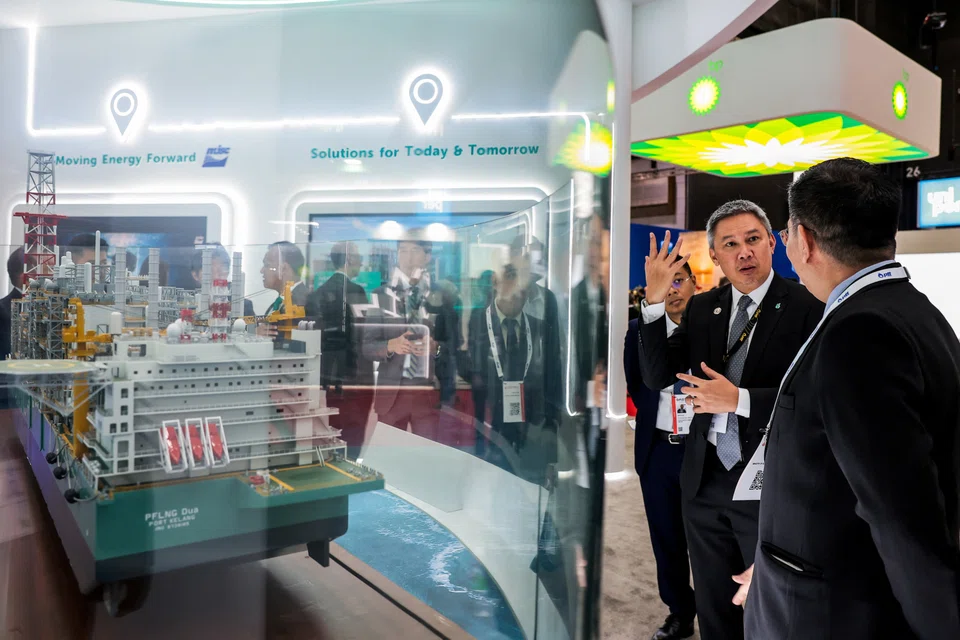
    • A mockup of Petronas’ floating liquefied natural gas facility. The company has about 40 MTPA of LNG capacity worldwide, and wants to reach 55 MTPA by 2035.
    • A mockup of Petronas’ floating liquefied natural gas facility. The company has about 40 MTPA of LNG capacity worldwide, and wants to reach 55 MTPA by 2035. PHOTO: REUTERS

    [SINGAPORE, BANGKOK] South-east Asia’s demand for liquefied natural gas (LNG) is expanding even in the wake of the US-Iran war, but concerns loom over price volatility and infrastructure gaps, industry players and analysts told The Business Times.

    Leong Wei Hung, CEO of gas terminal operator Singapore LNG Corp (SLNG), sees the fuel as a “mainstay of the region’s energy mix for years to come” – a view that analysts echo.

    The fuel “will very much remain a key part of South-east Asia’s energy mix as it is still the cleanest and most widely available fossil fuel”, said Lee Rou Urn, Asia LNG pricing analyst at Argus.


    In line with expected growth, South-east Asia is developing 70 million tons per annum (MTPA) of LNG ​import capacity, alongside over 100 gigawatts (GW) of gas-fired power generation capacity, a report by US think-tank Global Energy Monitor found.

    Upstream players, such as Malaysia’s Petronas, are also expanding LNG production.

    Petronas has about 40 MTPA of LNG capacity worldwide, and wants to expand this to 55 MTPA by 2035, via boosting its production capabilities in East Malaysia and Canada.

    Ezran Mahadzir, the company’s vice-president of LNG marketing and trading, is optimistic that “in the long run, the fundamentals (of LNG) are strong enough for us to further invest in capacity”.

    Not just data centres

    South-east Asia’s LNG demand is set to grow by more than 20 per cent year on year in 2026, followed by average annual growth of 10 per cent over the next three years, said Fadhlullah Omarali, principal analyst for gas and LNG markets at Wood Mackenzie.

    S&P Global Energy likewise expects the region’s LNG imports to increase by more than 10 per cent year on year in 2027, said Amanda Kang, principal analyst for South-east Asia gas research.

    Data centres are a key demand driver. KPMG last year forecast South-east Asia’s data centre capacity to triple by 2030.

    LNG is “top of mind” for the industry as a baseload source of power, Mahadzir told reporters on the sidelines of the Gastech industry conference in Thailand in mid-September.

    But energy-intensive data centres are “only part of the picture”, with South-east Asia’s strong economic and population growth also driving energy demand, noted Omarali.

    Falling domestic gas production, largely due to the resource decline in mature fields, is one more key driver. For instance, Malaysia and Indonesia are turning to LNG imports to offset the fall in domestic gas, said S&P’s Kang.

    “We believe that LNG will remain critical for decades to come, as many South-east Asian countries pursue a dual-track strategy of scaling up renewables while using gas to displace coal,” she said.

    Climate change is yet another factor.

    Lee of Argus noted that Thailand, Vietnam, Laos and Cambodia have traditionally relied on hydropower.

    “But climate change has made their weather patterns more unpredictable, which has then compelled these countries to turn to LNG for firming generation,” she said, referring to how gas remains a backup energy source when renewables are unavailable or insufficient.

    Omarali expects Thailand to post the highest LNG import growth of close to three million tonnes in 2026, “as gas demand in the power sector rises to offset the shortfall in coal generation”.

    Meanwhile, Vietnam, which began importing LNG only in 2023, is poised to record the strongest year-on-year percentage growth as its first LNG-fired power plant kicked off commercial operations in January.

    Price and infrastructure risks

    However, deepening LNG reliance also means greater exposure to volatile prices.

    This year’s LNG crisis is the second in four years, after market turmoil in 2022 that was triggered by Russia’s invasion of Ukraine.

    This year, the continued closure of the Strait of Hormuz has disrupted 20 per cent of global LNG flows, forcing several South-east Asian countries to roll out energy-saving work-from-home mandates and rely more on alternative suppliers such as Australia and the US.

    Asian spot LNG prices averaged US$17.50 per million British thermal units in Q2 2026, or 45 per cent higher year on year, according to the Global Energy Monitor report.

    A spike in Asian spot LNG prices could mean “immediate affordability pressures” for emerging regional economies, noted SLNG’s Leong.

    “For cost-sensitive power systems, higher LNG prices can also increase the economic incentive to fall back on cheaper, more carbon-intensive coal, complicating Asean’s broader decarbonisation objectives,” he added.

    Mahadzir acknowledged that the short-term impact of the crisis has been “very difficult, very up-and-down” for the industry. Asked to forecast LNG prices, he said: “I don’t think anybody in this world today will be able to tell you how long this volatility is going to last.”

    Sam Reynolds, research lead at the Institute for Energy Economics and Financial Analysis, recently observed that “major growth markets for LNG are often those with the least ability to mitigate economic shocks; those with the least foreign exchange reserves”.

    In a webinar on Sep 10, he remarked: “As a policymaker, am I really going to hitch my country’s energy sector development plans to this absolute roller coaster of a fuel?”

    Infrastructure gaps and supply chain constraints add to the challenges faced with LNG.

    An August report by Wood Mackenzie forecasts that South-east Asia may deliver less than one-third of its planned gas-fired power capacity by 2030, constrained by volatile fuel cost, equipment shortages, financing issues and infrastructure bottlenecks.

    The global shortage of gas turbines – an industry dominated by just three manufacturers – is a “major barrier” to fulfilling South-east Asia’s LNG demand, said Reynolds.

    Wait times for gas turbines can extend to six years, he noted.

    A separate Wood Mackenzie report in April also expects gas turbine prices to hit US$600 per kilowatt by end-2027, nearly triple from 2019.

    Leong noted that logistics, rather than gas supply, is the “most immediate bottleneck” facing South-east Asia’s LNG ecosystem.

    “Supply exists, but the constraint is getting it to where it is needed, at a time when shipping routes, vessel availability and freight costs are all reacting to disruptions,” he said.

    Difficult choices

    Amid these challenges, there are growing calls to balance South-east Asia’s LNG investments with greater diversification into renewables.

    Still, Laurent Nery, head of market analysis for supply and energy management at French energy group Engie, believes that LNG is a complement – not competitor – to renewables.

    He cited the development of green energy that taps domestic feedstock, such as biomethane, as good hedges “against future geopolitical crises”.

    Biomethane, which can be used interchangeably with fossil-derived natural gas in power plants, is produced from organic matter such as agricultural waste that South-east Asian countries can readily source from farms.

    Ultimately, LNG’s long-term role is not guaranteed, said S&P’s Kang.

    “Should renewable energy, battery storage technologies, nuclear energy and grid improvements accelerate quicker than expected over time, this could eventually displace gas,” she said.

    Arun Kumar, strategic advisor for power markets and technology innovation at Asia Research and Engagement, noted that while the fuel’s prices remain volatile, the cost of renewables and battery storage is falling.

    “Now, the risk matrix for LNG project evaluation should include… the possibility that there is supply disruption through an international chokepoint,” he said.

    The challenge for Asean will be to develop sufficient flexible gas infrastructure to strengthen energy resilience, but “without locking in assets that may become underutilised as renewables and other lower-carbon energy sources scale”, noted SLNG’s Leong.

    “Governments and market players have to make difficult investment choices amid an evolving energy transition.”