



How deeply have South-east Asian governments had to dig in this oil crisis?
Subsidies and tax cuts may stem the bleed, but the region’s budgets are coming under strain

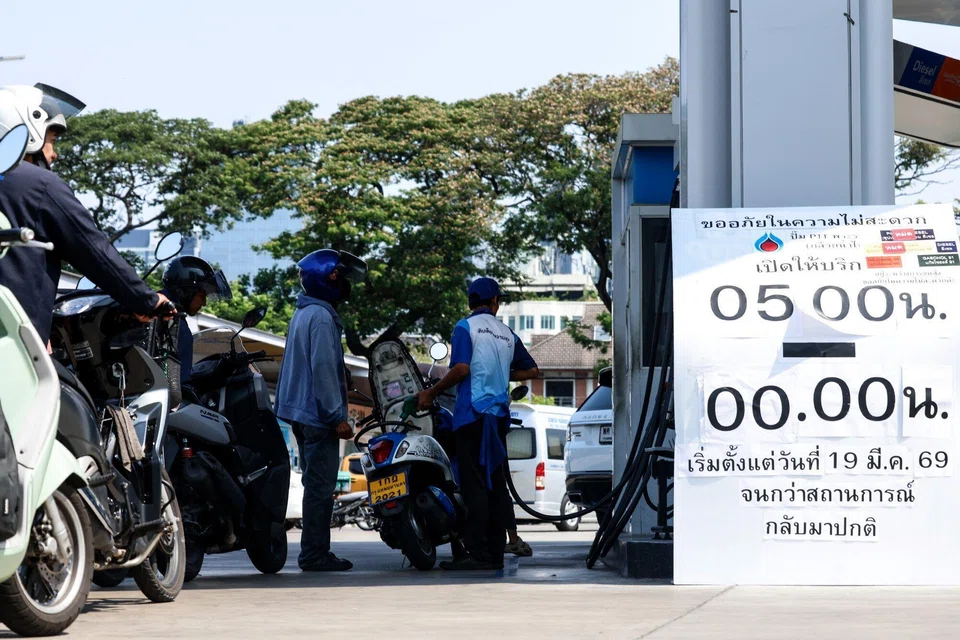
[SINGAPORE] More than five weeks have elapsed since the US and Israel launched attacks on Iran, triggering a global energy crisis that has hit South-east Asia particularly hard.
With much of the region’s fuel imports coming through the Strait of Hormuz, governments have scrambled to cushion the blow from rising oil and natural gas prices on their economies.
Not all countries have been equally hit. Net energy exporter Malaysia, for example, has been less affected by the rising oil prices, and its fiscal reserves have enabled its government to absorb the rising costs. Healthy fiscal reserves have enabled governments in Malaysia and Singapore to absorb some of the cost pressures.
But import-dependent economies such as the Philippines and Thailand have had to take more drastic measures to prevent a crisis.
Many of these measures have come at a massive financial and policy cost, as South-east Asian governments now find themselves trapped between inflationary shocks and slumping growth prospects.
Indonesia
Prime Minister Prabowo Subianto’s administration has remained steadfast in keeping fuel prices low, even as its regional neighbours have scaled back on subsidies.
Indonesia is instead turning to spending cuts and a potential new export tax on coal, even as the country’s fiscal deficit inches closer to the legally mandated limit of 3 per cent of gross domestic product.
Supply shocks have hit key industries such as aviation and manufacturing hard, as costs of jet fuel and natural gas skyrocket.
The Middle East accounts for about a quarter of Indonesia’s crude oil imports and 30 per cent of its liquefied petroleum gas (LPG).


Indonesia is also looking beyond its shores to meet domestic demand for energy. It is looking at potential oil purchases from Russia and the United States, and signing an agreement with Japan to step up coordination in energy security.
Indonesia’s fuel reserves cover just 23 days of domestic demand, and the country has insufficient storage capacity for further fuel supplies, its energy minister said in early March.
Malaysia
As the only net exporter of energy in South-east Asia, Malaysia has largely been spared from inflationary threats.
But the country has still felt the impact as global supply-chain disruptions push prices up for consumer goods, raw materials and fertilisers.
Despite rising global oil prices, a healthy fiscal balance has enabled Prime Minister Anwar Ibrahim’s government to keep the subsidies on RON95 petrol and diesel – though this has raised the country’s subsidy bill to about RM3.2 billion (S$1 billion), from RM700 million previously.
The country has temporarily reduced the monthly subsidised entitlement for RON95 for citizens from its current 300-litre quota to 200 litres per month.
Anwar said in March that Malaysia’s petroleum supplies remain sufficient to meet domestic demand until at least May.
Meanwhile, further relief could be inbound as Iran’s government has cleared several of the country’s tankers to pass safely through the Strait of Hormuz, following diplomatic efforts.
The Philippines
Importing about 95 per cent of its crude oil needs from the Middle East, the Philippines has been one of the region’s hardest hit economies. President Ferdinand Marcos Jr has declared a state of national energy emergency, citing “imminent danger” to the country’s energy supply.
On Mar 26, the energy ministry activated a 20 billion peso (S$426 million) emergency fund to support domestic supply. The government also plans to buy up to two million barrels of fuel, along with refined products and liquefied petroleum gas.
Manila, estimating that it has a 45-day fuel supply based on prevailing consumption levels, said it is looking to procure fuel from sources outside the Middle East.
Its fiscal balance could take a further hit as Marcos mulls cutting excise and value-added taxes on fuel, which could cost the country 136 billion pesos in Budget revenue in 2026.
Singapore
Singapore’s sizeable reliance on imports of crude oil and liquefied natural gas (LNG) from the Middle East has raised costs on petrol and electricity, pressuring households and industries including technology, transport and construction.
But the Republic’s healthy fiscal balance has enabled its government to cushion the blow.
The country announced on Tuesday (Apr 7) that it would dole out a S$1 billion support package to manage the fallout from the Iran conflict, consisting of measures supporting households, workers and businesses.
These included measures to help businesses better manage cash flows, including raising corporate income tax rebates and expanding energy efficiency grants to include larger disbursements and wider eligibility.
Meanwhile, the government said that Singapore’s supply of energy, food and fertiliser remains sufficient despite the conflict.
Singapore has yet to announce export restrictions on fuel or implement fuel rationing measures, with Minister for Home Affairs K Shanmugan noting that there is “no need to do so” for now.
Thailand
Fuel subsidies have placed Thailand under tremendous fiscal strain, forcing the government to scale back subsidies for diesel from 22.89 baht (S$0.90) to 17.78 baht a litre.
The country’s Oil Fuel Fund was in deficit by more than 56 billion baht as at Tuesday, as the country seeks a loan of up to 150 billion baht to finance further subsidies.
Shortly after the Iran conflict began, Thailand banned fuel exports, except for those to Laos and Myanmar. The country also announced on Monday that it would tighten crude palm oil exports and control bottled palm oil prices from Tuesday, as biodiesel demand rises as an alternative to oil and gas products.
The country is seeking an alternative fuel supply, including potential spot-market purchases of LNG from Malaysia’s Petronas through Thailand’s state-owned energy firm PTT PCL, and by requesting additional gas supplies from the Malaysia-Thailand Joint Development Area, a shared resource zone jointly managed by both countries.
Its energy ministry noted on Tuesday that its reserves and incoming demand are sufficient to meet the country’s oil needs for about 105 days.
Vietnam
Vietnam is working quickly on multiple fronts to conserve fuel and keep costs from being passed through to consumers.
The government has eliminated taxes on various fuels, a measure that will set back its Budget revenue by about 7.2 trillion dong (S$351 million).
Through its fuel price stabilisation fund, the country’s government has deployed disbursements to the tune of nearly 5.3 trillion dong in efforts to maintain pump prices. The fund’s balance fell to about 320 billion dong by late March, prompting regulators to stop further use.
To secure energy supplies, Hanoi has intensified its efforts to engage its diplomatic partners. It has mobilised about four million barrels of crude from its partners and is exploring access to strategic reserves, including from Japan.
Decoding Asia newsletter: your guide to navigating Asia in a new global order. Sign up here to get Decoding Asia newsletter. Delivered to your inbox. Free.
Copyright SPH Media. All rights reserved.
TRENDING NOW

DBS, OCBC, UOB rout lops billions off STI as inflation, rate concerns spook investors

Grab CEO’s wife Chloe Tong on life with Anthony Tan and finding her purpose

OCBC sheds S$8 billion in value as shares close nearly 6% down; analysts cautious on banks

Deal between tycoon friends sparks scrutiny of Philippine power sector

