

Gold’s bullish outlook makes it a core portfolio asset, not just a hedge, say panellists
The precious metal will likely continue to rally amid geopolitical uncertainty and central bank demand, observers say

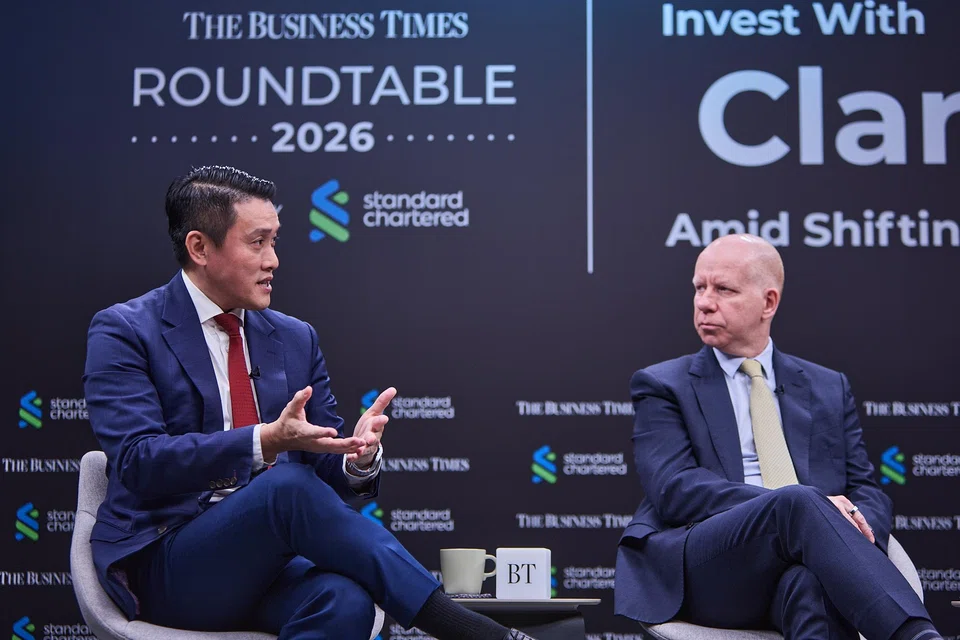
[SINGAPORE] Gold is increasingly a good asset to include in an investor’s foundation portfolio, given strong drivers for prices to keep rising in the year ahead.
The precious metal will likely continue to rally amid geopolitical uncertainty and central bank demand. This is on top of its diversification benefits, said market watchers at a roundtable organised by The Business Times and Standard Chartered (StanChart) on Monday (Jan 19).
“Momentum has been much stronger than we thought it would be by the end of this year,” said Steve Brice, global chief investment officer of StanChart.
The bank had an initial price target of US$4,800 for gold by the end of 2026, but the asset has since crossed that to hit a new high of US$4,888 on Jan 21, amid geopolitical tensions over Greenland.
The roundtable also featured Albert Tse, chief executive of Amundi South Asia, and was moderated by BT wealth editor Genevieve Cua.
Both Brice and Tse said being overweight on gold had been their best investment call for 2025, and expect it to continue as a core growth driver for 2026.
This comes as prices are being driven up by a weak US dollar, lower real interest rates and strong demand from emerging market central banks, Brice said.
In particular, sanctions imposed on the Russian central bank in 2022 – which had held reserves in US dollars – are leading central banks from around the world to diversify into other assets outside of US treasuries and European government bonds, he said.
“Every time gold goes down, demand from central banks will increase and that just leads to a rising trend,” he added.


Furthermore, Tse said many central banks are still at a very early stage in redeploying their assets away from the reserve currency.
Many clients remain underallocated to gold, which could continue to drive up prices as investors eventually add the precious metal to their core portfolios instead of treating it as a peripheral holding, he said.
“We still feel that gold plays a big part in helping clients who have a significant amount of property or in public assets; it helps to protect against inflation and geopolitical risk,” he added.
US dollar hedging
But while central banks are diversifying away from the US dollar, that should not be the case for every investor.
Tse said each investor’s true currency exposure may be misunderstood.
For example, an investor whose portfolio consists of largely US dollar bonds may require hedging. But for someone investing in US equities, the revenue and profits of many companies are not just based on domestic sources, he said.
“Instead of being overly worried, leave the currency topic aside and invest in a company that’s able to give you total returns,” he said.
Brice added that generally, a weaker US dollar usually results in better equity performance.
For those interested in hedging, Brice recommends that they consider the cost of hedging and whether they can predict the scale of the dollar weakness.
Decoding Asia newsletter: your guide to navigating Asia in a new global order. Sign up here to get Decoding Asia newsletter. Delivered to your inbox. Free.
Copyright SPH Media. All rights reserved.
TRENDING NOW

Once staunchly pro-China, Malaysian Chinese businesses are now distancing themselves from Beijing

Britain’s mansion tax shows the difficulty of targeting wealth

Three hats, one goal: How Ng Kian Swan runs sustainability at NUHS

COE review: The gap between luxury and mass-market cars isn’t the only one worth bridging

