GuocoLand needs to wow the market with a growth story

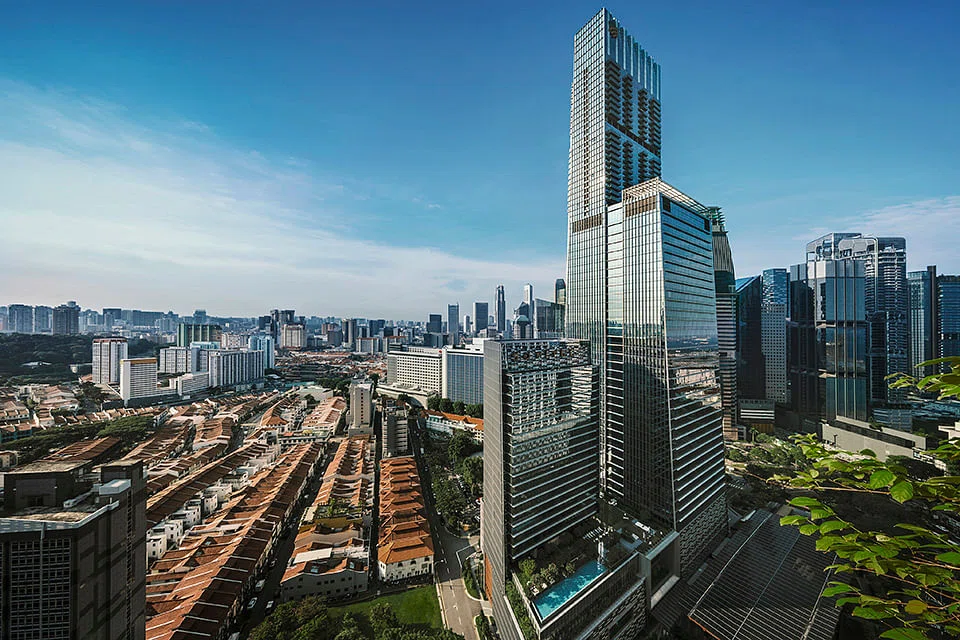
GUOCOLAND seems to be going places.
The mainboardlisted group's Guoco Tower in Tanjong Pagar, completed a few years ago, showcases the group's ability to deliver an integrated mixed-use project that has transformed and uplifted the locale. In the Beach Road area, Guoco Midtown is poised to have a similar effect.
The group has also made a name for itself for residential developments, with Leedon Residence being a prime example. Yet, the stock is hardly covered by analysts and trades at slightly less than half its net asset value.
Among the assets in the group's books is 20 Collyer Quay, which it has owned for a long time. Formerly known as Tung Centre, the office block sits in a prime location in the Raffles Place financial district.
In recent years, GuocoLand has also developed a couple of integrated mixed-use projects in urban areas: Guoco Tower here and Damansara City in Kuala Lumpur.
Hurdles to better valuations
Why has the market not taken notice of the group's potential? For a start, the counter has a small free float - which makes it hard for institutional investors to buy its shares.
Malaysian tycoon Quek Leng Chan controls about 72 per cent of GuocoLand, which has a market cap of S$1.94 billion.
He has the wherewithal to privatise the group. If that happens, however, the Singapore bourse would lose yet another listed company.
One way to boost the company's liquidity would be for Mr Quek to reduce his stake - perhaps via placements to institutional and other sophisticated investors.
Even if he was open to such an idea though, a placement without an accompanying narrative of income security and/or growth would do little for the counter.
Like many other listed property groups in Singapore, GuocoLand suffers from a mispricing of its assets because of its traditional residential development model.
In general, residential property developers' profit margins have thinned over the years. It also takes time for the earnings to materialise as developing a residential project typically takes three to four years. Put simply, profits are neither high nor steady.
Lurking in the background is policy risk: the danger of fresh measures from the authorities to cool the property market.
Also of concern to some investors is GuocoLand's relatively high gearing of approximately one time.
Options available
Since the stock market accords a better valuation to real estate investment trusts (Reits) than it does to residential developers, it would make sense for GuocoLand to spin off a Reit holding, for a start, 20 Collyer Quay and Guoco Tower's office, retail and hotel components.
Besides steady distributions, such a Reit would also offer a growth story. After Guoco Midtown in Beach Road is completed, parts of the project could be injected into the Reit.
Overseas, the group is developing three integrated mixed-use projects - in KL, Chongqing and Shanghai - which include recurring-income components that could extend the potential acquisition pipeline if the Reit's mandate were to cover multiple geographies.
By selling some of its investment properties to the Reit (in which it could also hold a 30-40 per cent stake), GuocoLand should be able to reduce its own gearing and increase the attractiveness of its stock.
The Reit could provide a capital recycling platform for GuocoLand, which could utilise the sales proceeds to buy sites for future developments that it could offer to the Reit. Thus, the growth story continues.
After listing a Reit, Mr Quek could even privatise GuocoLand.
Instead of a Reit, the company could also recycle its investment properties into a private property fund - teaming up with long-term partners (including pension funds), while maintaining control of the assets.
There are merits to such an approach.
A Reit's unit price is subject to market volatility and may, still, be underpriced. Several of Singapore's Reits trade below their net asset values.
Investors in a private fund, on the other hand, are more focused on the actual physical value of the properties. They might also be prepared to accept a lower yield - thus, allowing GuocoLand to fetch a higher price for its assets.
Unitholders of a Reit expect the manager to maximise net property income and distributions. In the past, tenants of some Reits have complained about being squeezed in a grossly unequal landlord-tenant relationship.
If GuocoLand were to inject its assets into a private fund, it could pick its co-investors carefully - ensuring their aims are aligned with its own business values. In the long run, this is a more sustainable approach.
Such a business model still leaves room for the company to continue developing residential projects for sale.
The group's core businesses would then be property development and, perhaps, property asset management - as GuocoLand could charge the Reit or private property fund a fee for managing the assets.
In due course, the group's activities could expand to include fund management and other skill sets - perhaps the provision of green technology, design and building solutions to third parties.
By transforming itself into a company with multiple business platforms - instead of being known primarily as a property developer and landlord - GuocoLand stands a higher chance of wowing stock market investors with a cocktail of income and growth.
Above all else, however, for GuocoLand to endear itself to the stock market, it should engage analysts and potential investors more actively, explaining its strategy. That calls for a change in culture for a group that rarely holds presentations.
READ MORE:
- GuocoLand opts for innovation
- Property development no longer offers healthy returns for shareholders
- GuocoLand's net profit up 48% for FY21 to S$169.1m
- GuocoLand top bidder for Lentor Central plot; Tampines EC site sets price record
- GuocoLand CEO Raymond Choong to retire; Singapore managing director Cheng Hsing Yao to take over
- Tanjong Pagar Centre game-changer for GuocoLand
- Tech, media tenants take up 37% of committed space at Guoco Tower