The high-stakes battle for invisible real estate in space
As radio spectrum becomes increasingly valuable, companies and governments are jostling to control more of it
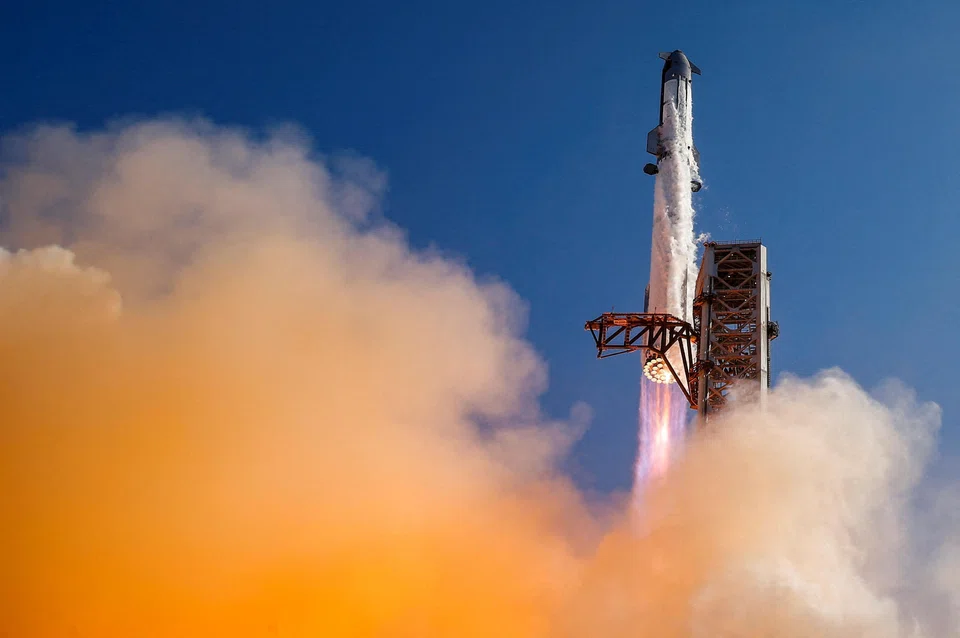
ELON Musk’s SpaceX is working to grab invisible real estate: the radio spectrum that carries wireless signals. Its competitors are doing the same.
That has set off a race that resembles the land rushes of the 19th century, except in the air.
Radio spectrum cannot be legally owned. But as it has become more valuable, companies and governments have been jostling to control more of it.
On Earth, competitors have heavily invested in staking out the rights to use broader swathes of airwaves. And in space, China and other countries have suggested they may want more say over who uses which spectrum to communicate with Earth.
In the US, licences to use specific spectrum bands serve as pseudo property rights. The Federal Communications Commission (FCC) allows them to be bought, sold and leased (with its approval), and it renews them almost automatically, absent misconduct.
USTelecom, a telecommunications trade group, told a federal court that the industry had sunk more than US$230 billion into FCC auctions, as well as US$700 billion into networks on the assumption it was buying something close to property.
Shares of phone and cable companies have been under pressure in recent months over fears that SpaceX will scoop up more spectrum at an auction next year and use it to compete with them, including by connecting ordinary cellphones directly to satellites.
There is also a race to acquire spectrum used for communications with outer space, where satellite frequencies are managed by the International Telecommunication Union (ITU), a branch of the United Nations.
The US federal government applies for these licences on behalf of American companies under a first-come, first-served system. Later entrants can use the same airwaves, but must coordinate with the incumbent to avoid interfering with it.
SEE ALSO





That system has worked well for SpaceX and other American companies that filed early and in bulk.
Much of the rest of the world isn’t thrilled with the status quo, seeing the airwaves less as a piece of property and more as a resource to be shared by all under international oversight.
That may seem high-minded, but it’s also a defensive move against powerful first movers such as SpaceX.
American negotiators are gearing up for a fight at the World Radiocommunication Conference, which will be held in October and November 2027 in Shanghai – home turf of the powerful Chinese delegation.
Late-coming Chinese companies have flooded the ITU with applications for satellite frequencies while insisting on “equitable access” to bands where earlier filings, mostly by American operators, hold priority.
SpaceX pinpointed the problem in the risk factors section of the prospectus for its initial public offering, which valued the company at US$1.8 trillion.
Getting spectrum licences “can be a complex and time-consuming process”, it said, “including in certain jurisdictions where regulatory processes may be influenced by protectionist policies or preferences”.
It also warned that “some countries” – unnamed but seemingly including China – were considering changing how they decided which satellite operator got a domestic operating licence: Instead of defaulting to whoever had spectrum priority from the ITU, they would weigh other factors, including whether the applicant was home-grown.
Global competition
The fight over the commercial exploitation of space goes back decades.
The 1967 Outer Space Treaty bars any nation from claiming sovereignty over the Moon or other celestial bodies, but it never settled the question of private claims.
A 1979 follow-up, the Moon Treaty, tried to declare space the common inheritance of all humanity, but the US didn’t ratify it; nor did any of the other major spacefaring nations. This has created a policy vacuum.
The administration of US President Donald Trump favours treating space more as private property than as shared inheritance. An executive order in Trump’s first term concerning outer space flatly stated that “the United States does not view it as a global commons”.
Americans are worried about the EU’s proposed Space Act, which would impose requirements for operating in Europe that appear designed to burden large non-European operators, SpaceX among them.
Researchers at the think tank New America have noted similar protectionist instincts showing up in regulatory frameworks in Canada, Brazil, Japan, India and China.
SpaceX has “a favourable administration in the US with the FCC, but not so much internationally”, said Chris Quilty, whose firm tracks the satellite industry’s financial statements and regulatory filings.
Even with global spectrum rights secured through the ITU, SpaceX needs each country’s sign-off to turn on service.

The FCC deserves some of the credit for America’s leadership in new wireless services. It requires incumbents to use advanced technology to minimise interference and maximise shared use of spectrum. Clever engineering often solves conflicts.
That modernisation push by the FCC, for which SpaceX has lobbied, has made the US “the envy of the world” in spectrum matters, said David Redl, executive director of the SpaceConnect Association, a trade group for low-Earth-orbit satellite companies Amazon Leo, Iridium, Telesat and Globalstar.
He ran the National Telecommunications and Information Administration, the federal government’s spectrum office, during the first Trump administration.
Redl’s group says the tighter bottleneck now isn’t Washington. It’s the “lengthy, often combative” licensing processes operators still face trying to serve customers outside the US. Each country’s regulator must issue landing rights.
The ITU has struggled to cope with changes in the technology of satellite communications.
Commercial satellites used to be mostly in geostationary orbit, about 22,000 miles above the Equator. The ITU assigned orbital slots to them so their signals would not interfere.
But the new constellations of low-Earth-orbit satellites are much closer – mostly a few hundred miles above Earth’s surface – involve many more satellites and don’t sit in fixed positions in the sky.
As a result, the ITU doesn’t even try to assign slots to low-Earth-orbit constellations, a hopeless task. Instead, it gives priority over frequency band use to the first filer.
To prevent companies from squatting on unused frequencies, which has happened in the past, it gives them a series of deadlines for putting them to use. But enforcement is weak: The ITU cannot independently inspect anyone’s satellites and relies largely on self-reporting.
Facts in the sky
Global spectrum rules have long been set through international consensus, hammered out at the ITU’s World Radiocommunication Conferences roughly every four years, on the informal understanding that no country would alone move too far ahead of that consensus.
The US, under the FCC’s current leadership, has been doing exactly that, getting ahead of the consensus.
Michael Calabrese, who directs the Wireless Future project at New America, believes that the US should keep the pressure on to “demonstrate the viability” of these reforms, and then push the rest of the world to adopt similar ones.
In the 1970s, when treaties such as the ITU’s were first written, only governments had the technology, so governments set the pace, said Harold Feld, a longtime telecom policy lawyer.
“Now, you have private-sector companies moving as quickly as possible, and you have rivalry between countries,” he said. “Not only are there no rules, there’s less incentive within the structure to create them.”
While diplomats dicker, what one advocate calls facts in the sky keep piling up. SpaceX’s Starlink accounts for about two-thirds of all active satellites in orbit, concentrated in the low-Earth-orbit shells best suited to low-latency broadband. Starlink is now something like 60 per cent of SpaceX’s revenue and essentially all of its operating income.
But the contingent that sees space as a shared commons isn’t giving up.
Hansdeep Singh, a human rights lawyer who cofounded the International Center for Advocates Against Discrimination, said that the world needs to act “before a few powerful states and companies are able to create norms that then just become the rules”. NYTIMES
Decoding Asia newsletter: your guide to navigating Asia in a new global order. Sign up here to get Decoding Asia newsletter. Delivered to your inbox. Free.
Share with us your feedback on BT's products and services