Keppel Q1 net profit dips on lower real estate contribution; Iran war yet to impact group
Recurring income improves year on year, on the back of higher income from operations and stable profits from asset management

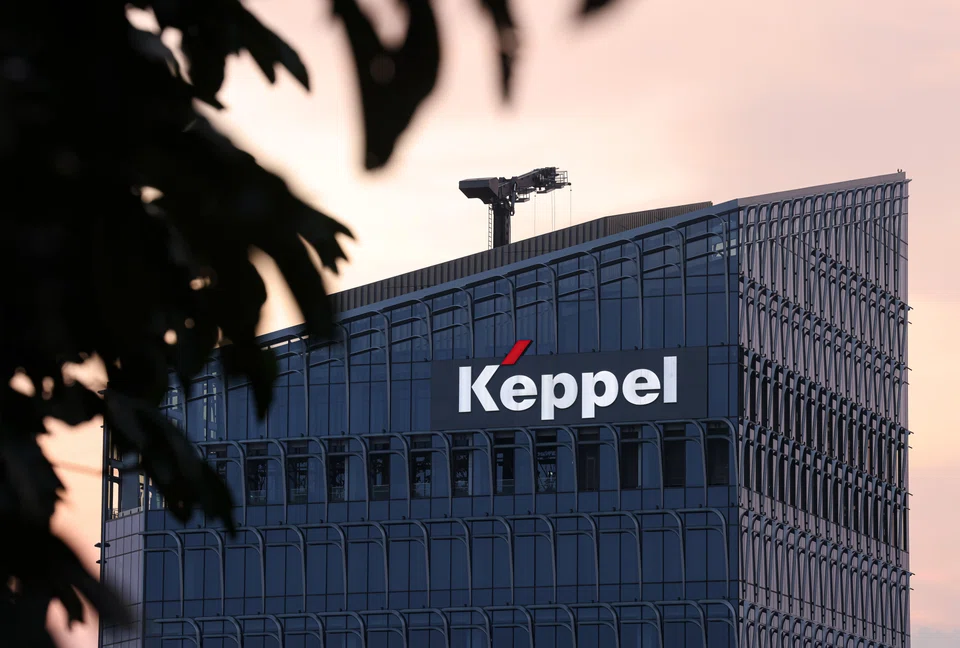
[SINGAPORE] Keppel reported a slightly lower year-on-year net profit for the first quarter ended March, as lower real estate contributions offset higher earnings from its infrastructure and connectivity segments. This excluded the company’s “non-core portfolio for divestment and discontinued operations”.
Including the non-core portfolio’s performance, overall net profit was also lower due to fair value losses and lower monetisation gains from its non-core assets, said the company on Thursday (Apr 23).
Asset monetisation in the year to date totalled S$385 million, including the sale of i12 Katong mall announced on Wednesday.
Keppel said that it is engaging with potential buyers for its assets, targeting S$2 billion to S$3 billion in non-core asset sales for the full year.
Previously, Keppel also sold its entire 5 per cent stake in Seatrium, realising a total value of S$430 million in cash based on a weighted average price of S$2.52 per share.
Recurring income improved year on year, supported by higher income from operations and stable net profit from asset management.
Asset management fees increased 13 per cent year on year to S$108 million in Q1 2026.
The company added about S$400 million in new funds under management during the quarter and is currently finalising another S$2 billion of investor commitments over the next few months.
In its infrastructure segment, the decarbonisation and sustainability solutions business saw long-term contracts expand to S$7.6 billion as at end-March. It secured long-term contract wins of more than S$700 million in the quarter.
The company also reported that its 600-megawatt hydrogen-compatible Keppel Sakra Cogen Plant has completed high-load commissioning and is on track to be ready for generation in the first half of 2026.
In connectivity, Keppel commenced construction of its floating data centre project and will begin construction of Keppel DC SGP 9 in mid-2026.
The company is also in advanced discussions with potential customers for its remaining two fibre pairs in the Bifrost Cable System, targeting to sign contracts in the first half of the year.
Limited Middle East exposure
Despite facing international geopolitical volatility, the company remains cautiously optimistic.
“Keppel has limited direct exposure to the Middle East, and we have not seen any notable impact on the company thus far,” said Loh Chin Hua, Keppel’s CEO.
He added during an earnings call on Thursday that fundraising and asset monetisation have not been affected, as its flagship funds continue to have good traction with asset owners, including Middle East investors.
“That said, if there is a prolonged disruption to gas supply and an energy crunch, this could have broader impacts on energy security and the macroeconomic environment, which may in turn affect Keppel, including on fundraising and asset monetisation.”
The company had earlier warned of such significant “second-order” effects on global energy prices and the international economy on Apr 13.
Still, Loh noted that the company’s integrated power business has been resilient, supported by diversified gas supplies and various mechanisms to shield against fuel cost fluctuations.
Cindy Lim, who heads Keppel’s infrastructure division, said that the company has procured replacement gas from Gasco – Singapore’s centralised gas procurement agency – at prevailing gas prices.
A significant portion of the elevated prices can be passed on to their downstream customers through fuel hedging or fuel indexing, she added.
Generation companies in Singapore have limited their exposure to gas from the Middle East as the city-state as a whole imports less than 10 per cent of its gas from Qatar.
Loh said that the company expects to see more customers seeking longer-term power supply contracts on the power supply, given the market volatility.
“So I think there will also be opportunities for us to term out some of our electricity power supply contracts,” he said.
Stronger financial position
Loh noted that Keppel’s financial position has improved, with a strong free cash inflow in Q1 2026 compared with an outflow in Q1 2025.
This inflow stemmed from both operating and investing activities, which included higher distributions from sponsor stakes in, and co-investments with, Keppel’s real estate investment trusts and private funds.
The counter closed on Thursday 3.4 per cent or S$0.41 down at S$11.62, after the announcement.
Decoding Asia newsletter: your guide to navigating Asia in a new global order. Sign up here to get Decoding Asia newsletter. Delivered to your inbox. Free.
Copyright SPH Media. All rights reserved.