

Sembcorp raises interim dividend despite 72% H1 profit slide to S$150 million on Alinta deal costs
CEO Wong Kim Yin is optimistic about the ‘tsunami of AI and data centre demand’ for energy solutions


[SINGAPORE] Sembcorp Industries’ earnings fell 72 per cent year on year to S$150 million for H1 ended June – hit by one-off acquisition costs, as well as lower contributions from its gas, renewables and urban solutions businesses.
This translates to a H1 earnings per share of 8.43 cents, down from 30.13 cents a year ago, the company announced on Thursday (Aug 13).
The news sent Sembcorp’s share price down 2.3 per cent to close at S$5.59 on Thursday. Separately, MSCI had also announced the company’s removal from its Singapore index on Thursday.
Despite the drop in net profit, Sembcorp declared an interim dividend of S$0.11 a share, up 22 per cent from S$0.09 a share in the year-ago period. The dividend will be paid on Sep 4.
The dividend increase reflects Sembcorp’s “recognition that our dividend payout is lagging our peer group”, said CEO Wong Kim Yin at an earnings briefing on Thursday.
The company is also confident about its future performance, with Wong especially bullish about a “tsunami of AI and data centre demand” for energy solutions that it could leverage.
Lower profitability in gas, renewables
Sembcorp’s H1 turnover rose 28 per cent to S$3.8 billion. This was driven by higher energy prices in Singapore, as well as contributions from Alinta, the Australian energy provider it acquired in June.
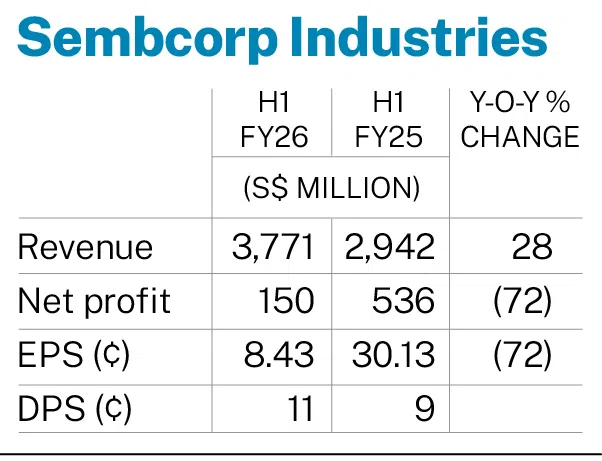
However, Sembcorp’s net profit was hit by S$155 million in transaction costs related to the Alinta purchase. It also recorded a S$57 million foreign exchange loss from a deferred payment note and a S$10 million fair value loss on energy derivatives.
Excluding these and another exceptional item, the company’s H1 underlying net profit fell 25 per cent to S$369 million. This came on the back of lower profitability across the gas, renewables and integrated urban solutions divisions.



The gas and related services segment saw a 14 per cent decrease in underlying H1 net profit to S$285 million. This was due to the closure of a key customer’s operations in the UK, as well as lower generation spreads in Singapore.
Meanwhile, underlying net profit from the renewables segment was nearly halved to S$69 million, from S$132 million a year ago.
Wong cited weaker wind and solar resources, lower tariffs and the removal of value-added tax refunds on onshore wind projects in China as key factors.
Another persistent challenge is curtailment, which occurs when a power plant generates more electricity than the grid can handle, and the electricity output has to be intentionally restricted. This results in wastage and lost revenue for developers.
Sembcorp saw improvements in curtailment in some provinces – such as Guangxi, Yunnan and Guizhou – but the issue has worsened in Hunan and Ningxia, said the company’s chief financial officer Eugene Cheng.
Asked if Sembcorp may divest underperforming assets in China, Wong said that such a move is not “top on the priority list”, and that curtailment could ease with the build-up of transmission infrastructure.
Nevertheless, Sembcorp is managing costs carefully and keeping the assets in good condition, so that it can consider any opportunities “when the right time comes”, he added.
Similar to the gas and renewables segments, Sembcorp’s urban solutions business also recorded a lower underlying net profit: down by 16 per cent to S$62 million. This was due to the absence of contributions from its divested waste business, Sembcorp Environment, as well as the timing of urban land sales.
Bright spots and growth levers
Beyond the three segments, Wong highlighted Alinta as a bright spot: it contributed S$5 million in underlying net profit for the one-month period following the completion of its acquisition.
On a pro forma basis, assuming the acquisition had been completed on Jan 1, Sembcorp’s underlying net profit for H1 would have stood at S$558 million, while turnover would have been S$5.6 billion.
Sembcorp thus expects a stronger performance in the second half of 2026, supported by full six-month contributions from Alinta, as well as higher land sales and improved earnings from its gas business.
Sembcorp is on track to complete a 600-megawatt hydrogen-ready power plant in Singapore in Q4. The gas segment also “remains well-positioned to capture growing power demand in Singapore, particularly from data centre and high-tech manufacturing sectors”, the company said in its earnings report.
For instance, Senoko Energy – backed by Sembcorp – is developing direct connection infrastructure to support the power needs of semiconductor player Micron in Singapore.
In the UK, Sembcorp’s Wilton site is a “precious commodity” for data centre development, Wong added, noting that it has an immediate grid connection and water availability.
He also sees Alinta as being well-positioned to serve AI-driven power demand in Australia, with its 3.4-gigawatt portfolio of thermal and renewable solutions, in both the east and west coasts.
Within South-east Asia, Sembcorp has received approval to develop a data centre in Vietnam. Wong also sees Batam as “an emerging location for data centres, supported by connectivity to Singapore with submarine cable networks”.
“Across all these markets, we have got ready platforms that are able to capture the structural growth in digital infrastructure demand, leveraging on our existing power, renewables and urban capabilities,” he said.
While Sembcorp expects that the renewables business will continue facing headwinds, it anticipates contributions from new installed capacity, with India as a key growth market.
Decoding Asia newsletter: your guide to navigating Asia in a new global order. Sign up here to get Decoding Asia newsletter. Delivered to your inbox. Free.
Copyright SPH Media. All rights reserved.
TRENDING NOW

Fed hike throws Singapore banks a margin lifeline; UOB most likely to feel impact

He built the Vingroup empire. Now South-east Asia’s richest man is handing some key roles to his sons

Real-estate veteran Desmond Sim quits from CEO roles at Realion, ETC

Chagee, Mixue and Luckin won the market. Sustaining their edge is the harder part

