

From Shell to Singapore Airlines: the potential winners and losers as volatile oil prices hover under US$100
Transport companies’ profit margins take a hit while developed and emerging markets in Asia-Pacific face spillovers
Deon Loke &
Koh Kim Xuan
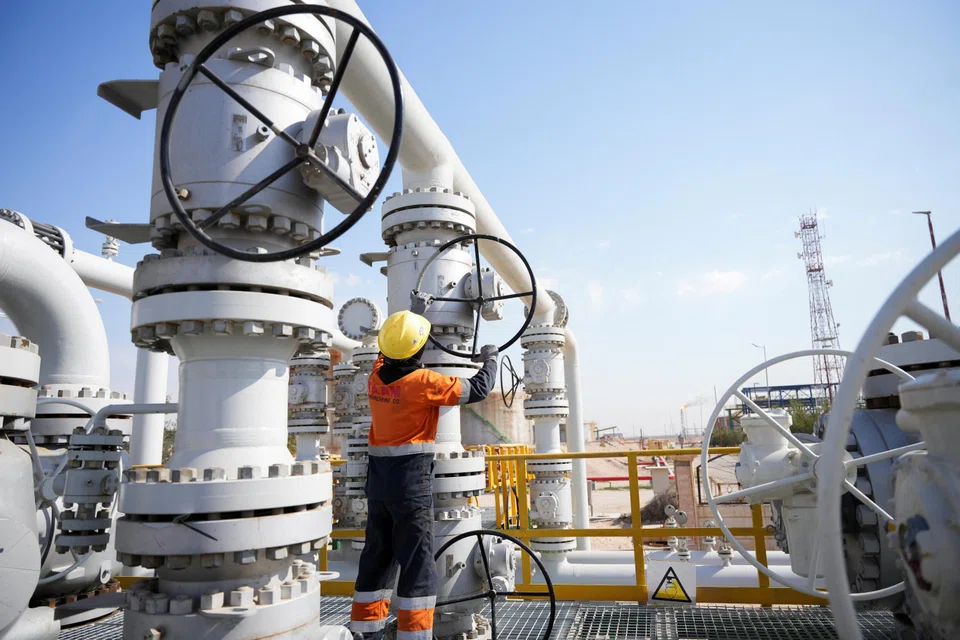
[SINGAPORE] Oil prices have been volatile over the past two days, falling to US$89.28 a barrel on Tuesday (Mar 10) after surging past the US$100 mark just a day earlier.
On Monday, global benchmark Brent crude jumped briefly to US$119.50 per barrel, the highest it has been since 2022, as the escalating US-Israel-Iran conflict upended energy markets.
It dipped a day later after US President Donald Trump signalled that the Iran War would end soon. Trump said he plans to waive oil-related sanctions and have the US Navy escort tankers through the Strait of Hormuz.
As at Tuesday, the Strait of Hormuz remains effectively closed, severely curbing shipments by Gulf oil exporters including Saudi Arabia.
While de-escalation of the conflict may be in sight, analysts warn that for transport and logistics players on the Singapore Exchange (SGX) and regional bourses, where fuel represents a large, often volatile slice of the operating pie, an oil spike may lead to significant margin pressure across air, sea and land transport.
Land, air, sea: absorbing the shock
On the ground, petrol station operators Shell, Caltex and Esso raised the prices of their fuel in Singapore twice in three days, with the popular 95-octane grade rising by S$0.05 to S$2.97 as at Friday.
Diesel prices have also climbed, with the highest being S$2.78 per litre at Esso, Shell and Caltex on Friday.
Singapore’s largest taxi operator ComfortDelGro (CDG) has moved to partially absorb the spike.
CDG, whose fuel and electricity costs accounted for roughly 7.5 per cent of total operating expenses in FY2025, raised its in-house pump prices to S$1.93 per litre on Mar 5. The phased increase is aimed at managing the adjustment and absorbing some cost for drivers.

CDG subsidiary SBS Transit had previously reported in its FY2025 results that lower fuel and electricity costs in 2025 contributed to offsetting operating loss – a tailwind that now faces the drastically altered energy landscape.
For most air carriers, fuel is the second-largest expense after labour, typically accounting for a fifth to a quarter of operating expenses.
Singapore Airlines’ (SIA) net fuel costs (S$1.4 billion) accounted for nearly 30 per cent of its total expenditure for its third quarter ended Dec 31, 2025.
Singapore jet kerosene prices surged to US$225 per barrel as at Mar 5, up 140 per cent from a week prior.
“For carriers, higher oil and insurance prices will likely result in greater margin pressure. Middle East is a key transit hub particularly for Asia-Europe routes, and prolonged closure of the airspace will likely result in longer flight times as planes are re-routed,” analysts from OCBC Group Research said in a Friday note.
“It is also important to note that the relationship between flight distance and fuel requirements is non-linear: As the distance increases, an aircraft must carry additional fuel, and this incremental weight further increases overall fuel burn,” they added.
SIA shares have tumbled 7 per cent month to date, despite reporting record Q3 revenue and encouraging signs of passenger yield stabilisation.
As oil prices cooled on Tuesday, shares of SIA were 2.5 per cent or S$0.16 higher at S$6.65 at market close.
The carrier typically hedges almost 50 per cent of its fuel over the next three months, which may help protect the airline from spikes in fuel prices through the use of derivative contracts.
“Hedged carriers in the Asia-Pacific like SIA, Qantas and Cathay Pacific are better positioned to weather the impact,” OCBC analysts said.
For jet fuel supplier China Aviation Oil , the oil price volatility “may bode well for its trading activities, offset by potentially lower jet fuel volumes on weaker travel demand”, OCBC analysts said in a Monday note.
“Elevated jet fuel prices have historically weighed on air travel demand and business volumes, but this is typically not significant to the financial performance of the company,” they noted.
Maritime players and shipping lines are facing similar dislocations.
“Pure-play oil tankers are the most exposed to volatility in the current conflict, while diversified players with alternative revenue streams such as port terminals (outside of the affected region) and logistics services are better positioned to absorb sector shocks,” analysts from Morningstar DBRS said in a Mar 2 note.
On SGX, shares of Samudera Shipping fell 2.8 per cent to close at S$1.04 on Monday while Cosco slid 2.6 per cent to S$0.112.
However, as oil prices slid on Tuesday, Samudera was 1.9 per cent or S$0.02 higher at S$1.06, and Cosco was 1.8 per cent or S$0.002 up at S$0.114 at market close.
Upstream players have seen heavy trading, with Rex International climbing 6.6 per cent and RH Petrogas rising 28.6 per cent as investors piled into the oil trade on Monday.
Singapore-listed palm oil planters with primarily upstream operations such as First Resources and Bumitama Agri could benefit from higher oil prices.
By Tuesday’s market close, following the pullback in oil prices, Rex International was the most heavily traded stock, down 7.8 per cent or S$0.015 at S$0.178 after 82.1 million shares changed hands. RH Petrogas was also among the most heavily traded counters, 14.8 per cent or S$0.04 down at S$0.23 after about 36 million shares were traded.
Regional market jolts
While Singapore may be able to tide through macroeconomic instability caused by the conflict and is likely to benefit from safe haven flows, the Republic may also be vulnerable to higher energy prices due to its “consumer pricing framework that is more responsive to changes”, said Julius Baer equity research analyst Chua Jen-Ai.
Emerging markets will be the most exposed to spillover effects from the conflict, said analysts at research firm BMI on Friday.
In particular, net energy importers in Asean would face terms-of-trade shocks from high energy prices, and destabilised external positions.
Energy importers such as the Philippines that run current account deficits will be most vulnerable to persistent oil and gas price increases, exerting downward pressure on the Philippine peso and straining the country’s balance of payments, the BMI analysts said.
“Elevated oil and gas prices should support net energy exporter currencies and fiscal positions, and could help cushion domestic consumers from the inflationary impact of higher global energy prices. The reverse is true for net importers,” they added.
The analysts also noted that Thailand, which is also a net energy importer, would face a “large energy import bill”, dampening its positive current account.
However, higher gas prices could lift coal prices, benefiting coal exporter Indonesia, and Malaysia’s oil-related revenues would be boosted by higher crude prices.
As for developed markets such as Japan and South Korea, with between 70 and 80 plus per cent of their oil trade relying on transit through the strait, they face near-term risks of disrupted oil deliveries and localised shortages, analysts said.
The absorption of these spillovers will depend on their energy balance deficits relative to current account surplus, fiscal position and monetary policy flexibility.
Decoding Asia newsletter: your guide to navigating Asia in a new global order. Sign up here to get Decoding Asia newsletter. Delivered to your inbox. Free.
Copyright SPH Media. All rights reserved.






