SIA Engineering H1 profit falls 1.7% to S$81.9 million
The group declares an interim dividend of S$0.025 a share, to be paid out on Nov 27

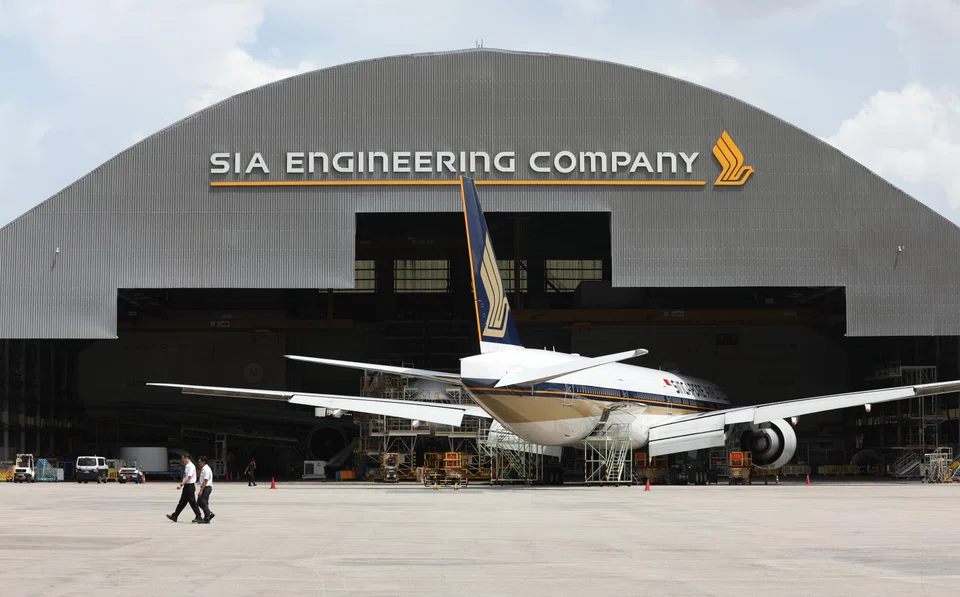
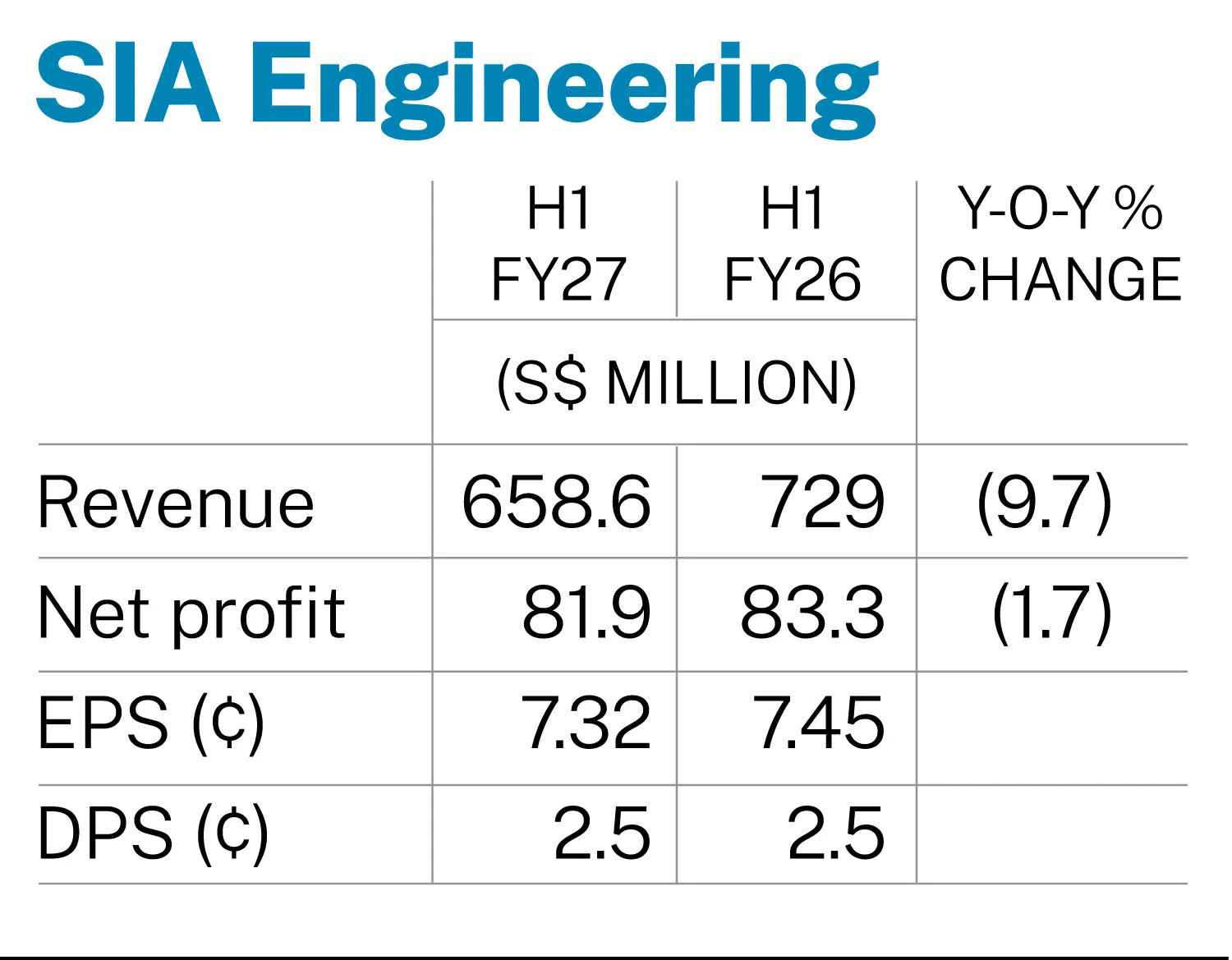
[SINGAPORE] SIA Engineering Company ( SIAEC ) reported a 1.7 per cent year-on-year drop in net profit to S$81.9 million for the six months ended Sep 30.
This came as revenue fell 9.7 per cent to S$658.6 million. On a per-share basis, earnings were down at S$0.0732, from S$0.0745 a year earlier.
The mainboard-listed provider of maintenance, repair and overhaul (MRO) services for aircraft and engines declared an interim dividend of S$0.025 a share, which will be paid out on Nov 27.
SIAEC said in a bourse filing on Tuesday (Nov 3) that the reduction in profit was due to a 10.7 per cent dip in its share of profits of associated and joint-venture companies, coupled with lower interest income, higher finance charges and higher taxes.
The S$7.6 million drop in share of profits of associated and joint-venture companies, to S$63.7 million in H1, was due to higher costs incurred for capacity and capability expansion at Singapore Aero Engine Services (SAESL).
SAESL, a JV between SIAEC and engine maker Rolls-Royce, is in the midst of a major US$180 million expansion.

This was only partly offset by higher output and profit margins of other associated companies.
SIAEC expects such expansion costs to tail off in the next financial year, as facility development work is expected to finish by the end of that period.
SIAEC CEO Chin Yau Seng described this as a near-term drag on earnings required to cater to the large capacity and capability expansion, and expects the largest gestation costs to be in the current financial year.
SEE ALSO




“Note that as we improve our operating line, which I think the numbers show, we are now already reaping some of the rewards of expansion,” he said.
Revenue affected by material costs
The group’s top line was affected by lower revenue from materials, it noted, adding that excluding materials, its revenue would have been 1.6 per cent higher year on year.
Group expenditure was down 11.6 per cent at S$623.9 million, in part due to the absence of an impairment cost recorded a year earlier.
Operating profit doubled to S$25.7 million, thanks to “healthy MRO demand” and lower losses at startup subsidiaries.
For the second quarter ended Sep 30, group net profit rose S$1.2 million year on year to S$41.6 million, as group operating profit increased S$5.6 million to S$12.5 million as cuts in expenditure outweighed a dip in revenue.
Outlook steady
SIAEC said that demand for its MRO services remained steady in H1, with its line maintenance operations in Singapore handling 3.3 per cent more flights year on year.
Its Malaysian subsidiary, Base Maintenance Malaysia, opened its facility and first hangar in May and finished its first aircraft maintenance check for Air India in July. This is expected to broaden the unit’s customer base.
The group also expanded its footprint in China with a 30 per cent stake in Arport Aircraft Maintenance & Engineering (Fujian), which will provide services to airports in Xiamen, Fuzhou, Wuyishan and Longyan.
Chin described the move as an “entry point”, adding that it is unlikely the group will target major hubs such as Shanghai or Beijing. “We see an entry opportunity at second and third-tier airports, and that’s where we intend to grow our footprint.”
The group is also targeting expansion in India in the future, having signed a memorandum of understanding with Air India in June to expand their partnership in MRO, with further discussions ongoing.
He said that the partnership is independent of SIA Group’s investment in Air India and an opportunity to tap into the “very promising” Indian MRO market, which is “underserved, and we see the fastest path forward as Air India because it’s a large Indian carrier that offers baseload in order to launch venture at scale”.
In June, SIAEC signed a joint-venture agreeement with Safran Aircraft Engines to establish a full shop for CFM Leap engines. An existing joint venture in Singapore, Safran Landing System Services Singapore, opened a new S$22 million facility in September, raising its capacity by 40 per cent.
The joint venture for CFM Leap engines is expected to be a major contributor to the business in the future, with SIAEC chief commercial officer Wong Yue Jeen saying that demand for this engine for MRO will be “very strong in the decades to come”.
The Leap is a new-generation airliner engine that is expected to power the majority of narrowbody aircraft, being fitted to the Airbus A320neo and Boeing 737 Max. Around 11,000 engines have been delivered, with a backlog of around 13,000.
The group said demand for its MRO services will continue with the growth of air travel demand, especially in the Asia-Pacific, and particularly as older aircraft see delayed retirement due to slowdowns in new aircraft deliveries.
The Middle East conflict has bumped up energy and freight costs, as well as continued supply chain bottlenecks for selected aircraft parts, SIAEC noted. It added that it “remains focused on driving productivity improvements, increasing operational resilience and maintaining cost discipline”.
“(Macropolitics are) not a risk we can ignore, but what we have seen to date suggests that demand is still resilient. No one is giving up hangar space – so it’s still in high demand,” said Chin.
Shares of SIAEC fell 1.3 per cent or S$0.04 to close at S$2.94 on Tuesday, before the results were announced.
Decoding Asia newsletter: your guide to navigating Asia in a new global order. Sign up here to get Decoding Asia newsletter. Delivered to your inbox. Free.
Copyright SPH Media. All rights reserved.