Singapore stocks rise on Friday; STI up 0.3%
City Developments leads the gainers on the blue-chip index
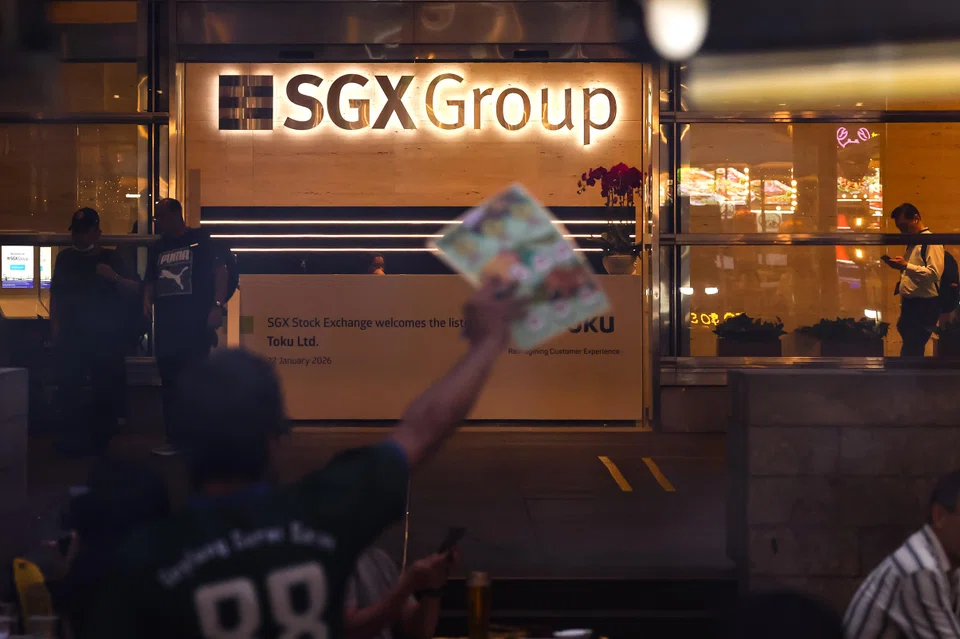
[SINGAPORE] Singapore stocks ended higher on Friday (Aug 21).
The benchmark Straits Times Index (STI) gained 0.3 per cent or 17.05 points to finish at 5,688.96.
City Developments led the gainers on Singapore’s blue-chip index, rising 1.7 per cent or S$0.14 to S$8.25.
The worst performer among STI constituents was ST Engineering , which fell 1.6 per cent or S$0.17 to S$10.68.
The trio of local banks ended higher. DBS gained 0.2 per cent or S$0.16 to finish at S$76, OCBC rose 0.7 per cent or S$0.20 to S$30.98, and UOB was up 0.8 per cent or S$0.31 at S$40.53.
Within the iEdge Singapore Next 50 Index, First Resources was the top gainer, rising 3.3 per cent or S$0.14 to S$4.42, while UltraGreen.ai was the biggest decliner, falling 14.8 per cent or US$0.11 to US$0.635.
In the broader market, gainers outnumbered losers 322 to 242, after 1.1 billion securities worth S$2 billion changed hands.
International Cement Group was the most actively traded stock, with 47.3 million shares changing hands.
DBS was the most actively traded stock in terms of value, with a volume of 3.4 million shares worth S$255.8 million.
Key regional indices were mixed. Hong Kong’s Hang Seng Index gained 1.2 per cent and South Korea’s Kospi was up 0.9 per cent, while Japan’s Nikkei 225 fell 0.3 per cent and the FTSE Bursa Malaysia KLCI was down 0.01 per cent.
Stephen Innes, managing partner at SPI Asset Management, said that the US Treasury’s move to increase the size of buybacks of longer-dated debt will matter for Asian markets.
A softer US dollar will loosen financial conditions in the region, give local central banks more “breathing room” and keep capital circulating through equities rather than being pulled relentlessly back towards US cash and Treasuries, he added.
This article was written with the assistance of AI and reviewed by a reporter
Decoding Asia newsletter: your guide to navigating Asia in a new global order. Sign up here to get Decoding Asia newsletter. Delivered to your inbox. Free.
Share with us your feedback on BT's products and services