Singapore’s easy wins in attracting global capital are over, say industry watchers
Tax incentives often not the deciding factor for companies looking at where to relocate
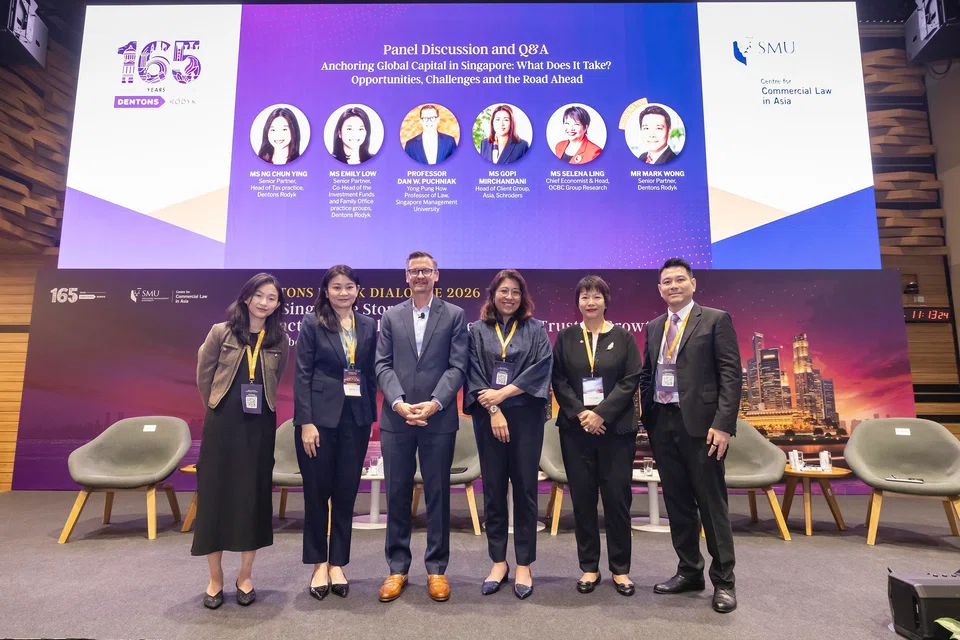
[SINGAPORE] The “low-hanging fruit” of attracting capital and talent to Singapore is gone, said Gopi Mirchandani, head of client group, Asia at Schroders. Simply setting up offices or placing people here is no longer enough.
Companies increasingly want substantive operations, senior decision-makers and investment expertise in locations that offer long-term stability, panellists at the Dentons Rodyk Dialogue 2026 said on Wednesday (Oct 28).
The panel discussion, which centred on what it takes to anchor global capital in Singapore, was moderated by Mark Wong, senior partner at Dentons Rodyk. It was held at the Singapore Management University (SMU) Yong Pung How School of Law.
As companies become more selective about where they place their highest-value functions, Singapore’s “rule of law, stability, predictability and good talent pool”, along with tax incentives, remain important, said Mirchandani.
While the Republic is seen as a safe haven amid geopolitical uncertainty, it cannot take its trusted status for granted, said OCBC chief economist Selena Ling. “Does it mean that we will always enjoy this trust or safe-haven status going forward? I would say, don’t count the chickens before they hatch. You actually have to work very, very hard at it,” she added.
Ling pointed to Singapore’s multi-pronged strategy of attracting portfolio, wealth and management flows, while also drawing in foreign direct investments at the underlying level. Attracting investment goes hand in hand with attracting an entire ecosystem of treasury and corporate functions, management decisions and talent, she noted.
Meanwhile, incorporating in Singapore does not shield companies from foreign scrutiny, noted Professor Dan W Puchniak from the Yong Pung How School of Law at SMU. He pointed to the experiences of social media company TikTok and fast-fashion retailer Shein, adding that a company’s supply chains, ownership structures and location of data storage increasingly matter.
Maintaining a competitive edge
While tax incentives have helped Singapore attract capital, panellists noted that they are often not the deciding factor for companies looking at where to relocate.
Ng Chun Ying, senior partner and head of tax practice at Dentons Rodyk, said that large corporates in particular have largely acknowledged that they have to pay a minimum level of tax somewhere. “The focus has shifted to trying to achieve tax certainty, trying to minimise tax disputes (and) trying to minimise double-tax risk,” she pointed out. Ng added that Malaysia and Thailand remain lower-cost alternatives to Singapore and have also introduced tax incentives to attract investments.
SEE ALSO


However, she noted that following the introduction of the Global Minimum Tax, which sets up to a 15 per cent tax rate on corporates with annual revenues of at least 750 million euros (US$835.5 million), the competition has now shifted from tax to fiscal support. Ng cited Singapore’s expenditure-based Refundable Investment Credit scheme, adding that the country is well-positioned to provide such support because of its fiscal strength.
The panel also discussed the Republic’s variable capital company (VCC) structure, which is designed to house investment funds for a wide range of assets. Popular among some wealthy individuals and family offices, VCCs enable the creation of segregated funds so that managers can pull together assets for private investments or manage individual sub-funds on behalf of clients.
Because VCCs can only be managed by Singapore-based fund managers, it has created “more substantive” fund management in the Republic, said Emily Low, senior partner and co-head of the investment funds and family office practice groups at Dentons Rodyk.
She added that while Singapore VCCs are now established, the country needs to deepen its fund-management capabilities and strengthen governance standards.
OCBC’s Ling said that, more broadly, attracting global capital to Singapore benefits both the domestic economy and small and medium-sized enterprises (SMEs). “SMEs are still very much tied to the health of the MNCs (multinational corporations) and the global economy, so I don’t think we can draw a separate line. We just have to look a lot harder at things that we didn’t look at in the past.”
Decoding Asia newsletter: your guide to navigating Asia in a new global order. Sign up here to get Decoding Asia newsletter. Delivered to your inbox. Free.
Copyright SPH Media. All rights reserved.