

Singapore’s financial sector must resist risk aversion, be bolder to stay at cutting edge: former DBS chief Piyush Gupta
Success in building Singapore’s financial system makes it easy to ‘focus too much on stability’

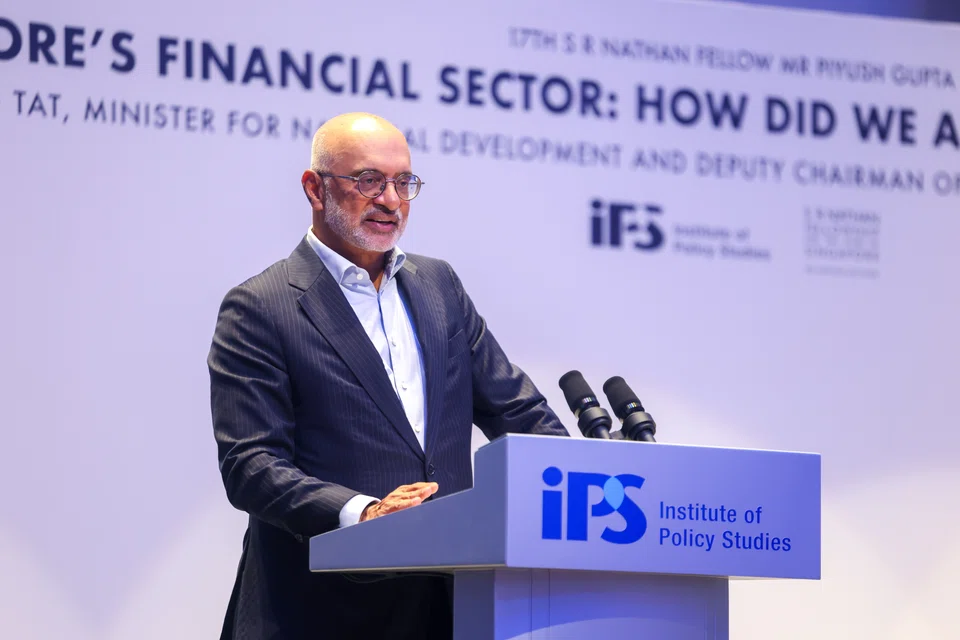
[SINGAPORE] Singapore’s financial sector must continue to innovate and not become adverse to risk in order to stay ahead, said banking veteran Piyush Gupta.
The city-state’s success in building a strong financial system makes it easy to “focus too much on stability” given that it has a reputation to keep up, said the former chief executive of DBS.
“But at the same time, you have to recognise that in this world, the pace of change is extraordinary,” he said. “This is the time that we have to be as bold as we were in the 1960s and 70s.”
Gupta was speaking at the launch of his book Singapore’s Financial Sector: How did we arrive, how do we thrive? held at the National University of Singapore on Monday (Aug 17).
The book is based on three lectures that he delivered at NUS’ Institute of Policy Studies in 2025. The lectures covered the evolution of Singapore’s financial sector; how new technologies made an impact; and how Singapore can remain relevant as a global financial hub.
He noted that the tension between innovation and stability exists particularly in the financial services sector – while the sector can innovate quickly, it must be mindful of upholding trust, given that it handles the money of regular people.
“Trust is not a soft virtue in this business; trust is the product,” he said.
In that aspect, Singapore has “done extraordinarily well” in balancing innovation and stability, and would need to continue doing so to position itself for the future, he noted.
This was echoed by Minister for National Development Chee Hong Tat, who is also deputy chairman of the Monetary Authority of Singapore.

Also speaking at the book launch, Chee said Singapore must be prepared to take calculated risks when seeking new opportunities.
“Not every challenge or endeavour comes with an established playbook or a clear road map,” he said. “Sometimes, we need to be willing to test new ideas and approaches, and accept some failures along the way.”
He cited the success of the Global Listing Board, which allows companies to list simultaneously on the Nasdaq and the Singapore Exchange, as well as the S$6.5 billion Equity Market Development Programme (EQDP), to boost the local equity market.
Gupta initially felt that Singapore was “not taking as much risk as I thought we might as a system”, but noted subsequent successes in risk taking in the past years, such as the EQDP.
“I’m so enormously energised by the fact that we’re taking the same kinds of balanced positions and risks that we had in the decades before us – the truth is, the pace of change in our industry is continuing to accelerate,” he said.
This comes as the global race to build the next generation of financial infrastructure is already happening.
For example, Hong Kong has pulled ahead to be the first market to launch fiat-backed digital currencies. Hence, Gupta recommended that Singapore should explore launching a Singapore dollar-backed stablecoin.
“Singapore’s edge has always been our ability to walk this tightrope better than anybody else,” he said.
“The future is ours for the taking – but only if we keep earning it every single day.”
Decoding Asia newsletter: your guide to navigating Asia in a new global order. Sign up here to get Decoding Asia newsletter. Delivered to your inbox. Free.
Copyright SPH Media. All rights reserved.
TRENDING NOW

Once staunchly pro-China, Malaysian Chinese businesses are now distancing themselves from Beijing

Looking beyond looming CEO succession, should UOB potentially pursue a transformative merger?

Could stablecoins be the future of money?

Grab CEO’s wife Chloe Tong on life with Anthony Tan and finding her purpose

