

SK Hynix plans to double capacity to ease memory chip crunch
The company will do whatever it takes to fund the expansion, says chairman Chey Tae-won
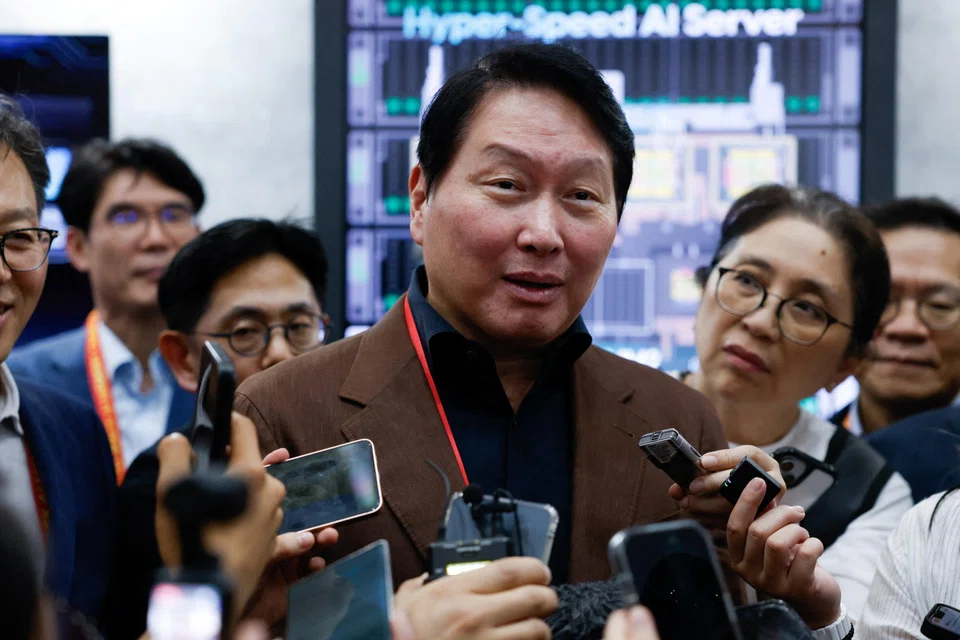
[TAIPEI] SK Hynix plans to double its memory chip capacity over the coming half-decade, in a major expansion that should help ease a global shortage of an essential component of artificial intelligence.
The company is responding to an endemic deficit of storage chips that could last till 2030, chairman Chey Tae-won told reporters in Taipei, upholding a previous estimate.
SK Hynix is ramping up spending to address that demand-supply imbalance, though it is hard to quantify because of volatile prices for a panoply of resources including land, equipment and electricity, Chey said.
He added that the company will do whatever it takes to fund that expansion in chip wafer capacity. “Whatever we need, we’ll provide it,” he said. “Until 2030, there’s still some shortage.”
SK Hynix, which with Samsung Electronics and Micron Technology dominates the global market for memory, is one of the biggest beneficiaries of a global data centre build-out.
Trillions of dollars in projected spending by hyperscalers such as Meta Platforms sent SK Hynix’s and Micron’s market valuations past the US$1 trillion mark for the first time last week.
Memory chips, used to store and funnel the large amounts of data required for AI services, have become one of the biggest bottlenecks to AI development. Investors and analysts expect memory shortages to last through 2027, giving its producers unusual pricing power over the world’s largest technology companies.
Some industry executives have declared a “super-cycle” of exponential demand for memory, from the high-bandwidth or HBM variety required to train AI such as ChatGPT to more conventional DRAM and NAND flash employed across data centres.
That is helping the industry break a decades-long cycle of boom-and-bust, as well as propel South Korea’s economy.
SEE ALSO


On Tuesday, Arm Holdings CEO Rene Haas said memory remained the biggest bottleneck for the global AI industry, in part because the sector leaders had pulled back on expansion during the post-Covid downturn of a few years ago.
More generally, the memory industry remains wary of over-expanding and precipitating another market collapse.
Chey said that the lead time for setting up a new site was long, with a green-field project potentially requiring more than five years.
SK Hynix’s capital expenditure in 2026 will rise significantly from 30.2 trillion won (S$25.6 billion) in 2025, executives have said previously without elaborating.
The company has filed to list American depository receipts this year. If that pans out, it would rank among the biggest New York debuts by a foreign company, giving American investors another way to play the AI memory trade. BLOOMBERG
Decoding Asia newsletter: your guide to navigating Asia in a new global order. Sign up here to get Decoding Asia newsletter. Delivered to your inbox. Free.
Share with us your feedback on BT's products and services
TRENDING NOW

Once staunchly pro-China, Malaysian Chinese businesses are now distancing themselves from Beijing

Looking beyond looming CEO succession, should UOB potentially pursue a transformative merger?

Could stablecoins be the future of money?

Grab CEO’s wife Chloe Tong on life with Anthony Tan and finding her purpose

