

As SpaceX scores a record US$75b IPO, retail investors can turn to ETFs for a piece of the space economy
But such funds should not be taken as just a stand-in for owning shares of Elon Musk’s firm, professionals say
Meera Pathmanathan
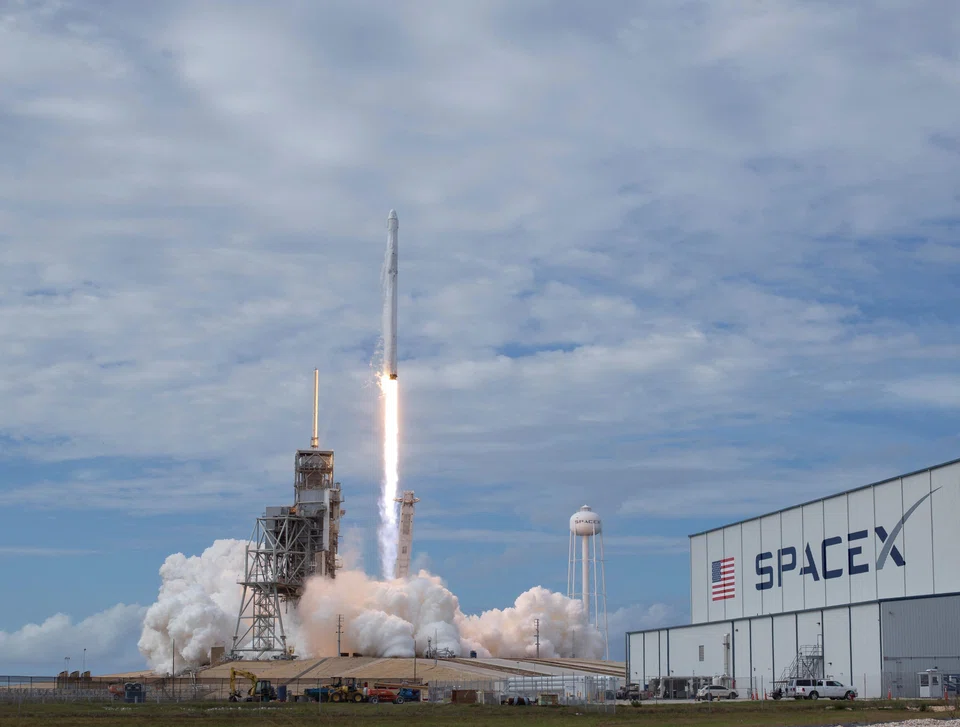
[SINGAPORE] With SpaceX making its Nasdaq debut on Friday (Jun 12), retail investors can look to space-themed exchange-traded funds (ETFs) as an alternative way to tap into the expanding space economy.
SpaceX’s long-awaited initial public offering (IPO), which is valued at a record US$1.77 trillion, has fuelled strong interest among investors eager to gain exposure to Elon Musk’s rocket, satellite and artificial intelligence venture.
A Longbridge spokesperson described the IPO as “one of the most anticipated listings in recent memory”, noting that Singapore investors have been closely following developments around the company.
The excitement has also drawn attention to investments offering broader exposure to the space economy.
Looking beyond SpaceX
“Space-related ETFs offer a way to invest in companies involved in space and aerospace industries,” said Chua Yi Wen, Singapore head of investment products at DBS’ consumer banking group.
Funds that track baskets of publicly traded companies within the sector include the ARK Space & Defense Innovation ETF and Tema Space Innovators ETF.
“If customers wish to gain exposure to SpaceX instead of directly purchasing its shares, some space-related ETFs will have integrated that exposure within their portfolio mix,” Chua added.
The ETFs can be purchased through retail brokerage platforms in the same way investors buy US-listed stocks and funds.
Sector ETFs’ performance
But investment professionals caution against viewing ETFs simply as a substitute for owning SpaceX shares.
SEE ALSO


While ETFs provide diversification across multiple companies, the pure-play space sector remains relatively small.
Tiger Brokers market strategist James Ooi described the space economy as “an emerging theme with relatively few large-scale listed players”.
This has translated into varied returns across the small basket of space-related ETFs. Bloomberg data shows that the VanEck Space Innovators UCITS ETF has been the strongest-performing dedicated space ETF this year, delivering a return of 52.15 per cent.
Within the pure-play space, the Tema Space Innovators ETF has gained 6.73 per cent in the year to date, narrowly outperforming the ARK Space & Defense Innovation ETF, which returned 6.71 per cent.
Chua noted that many space-focused ETFs have significant overlaps in their holdings, often with more than half of their top positions in common. This means holding multiple space ETFs may not necessarily provide broader exposure.
She also highlighted the sector’s volatility, noting that many listed space companies are valued more on growth expectations and potential rather than current earnings.
Why investors remain interested
Nonetheless, the long-term investment case remains strong.
DBS chief investment officer Hou Wey Fook pointed out that the global space economy reached US$613 billion in 2024. It also continues to benefit from “fundamental drivers, cost deflation, commercialisation, sovereign demand and the proliferation of satellite applications”.
The commercialisation of space has accelerated dramatically over the past decade; this is in part due to reusable rocket technology that has sharply reduced launch costs and opened new opportunities across communications, earth observation and national security.
At the same time, emerging developments such as space-based data centres are beginning to draw attention from investors seeking exposure to the intersection of AI and space infrastructure.
Hou cautioned that the risks of orbital sustainability and regulatory risks remain. For medium-to-long-term investors, however, diversified exposure “across launch, connectivity and defence remains a compelling structural allocation”.
For retail investors unable to access SpaceX before any market debut, space-themed ETFs may offer a way to participate in the broader growth story.
“The question is no longer whether space is an investable theme,” Hou said. “It is how to access it without overpaying for the hype”.
Decoding Asia newsletter: your guide to navigating Asia in a new global order. Sign up here to get Decoding Asia newsletter. Delivered to your inbox. Free.
Share with us your feedback on BT's products and services
TRENDING NOW

DBS, OCBC, UOB rout lops billions off STI as inflation, rate concerns spook investors

Grab CEO’s wife Chloe Tong on life with Anthony Tan and finding her purpose

OCBC sheds S$8 billion in value as shares close nearly 6% down; analysts cautious on banks

Deal between tycoon friends sparks scrutiny of Philippine power sector

