

ST Engineering to design and develop new satellites in Singapore
These will improve high-speed data transfer, disaster response planning and environmental monitoring

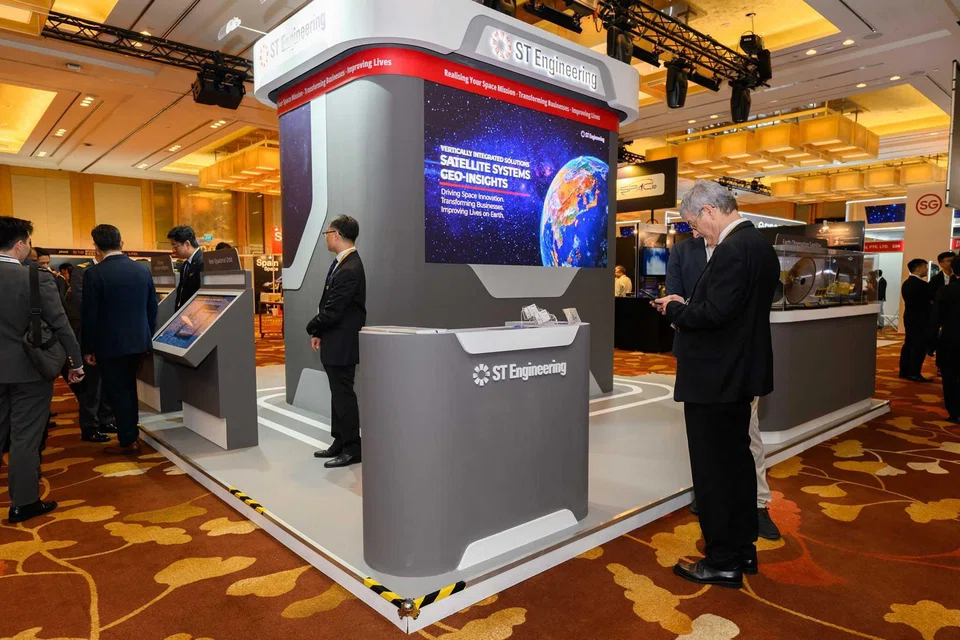
[SINGAPORE] ST Engineering will design and develop a constellation of four radar satellites in Singapore, a move set to accelerate the growth of the city-state’s space capabilities and high-tech engineering ecosystem.
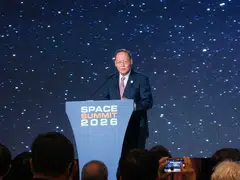
The company made the announcement on Monday (Feb 2) as part of the inaugural Space Summit at the Singapore Airshow 2026.
“Our innovative satellite systems and geospatial solutions unveiled today at Space Summit 2026 leverage artificial intelligence (AI) to solve real-world problems for customers worldwide,” said Low Jin Phang, ST Engineering’s chief operating officer for defence and public security, and president for digital systems.
This next phase of the group’s space programme comprises the delivery of Nebula – a laser communications demonstrator for ultra-fast networks – in the second half of 2026, and the roll-out of the NeuSAR-2 constellation by 2030.
These platforms, alongside a new AI-enabled optical satellite dubbed Polaris, aim to support functions ranging from broadband coverage to environmental monitoring focused on the equatorial region.
Indigenous innovation
ST Engineering has two decades experience in Singapore’s space ecosystem; the group deployed the standalone Earth observation satellites Teleos-1 and Teleos-2 in 2015 and 2023, respectively.
The new programme shifts the focus to a coordinated network of smaller, locally designed spacecraft.
Nebula, a locally developed satellite, will be used to test data-transfer speeds of gigabits per second. ST Engineering said such data-transfer capabilities “will form the critical foundation for ultra-fast space networks supporting global broadband coverage, Earth observation and secure data exchange”.
Crucially, Nebula serves as a “pathfinder” for inter-satellite links, which allow satellites to “talk” to one another in space. Currently, most satellites must wait until they pass over a ground station to download their data. Such a delay can last hours.


By hopping data from one satellite to another that is already within range of a ground station, this future technology could allow for near-instantaneous data transmission.
Equatorial eye
ST Engineering aims to launch the four synthetic aperture radar satellites that will make up NeuSAR-2 by 2030. The first of these units is slated for orbit in 2027.
Weighing under 280 kg each – three times lighter than Teleos-2 – the new satellites are designed for agility and cost-efficiency. Unlike traditional optical cameras, radar satellites can capture images at night and through cloud cover.
Once fully operational, the network will orbit near the Equator to provide frequent imaging updates, aiding missions such as disaster response and environmental monitoring.
A potential use case of the satellite constellation is responding to oil spills, such as the one in Singapore in 2024. As oil spreads rapidly due to tides and winds, the authorities need hourly updates to deploy containment booms effectively.
The NeuSAR-2 constellation is designed to revisit the same spot up to 16 times a day, providing the high-frequency data needed to track such fast-moving events.
The four-satellite architecture also offers resilience: If one unit requires maintenance, the others can continue the mission, ensuring an uninterrupted flow of data.
Software developments
On the software front, ST Engineering showcased new platforms to manage congestion in orbit and environmental issues on Earth.
Its new Minerva Hub tracks space objects and weather to help operators avoid collisions. Meanwhile, Earthsurance uses satellite data to verify carbon credit projects by monitoring deforestation.
ST Engineering on Feb 1 launched its largest unmanned cargo aircraft to date at the media preview of the Singapore Airshow, along with other products from its defence and urban solutions divisions.
On Monday, Singapore announced that it will set up the National Space Agency of Singapore under the Ministry of Trade and Industry from Apr 1. The agency will front national space ambitions to be a leader in space technologies and a credible contributor to the global space ecosystem.
Decoding Asia newsletter: your guide to navigating Asia in a new global order. Sign up here to get Decoding Asia newsletter. Delivered to your inbox. Free.
Copyright SPH Media. All rights reserved.
TRENDING NOW

Once staunchly pro-China, Malaysian Chinese businesses are now distancing themselves from Beijing

Stocks to watch: HPL, Aims Apac Reit, Zico, Advanced Systems Automation, ComfortDelGro
‘How many will survive?’: Bubble fears arise as China’s humanoid robotics face reality check

Smaller board lots can’t fix a market run by three banks

