

Data centre sector ‘politically salient’; Singapore takes practical approach to regulation: Tan Kiat How
The Republic is not out to compete ‘for every megawatt’ of capacity, aims to strengthen regional capabilities

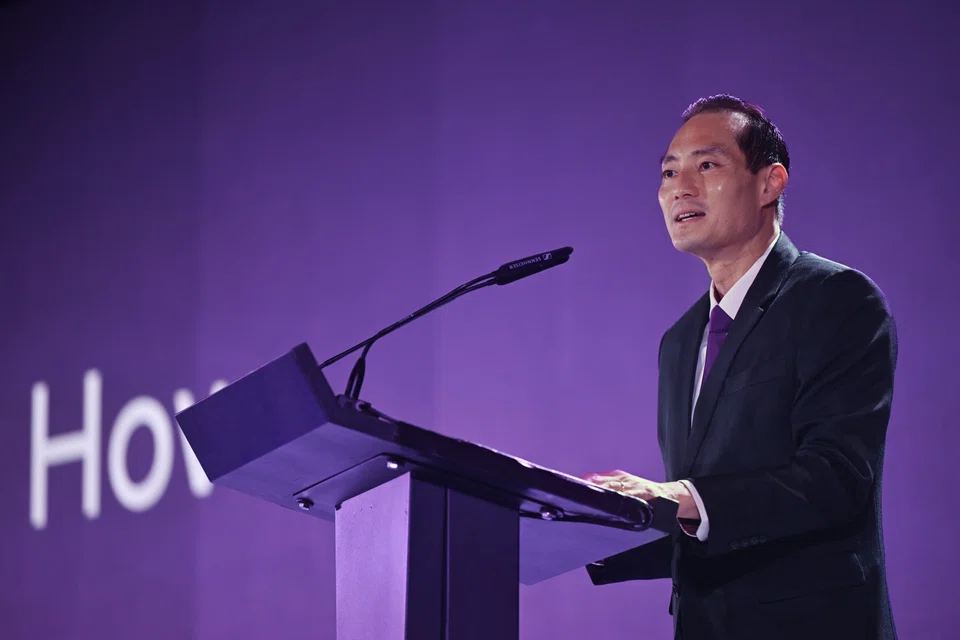
[SINGAPORE] Data centres have become “politically salient”, Tan Kiat How, Singapore’s Senior Minister of State for Digital Development and Information, said on Friday (Nov 6).
With communities and policymakers asking “legitimate questions around... water, land, grid capacity and what they receive in return”, he emphasised the need for industry and government to collaborate for sustainable growth in the sector.
His comments came in the wake of American voters’ bruising rebuke to data centre expansion in the US, as midterm election results widely seen as signalling support for restrictions on development have fuelled a global sell-off in tech stocks.
“The problem comes when these questions are addressed only after pressures become acute. Then debates become polarised: growth versus communities; industry versus government; and investment versus sustainability,” Tan added.
Data centre strategy
Amid the debate around data centres, Tan pointed to how policymakers in Singapore planned early and worked with the industry on rules that he called “practical, balanced and forward-looking”, such as a digital infrastructure law passed in October.
He was speaking at the launch of Nasdaq-listed Equinix’s sixth data centre in Singapore, dubbed SG6.
The data centre operator has made an initial investment of US$290 million – up from the US$260 million sum announced two years ago – in the first data centre to be built under a process that Singapore introduced after imposing a moratorium on new data centres from 2019 to 2022.
Given concerns about data centres’ power and land demands, the Data Centre-Call for Application (DC-CFA) tender put in place fresh sustainability requirements for such facilities.
Indicating that Singapore’s data centre strategy places quality over quantity, Tan added that the city-state’s ambition is “not maximum compute” but “maximum value from compute”.
“I see Singapore’s contribution not to pull every workload here into Singapore, not to compete for every megawatt, but to help make the regional system work better,” he said.
South-east Asia has seen a boom in data centre investments, with tech giant Google unveiling plans on Wednesday for a US$15 billion expansion in Malaysia in 2027 and 2028, which includes new data centre campuses in the states of Selangor and Negeri Sembilan.
But energy watchers have also warned of potential strain on resources in the region as data centres guzzle power and water for their electricity and cooling needs.
Green from the get-go
Leong Yee May, Singapore managing director of Equinix, told reporters after the launch of SG6 that “marriage between the government and industry” is needed to spark innovation for sustainable data centres.
Equinix was provisionally awarded 50 megawatts (MW) capacity in August for another data centre on Jurong Island, under the second round of the DC-CFA.
Known for its petrochemical refineries, Jurong Island has been envisioned as the future home of Singapore’s largest low-carbon data centre park.
DC-CFA2 stipulates that facilities must be at least 50 per cent powered by green energy pathways, such as vertical solar panels on buildings, biomethane, low-carbon ammonia or hydrogen, and fuel cells with carbon capture and storage technologies.
These rules have “created a very good opportunity” for the industry to explore green energy options that it would not have previously considered, said Leong.
Equinix has shortlisted two clean energy sources from the options listed in DC-CFA2, but Leong declined to share more details.
The company has thus far inked four renewable energy power purchase agreements in Singapore, bringing its local renewable energy portfolio to a cumulative 215 MW-peak by 2028.
The newly operational SG6, located in Jalan Tukang in western Singapore, will provide about 1,550 cabinets in its first out of an unspecified number of phases, and have up to 20 MW of IT capacity upon full build-out.
It has been designed to achieve a power usage effectiveness (PUE) of 1.2 – under the DC-CFA limit of 1.3. PUE is the ratio of a facility’s total energy usage to the energy used by its IT equipment.
SG6 taps both Singapore’s reclaimed NEWater and rainwater harvesting systems, reducing the usage of potable water for cooling.
Equinix also expects to invest S$5 million in fitting out a facility based at SG6 to innovate new solutions for data centre sustainability.
The co-innovation facility, which is being developed in partnership with the National University of Singapore Energy Solutions Hub, will focus on emerging technologies such as liquid cooling, cognitive digital twins and battery energy storage, and is expected to open in 2027.
TRENDING NOW

Analysts cut DBS target price on lower 2027 earnings, but see buying opportunity after share price slide
China Investment Corp, PGIM’s 50% stake in Nex mall up for sale; asking about S$1.2 billion

Nvidia CEO Jensen Huang drops from world’s top 10 richest after chips sell-off

OCBC wealth clients turn defensive amid market volatility as Q3 profit rises 3%

