

Singapore tech unfazed by global sell-off on low AI exposure, supportive macro data
Overnight sell-off is linked to AI hardware stocks, including Nvidia, says RHB analyst

[SINGAPORE] Technology stocks in Singapore are avoiding a global sell-off thanks to lower exposure to crowded artificial intelligence trades and supportive domestic macroeconomics.
Tech stocks such as , and were in flux on Wednesday (Jun 24), swinging between small gains and smaller declines. Only was consistently down, falling about 3 per cent as at midday, as it dealt with the ripple effects of a boardroom dispute.
The tech-led sell-off overnight in other markets was linked to AI hardware stocks, including Nvidia, said RHB analyst Alfie Yeo. Memory stocks SK Hynix and Samsung, which offer integrated device manufacturing for memory chips, were also affected, he noted.
“This is partly due to interest-rate increase concerns and inflated valuations in this space, as well as the clarity of future returns versus initial investment,” Yeo added, pointing to the fear that central banks might keep interest rates high or raise them further.
Such growth stocks rely on low rates to keep the present value of future earnings high.
The Business Times looks at why Singapore’s market is weathering the storm better than most markets.
Asian stocks hit on Tuesday
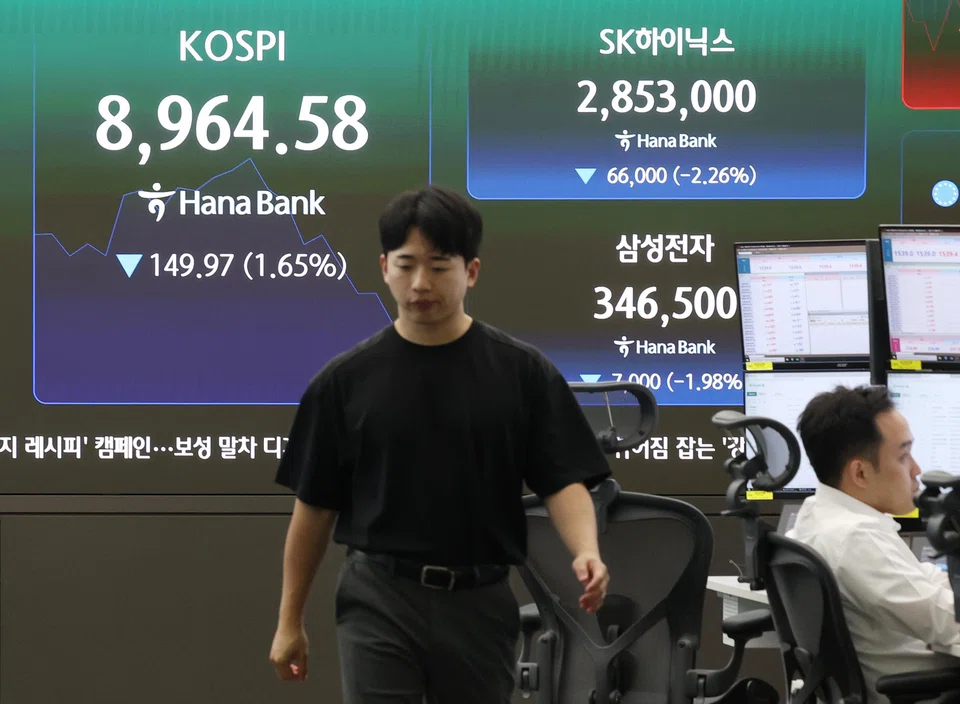
Asian stocks fell sharply on Tuesday as investors rotated out of some of this year’s best-performing technology shares. MSCI’s gauge of regional equities declined more than 2 per cent after closing at a record high.
The drop was particularly stark in South Korea, where the Kospi plunged over 6 per cent before rebounding more than 4 per cent on Wednesday morning.
However, the rebound in the Kospi, and Asian stocks as a whole, lost momentum as losses in chipmaker Taiwan Semiconductor Manufacturing Company weighed on the market.
SEE ALSO



This caused the MSCI Asia-Pacific Index to inch lower after rising nearly 1 per cent. The Kospi also briefly dipped in an intra-day fall.
The rout in South Korean semiconductor stocks was driven by concerns around overly sharp price gains over a short period, technical selling and profit-taking, explained Carmen Lee, OCBC’s head of equity research.
“Underlying fundamentals remain sound, which explains the rebound observed (on Wednesday),” she said.
Lorraine Tan, Morningstar’s director of equity research, noted that the recent sell-off came after AI optimism-led gains in April and May. Stocks had soared globally due to “some positive earnings results and relatively decent outlook guidance”.
“Our view is that the growth in chip prices will start to taper off as supply from added capacity comes on stream in 2028,” she added.
"We think the share sales seen in the past two days, to some extent, show a cooling off by investors given that chip company share prices were priced for perfection.”
Why are Singapore tech stocks resilient?
Market experts point to three main reasons local tech shares have avoided the worst of the global tech rout.
The first is a lower level of exposure to the more crowded AI and semiconductor trades that are now being unwound in other markets, said Singapore Exchange (SGX) market strategist Geoff Howie.
OCBC’s Lee agreed, pointing out that most tech stocks in Singapore are not directly involved in the overheated segments of the semiconductor industry and, as a result, did not experience the same outsized, hype-driven gains in the first place.
Because local tech stocks did not surge purely on AI hype, their valuations are also grounded in tangible business metrics.
“Locally, the sector’s recent performance has been more underpinned by earnings delivery, order book visibility and execution, rather than purely valuation expansion,” Lee added.
RHB’s Yeo noted that Frencken and UMS mainly supply components or modules to front-end equipment manufacturers that support the semiconductor supply chain and are not directly exposed.
“Singapore tech stocks are also generally trading at cheaper valuations and have a more diversified earnings base, making them less sensitive to shifts in AI sentiment and valuation-driven corrections,” he said.
Beyond that, Singapore’s domestic macroeconomic environment has also provided a sturdy foundation, noted SGX’s Howie.
The city-state’s core inflation, released on Tuesday, held at 1.4 per cent in May. This defied forecasts of an increase, with a median estimate of 1.6 per cent.
Furthermore, private-sector economists expect the Monetary Authority of Singapore to hold its monetary policy settings steady at its July meeting.
“(This) helps temper valuation pressures even as global yields stay elevated,” said Howie.
Decoding Asia newsletter: your guide to navigating Asia in a new global order. Sign up here to get Decoding Asia newsletter. Delivered to your inbox. Free.
Copyright SPH Media. All rights reserved.
TRENDING NOW

Government to bring forward raising of retirement age, give employers more financial support to create flexi-load jobs

If Europe goes to war, the fallout will be felt in East Asia

Indonesia stocks suffer worst plunge in nearly 30 years as MSCI proposes standalone status

Vietnam’s northern provinces, not Hanoi or Ho Chi Minh City, are powering near 10% GDP growth

