

Cost over climate: Most Asean firms scaling back decarbonisation plans as higher energy prices bite
Singapore has the most companies delaying sustainability strategies; Vietnam least affected by cost hikes

[SINGAPORE] Close to eight in 10 businesses in South-east Asia have been hit by higher energy costs since the Iran war began, with a similar proportion experiencing a squeeze on their profitability.
This has led to one in two companies in the region delaying decarbonisation and sustainability plans.
Despite these challenges, businesses remain committed to the low-carbon energy transition, opting to invest in productivity-led solutions to manage cost pressures, rather than relying on short-term measures.
Companies are also closely tracking progress on the Asean Power Grid (APG) – the effort to link up the region’s power systems for cross-border electricity trade – with a significant number indicating that meaningful progress would directly increase their willingness to invest in Asean.
Meanwhile, they continue to search for productivity gains, with most turning to artificial intelligence.
More than 60 per cent of companies have increased their investments in AI, with a higher proportion believing that the benefits would outweigh the technology’s energy burden.
'%3e%3cpath%20d='M12.1475%2025.5262C13.7713%2025.4295%2014.94%2023.913%2014.94%2021.8832C14.94%2019.5359%2013.474%2018.093%2011.5917%2018.093C11.3745%2018.093%2010.9582%2018.093%2010.8393%2018.1413V25.2086L11.8891%2025.5745C11.8891%2025.5745%2012.207%2025.5262%2012.1475%2025.5262ZM11.4934%2017.6281C13.2567%2017.6281%2014.3843%2016.4292%2014.3843%2014.4501C14.3843%2012.372%2013.275%2011.2973%2011.4339%2011.2973H10.8393V17.6305H11.4934V17.6281ZM6.66078%2025.6482L7.39265%2025.5492C8.02617%2025.4502%208.26403%2025.3053%208.26403%2025.1097V11.6149C8.26403%2011.4193%208.1451%2011.3709%207.23484%2011.249L6.68137%2011.173L6.6219%2010.7588H11.9508C15.7153%2010.7588%2017.0624%2012.0797%2017.0624%2014.1578C17.0624%2015.9666%2015.7748%2017.1909%2013.4969%2017.6305V17.7041C16.111%2017.948%2017.6571%2019.5382%2017.6571%2021.7636C17.6571%2024.3318%2015.8937%2026.0417%2012.1109%2026.0417H6.60132L6.66078%2025.6482Z'%20fill='%232B2B2B'/%3e%3cpath%20d='M20.6287%2025.6505L21.5596%2025.5515C22.1725%2025.4779%2022.4104%2025.3076%2022.4104%2025.112V11.249H21.9346C20.073%2011.3479%2018.982%2013.0095%2018.408%2014.6227L18.1907%2015.5018H17.6555L18.1701%2010.7588H29.3837L29.6421%2015.4787H29.1664L28.9491%2014.6227C28.3728%2012.8645%2027.3047%2011.2743%2025.5002%2011.249H24.9856V25.1856C24.9856%2025.3812%2025.1251%2025.4548%2025.9965%2025.5515L26.7695%2025.6505L26.829%2026.0417H20.5693L20.6287%2025.6505Z'%20fill='%232B2B2B'/%3e%3c/g%3e%3cdefs%3e%3cclipPath%20id='clip0_5242_21648'%3e%3crect%20width='24'%20height='16.8'%20fill='white'%20transform='translate(6%2010)'/%3e%3c/clipPath%3e%3c/defs%3e%3c/svg%3e)
These were some of the key findings from The Business Times Insights: Powering Asean’s Future 2026, which was launched on Monday (Oct 12). Working with market survey firm Kantar, The Business Times polled 514 corporates in the Asean-6 economies, comprising Indonesia, Malaysia, the Philippines, Singapore, Thailand and Vietnam.
Higher energy costs
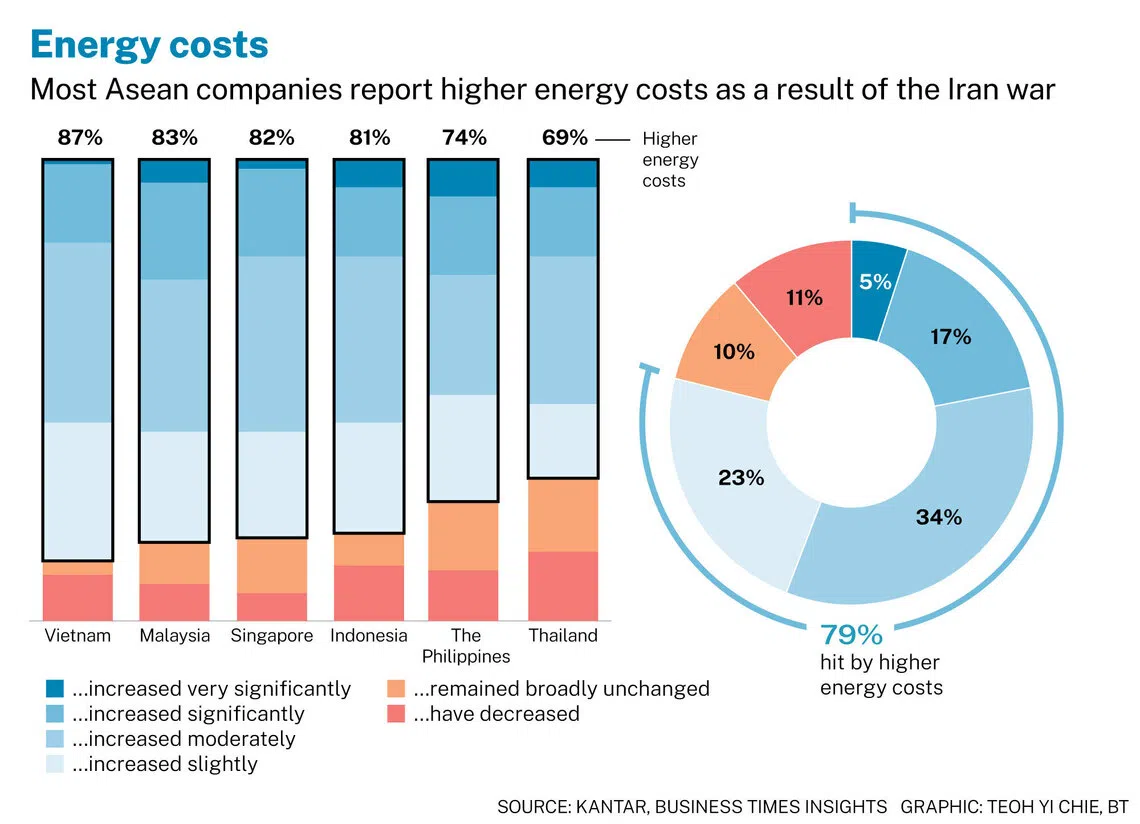
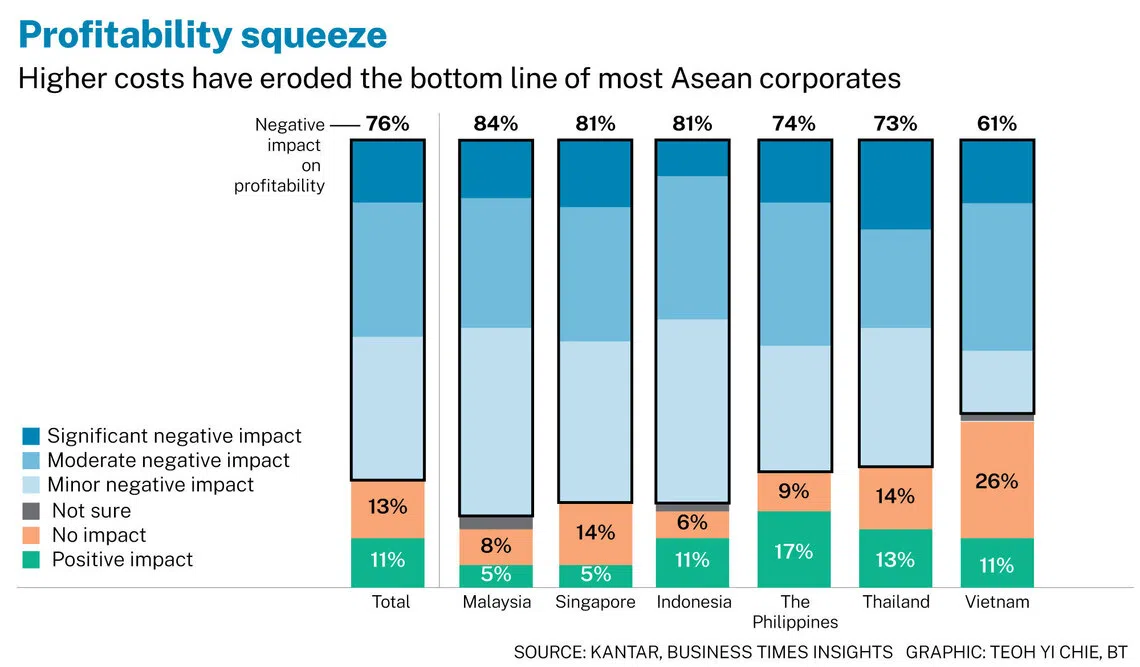
Businesses all around the region are hurting; 79 per cent of enterprises have experienced higher energy costs since the start of 2026, with 76 per cent reporting profit erosion as a result.
About one-third of respondents (34 per cent) reported that their energy costs increased moderately – between 10 and 29 per cent – while 23 per cent said it only went up less than 10 per cent.
SEE ALSO









Only 5 per cent reported a very significant hike – where energy costs had risen by more than 50 per cent – and 17 per cent experienced a significant increase of between 30 and 50 per cent.
One country that stood out was Vietnam. While 87 per cent of Vietnamese businesses reported elevated energy costs – higher than the regional average of 79 per cent and the highest across all six markets – only 61 per cent said this has had a negative impact on profitability, compared with the regional average of 76 per cent.
“More businesses are accelerating their procurement of solar and adding battery storage where the site allows it,” said Douglas Macfarlane, founder of clean energy development company VHALT.
“So while costs have gone up, businesses can respond on their own terms, whether that means investing themselves or working with renewable energy investors.”
To mitigate costs, 61 per cent of respondents are investing in energy efficiency, while 54 per cent are speeding up automation and adoption of AI.
These were also the top picks for respondents should high energy prices continue to persist over the long term, with 66 per cent planning to invest in energy-efficient technologies, and 62 per cent looking at accelerating automation and digitalisation.
The report noted that this “signals a clear strategic pivot across South-east Asia, from viewing energy as an operational expense to treating it as a critical enabler of competitiveness, expansion and business continuity”.
While there may be some relief from elevated prices as emergency oil reserves are released and alternative export routes are plied, OCBC ESG analyst Ong Shu Yi indicated that this does not mean a sustained normalisation of energy markets.
“The duration and trajectory of the Middle East conflict remains uncertain, while shipping and insurance costs continue to be elevated amid persistent security risks,” she added.
“The impacts of the war are likely to persist even after tensions ease, as the normalisation of energy markets could be gradual and uneven.”
Pullback on decarbonisation
In the light of existing profit pressures, only 9 per cent of Asean companies indicated that they prioritise decarbonisation and sustainability goals, while 38 per cent chose cost efficiency as their top business priority.
More than half (53 per cent) reported that their decarbonisations plans have been deprioritised or delayed, compared with 29 per cent that have sped up their efforts.
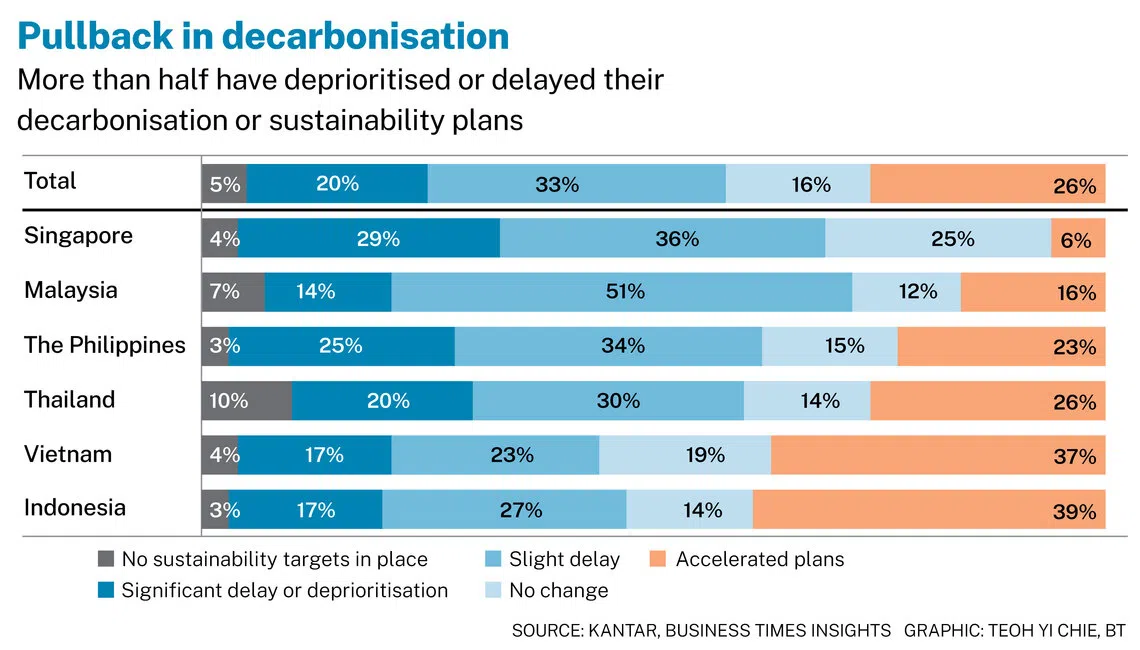
Among the Asean-6 markets, Singapore had the most companies reporting significant delays at 29 per cent, above the average of 20 per cent.
This is in contrast to 39 per cent of Indonesian companies and 37 per cent of Vietnamese companies which are accelerating their decarbonisation plans.
The results were similar when it came to energy efficiency, with Singapore companies making up the lowest proportion prioritising those upgrades compared with the other five markets.
Analysts believe this could be because Singapore companies are at a different stage in their energy efficiency and decarbonisation efforts.
Professor Johan Sulaeman, director of the Sustainable and Green Finance Institute at the National University of Singapore, said that the gains from earlier phases of energy efficiency upgrades or decarbonisation could have already been captured, making the next stage more challenging and costly.
OCBC’s Ong added: “Singapore companies could be reassessing the timing and pace of further capital-intensive decarbonisation investments, particularly amid elevated costs and a more uncertain operating environment.”
Alicia Chew, a consultant at Rystad Energy, also noted that Indonesia is not as far along in its sustainability journey and may still see low-cost and low-barrier opportunities to improve efficiency, attract investment and strengthen competitiveness.
As for Vietnam, the concentration of multinational corporations, which have enforced their sustainability targets through their supply chains, is putting commercial pressure on local suppliers to comply with externally imposed sustainability requirements.
This includes the EU’s carbon border adjustment mechanism, which places a carbon price on certain imported goods based on their carbon intensity.
While decarbonisation has taken a backseat for now, there remains a steady shift towards cleaner energy; 69 per cent of companies project that their energy mix will be greener over the next three to five years.
Among the various actions companies are taking, improving energy efficiency and reducing energy consumption were cited as the top priority at 41 per cent, followed by increasing the use of renewable energy sources at 20 per cent.
When selecting clean energy solutions, companies said they favour mature and scalable solutions, including on-site renewable generation such as rooftop solar (66 per cent), as well as renewable energy certificates or power purchase agreements (63 per cent).
Given the region’s high reliance on fossil fuels as an energy source, Asean companies rated greater access to renewable energy sources and procurement options (55 per cent) as the most important policy support they would like to receive.
This was even higher than tax incentives or grants for energy efficiency and decarbonisation initiatives, at 48 per cent.
This ties in with how the limited availability of clean energy options was cited as the most challenging barrier (48 per cent) faced by Asean companies in their energy transition journey.
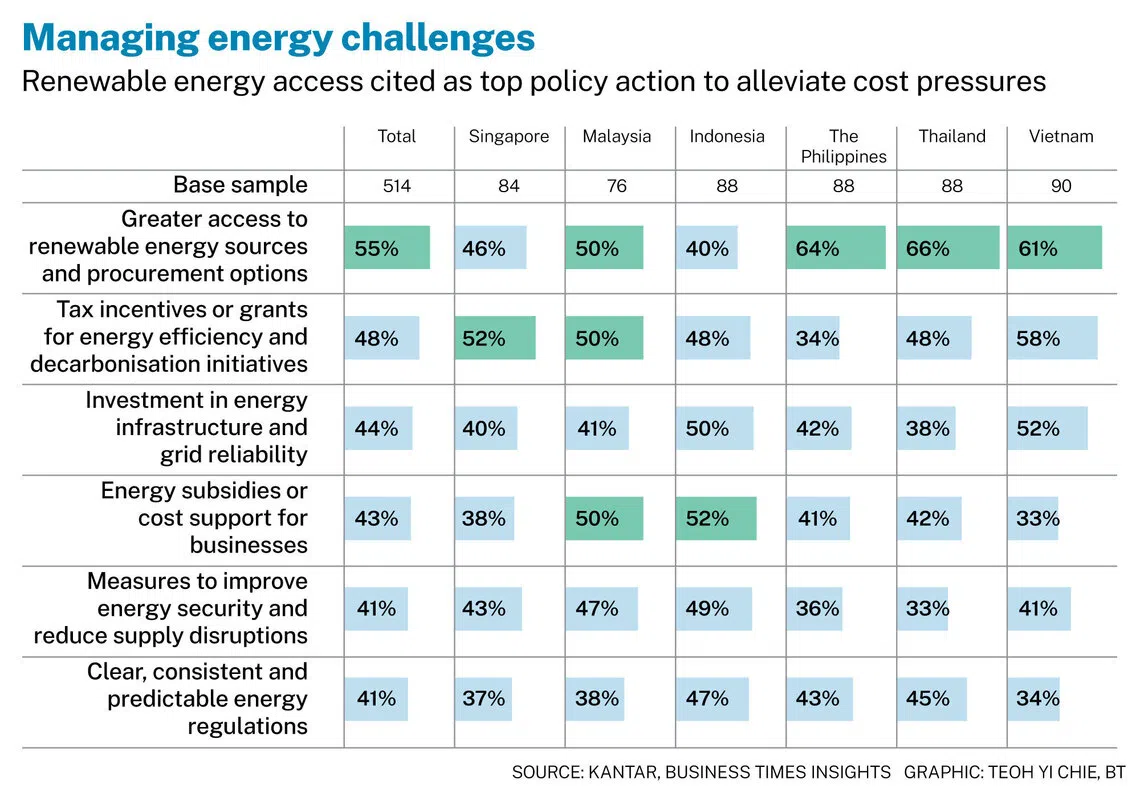
Prof Sulaeman said that this shows that businesses are looking for a more structural solution: more renewable energy supply, better grid infrastructure, stronger regional connectivity and the ability to obtain clean energy at commercially viable prices.
“A subsidy helps firms pay for the energy they are already using, but it does not fundamentally reduce their exposure to future fossil-fuel price shocks,” he said. “Better renewable access changes the energy they can use in the first place.”
Ong noted that this shift could also be facilitated with the growing cost-competitiveness of renewables.
“Businesses are recognising that financial support alone may not be sufficient to address their energy challenges,” she added.
“As renewables become more cost-competitive, businesses may value policies that provide greater access to renewable energy and procurement options. This can help them manage energy costs and volatility while supporting their energy transition.”
Despite headlines spotlighting the rollback in global climate action, ESG considerations remain embedded in the strategy and decision-making of 76 per cent of the companies surveyed.
Still, analysts warned that while Asean companies are increasingly treating energy security as part of their business strategy, the bigger constraint is whether the broader ecosystem can keep pace to meet their needs.
Stronger regional connectivity through the APG and a greater alignment of policies and market frameworks in the region that support renewable energy deployment and cross-border electricity trade are crucial, said Ong.
Prof Sulaeman said: “Ultimately, the challenge is not simply to decarbonise the energy system, but to expand it while decarbonising it, while also managing growing constraints on natural capital and resources.
“That means the transition has to be broader than energy alone; it has to improve how we use land, water and other natural resources, while supporting continued economic growth and business resilience.”
The Business Times Insights: Powering Asean’s Future 2026
Following the warm reception to our inaugural flagship study, Asean Intelligence 2026, The Business Times is proud to present our second regional report.
Commissioned by BT and executed by Kantar, this regional study provides a grounded examination of how South-east Asian enterprise decision-makers manage energy cost inflation, sustainability targets and digital acceleration.
The study was conducted in July and polled 514 corporates in the Asean-6 economies: Indonesia, Malaysia, the Philippines, Singapore, Thailand and Vietnam.
They are from diverse industries including manufacturing, energy and infrastructure, financial and professional services, logistics and transport, as well as technology and digital infrastructure.
They all identified as being business owners, C-suite executives and senior strategic decision-makers who lead or co-lead organisational decision-making regarding energy strategy, fuel sourcing, utility management, ESG or sustainability impact.
About 60 per cent of respondents are from large enterprises, and 40 per cent from small and medium-sized enterprises.
Decoding Asia newsletter: your guide to navigating Asia in a new global order. Sign up here to get Decoding Asia newsletter. Delivered to your inbox. Free.
Copyright SPH Media. All rights reserved.






