Indonesia, Philippines and Vietnam need $3.7 billion in development finance to meet climate targets: report
The report says the funds are for clean-energy solutions such as rooftop solar panels and offshore wind

[SINGAPORE] Indonesia, the Philippines and Vietnam will need US$3.7 billion in development finance by 2035 to fund four clean-energy solutions, so that they stay on track with their development and climate targets.
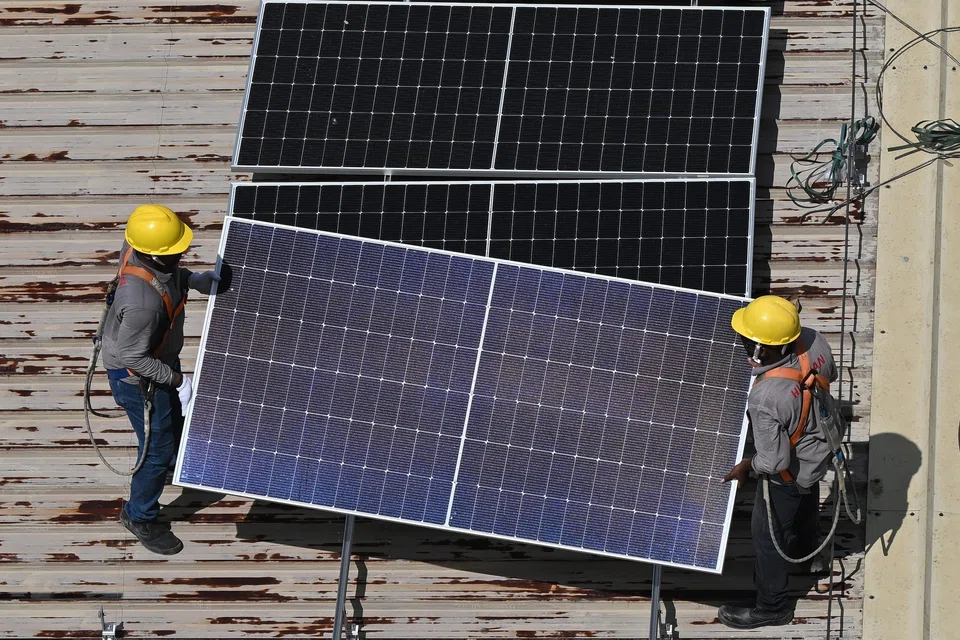
A recent report jointly prepared by blended finance organisation Convergence and the International Energy Agency identified the four solutions as rooftop solar, decentralised energy systems such as mini-grids, battery-energy storage systems and offshore wind.
The report, released at the Singapore International Energy Week (SIEW), focused on these four sectors because of their potential to mobilise commercial capital at scale through blended finance structures. These sectors also offer additional benefits, such as the delivery of electricity to communities that currently lack it.
Blended finance is a capital-raising approach that essentially relies on investors with higher risk appetites – multilateral development banks, development finance institutions, philanthropists and governments – to provide concessional or catalytic capital that reels in more commercial investors for projects that are not bankable, but are environmentally and socially important.
Because public finances from sovereign entities and multilateral development banks are involved, the funds cannot be used for projects that are already commercially bankable; they have to be used for projects that would not have happened without the use of concessional funding.
Blended finance has emerged as a key way to mobilise capital for climate projects that are not yet bankable, but have a pathway to commercial viability.

The report, factoring in the immense financing gap that emerging markets in South-east Asia are facing in meeting their energy transition goals, examines where this form of financing would be the most applicable and useful in the markets of Indonesia, the Philippines and Vietnam.
Indonesia
The report said opportunities for blended finance in this sprawling archipelago lie in rooftop solar and decentralised solutions.
This is because credit guarantees can reduce lender exposure to borrower or project-level risks, enabling longer tenors or lower collateral requirements for larger projects.
SEE ALSO





The report noted that the economics of decentralised solutions can be improved by aggregating small renewable energy projects in remote areas.
In addition to blended fund structures, portfolio guarantees and risk-sharing facilities with local financial institutions can expand lending to off-grid solar developers and operators while reducing lenders’ net loss exposure.
The Philippines
As the renewable energy market in the Philippines is already mature, there is a limited role for blended finance in this sector.
However, the report noted that it can play a larger role in decentralised solutions by aggregating smaller projects, as well as in battery-energy storage solutions.
Vietnam
In the case of Vietnam, the report said that blended finance can play a targeted role in rooftop solar projects in specific segments, such as for corporate offtakers. This is because the solar power market in Vietnam is quite mature.
As battery storage and offshore wind are nascent markets in the country, blended finance can play a more catalytic role in supporting early deployment and establishing scalable financing structures that improve lender familiarity with these technologies.
Elaborating on the report findings at a panel discussion at SIEW, Sharad Somani, partner and head of infrastructure for the Asia-Pacific at KPMG, said that his clients are a tad frustrated with the pace of renewable energy deployment in South-east Asia.
“We work quite extensively in the Middle East as well, and if you see the pipeline that happens in the Middle East, the way projects progress, (it’s been) quite seamless ...
“Over the last five years, I think we have done more than 6 gigawatts of renewables in the Middle East... I would say that what we’ve done in this region is not even a 10th of that.”
He said South-east Asia can accelerate the pace of renewable energy deployment by:
- Preparing extensively for projects;
- Prioritising a few critical ones; and
- Adopting a programmatic approach, such as by standardising contracts.
Also speaking at the panel was Tan Sue-Ern, head of the International Energy Agency regional cooperation centre in Singapore. Referring to incomplete regulatory frameworks, such as those for battery-energy storage solutions and offshore wind, she called for change.
Infrastructure gaps such as the lack of grid connection hold back the deployment and integration of renewable-energy assets. The lack of pipeline projects is another structural weakness, she added.
Decoding Asia newsletter: your guide to navigating Asia in a new global order. Sign up here to get Decoding Asia newsletter. Delivered to your inbox. Free.
Copyright SPH Media. All rights reserved.