

Singapore commits S$143 million to fund R&D for industrial decarbonisation
Initiative aims to increase the potential that companies’ solutions will be commercialised and deployed

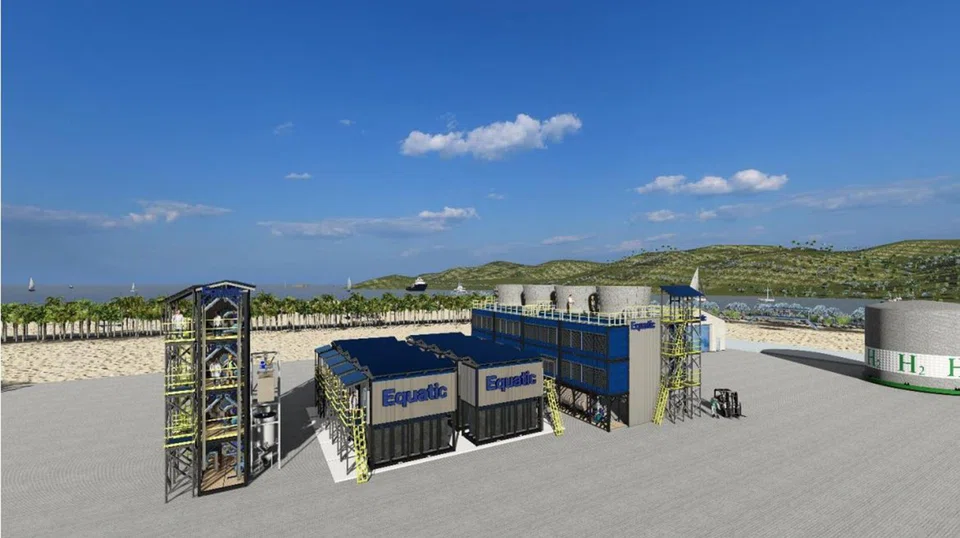
[SINGAPORE] The Republic will be deploying S$143 million to fund the R&D and commercialisation of low-carbon technologies that could support the decarbonisation of heavy industries.
This new funding initiative will focus on three areas of technologies:
- Carbon capture, which refers to solutions that can trap carbon dioxide emissions from industrial facilities before it is released into the atmosphere;
- carbon utilisation, which looks at how carbon dioxide can be converted into other products;
- and other emerging decarbonisation solutions, such as the electrification of industrial heating.
Out of this sum, S$100 million will be set aside for a new co-funding programme to encourage companies to initiate and design R&D projects, with the support of Singapore’s public research institutions, to address decarbonisation challenges in industries. Projects that qualify will receive funding from the government that covers up to 75 per cent of its costs.
By prioritising industry-led projects and involving companies directly in R&D, the initiative aims to increase the potential that their solutions will be commercialised and deployed.
The other S$43 million will be allocated to research institutes for the same purposes.
This new S$143 million scheme is Singapore’s largest single funding initiative dedicated to industrial decarbonisation R&D thus far.

It will be led by the Economic Development Board (EDB) and the Advanced Energy and Decarbonisation Office (AEDO), the decarbonisation arm of the Agency for Science, Technology and Research (A*Star), said both agencies on Friday (Oct 23).
Announcing the launch of this new funding initiative the same day, Deputy Prime Minister Gan Kim Yong said the transition of Singapore’s industries is essential for the city-state to achieve its climate goals. The country has set a target of achieving net-zero carbon emissions by 2050.
“Our industries account for around 65 per cent of our emissions, including emissions from the electricity they use. We cannot achieve net zero by 2050 without reducing these emissions significantly. But we must also keep these industries competitive while decarbonising them,” said DPM Gan.
SEE ALSO




“As we move towards a low-carbon future, we must help our industries make the transition successfully, so that they can continue growing and providing good jobs.”
However, emissions from energy-intensive activities remain difficult to reduce, while Singapore’s land and resource constraints limit the feasibility of deploying some solutions at scale, the agencies said. Targeted R&D is therefore needed to develop and adapt technologies suited to Singapore’s industrial needs and operating conditions, they added.
The new initiative is part of a larger S$800 million programme to support research and innovation in low-carbon technologies, announced earlier during this year’s Budget debate.
And this S$800 million programme is under the national Research, Innovation and Enterprise (RIE) 2030 strategy, which lays out Singapore’s master plan for research, science and technology for the five years between 2026 and 2030.
This new funding initiative builds on the previous Low-Carbon Energy Research (LCER) funding programmes, which were also schemes to support R&D in low-carbon technologies under the previous RIE 2025 master plan.
Scaling emerging technologies
A pipeline of promising technologies developed through this new funding initiative could be tested for subsequent scale-up through the Low-Carbon Technology Translational Testbed programme.
It is a S$62.5 million physical facility, which broke ground on Monday at Jurong Island, that will help companies test and scale emerging low-carbon technologies for industrial use.
Amogy, IHI and Metha8 are the first three companies selected to testbed their solutions at the facility, said EDB and A*Star in another media release.
Amogy is piloting a technology to develop hydrogen through ammonia at lower costs, while Metha8 is working on producing hydrogen though a methanol-reforming process. IHI is looking at catalyst technologies that can convert carbon dioxide to sustainable aviation fuel.
Separately, AEDO has awarded a total of S$65 million to five projects which delivered promising outcomes under the earlier LCER programme.
The five projects, which came out of partnerships between companies and research institutes, are:
- carbon capture and utilisation through metal-organic frameworks (National University of Singapore (NUS), Chevron and YTL PowerSeraya);
- hydrogen production through methane pyrolysis (NUS and PacificLight Power);
- carbon capture through incineration ash residue (A*Star and Cora Environment);
- carbon capture through the use of membranes (NUS);
- and carbon capture and utilisation via incineration fly ash-derived sorbent (Nanyang Technological University).
These research teams will receive follow-on funding to support the scale-up of their technologies under real-world industrial settings, said EDB and AEDO.
Partnerships
The two agencies also announced new partnerships with climate and clean energy investors that could provide global perspectives on emerging technologies and industry needs to inform Singapore’s R&D funding priorities.
The three new partners are venture capital firms Extantia and Main Sequence, as well as clean energy-focused non-profit entity RMI, formerly known as Rocky Mountain Institute.
This builds on ongoing collaborations with Bill Gates-founded investment firm Breakthrough Energy, energy investor Energy Impact Partners, EDB’s investment arm SG Growth Capital and state investor Temasek.
“These climate and clean energy investors and accelerators will avail their networks and recommend relevant companies to tap on Singapore’s decarbonisation initiatives. Promising companies can access opportunities for R&D support, develop capabilities around low-carbon technologies and scale potential solutions for eventual commercial deployment,” said EDB and AEDO.
Decoding Asia newsletter: your guide to navigating Asia in a new global order. Sign up here to get Decoding Asia newsletter. Delivered to your inbox. Free.
Copyright SPH Media. All rights reserved.
TRENDING NOW
Easy to rent out, hard to sell: Are buyers losing interest in Singapore’s one-bedroom condos?

GovTech retrenches another 38 staff in second round of layoffs
Stocks to watch: Seatrium, CapitaLand Investment, Keppel DC Reit, Suntec Reit, CLCT, TSH Resources

World’s largest offshore wind platform by Seatrium consortium on track to be completed by 2028

