Sustainability reporting largely adopted in Asia-Pacific, but gaps remain in disclosure quality and depth
Listed firms in Taiwan, South Korea and Singapore score the best in a new study by The Business Times


[SINGAPORE] The Asia-Pacific’s largest companies have mostly adopted sustainability reporting, although the quality and depth of their disclosures remain a challenge.
Among the biggest gaps are limited disclosures on board directors’ sustainability competencies and a lack of quantitative assessments showing how climate risks could impact balance sheets.
These findings are drawn from the inaugural Asia Pacific Sustainability Index (APSI), a new study by The Business Times and the National University of Singapore Business School’s Centre for Governance and Sustainability.
Launched on Monday (Nov 23), the index scores the sustainability reporting performance of the 50 largest listed companies by market capitalisation in each of 14 regional markets – for a total of 700 companies – against six dimensions.
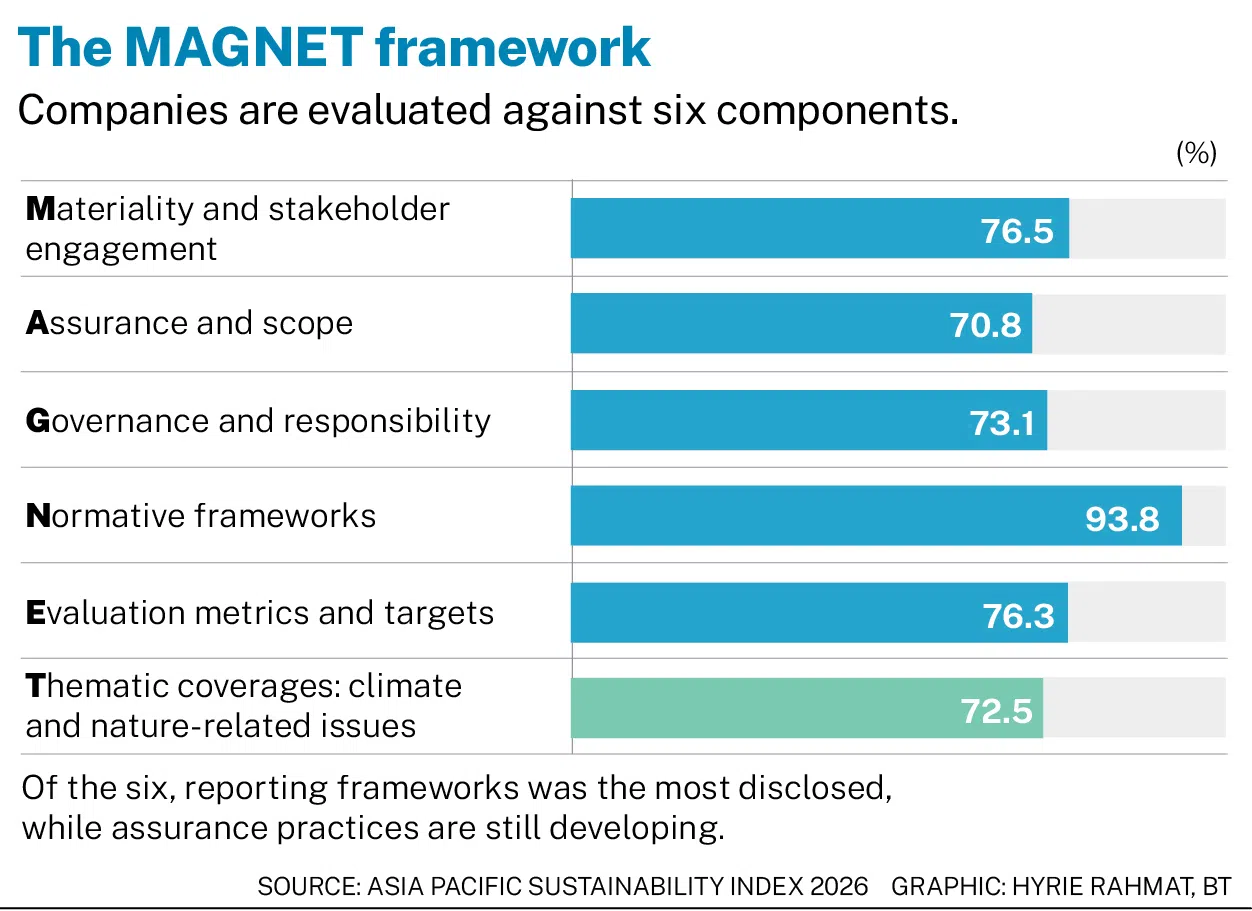
These dimensions, collectively known by the acronym “MAGNET”, are:
- Materiality and stakeholder engagement;
- Assurance and scope;
- Governance and responsibility;
- Normative frameworks;
- Evaluation metrics and targets; and
- Thematic coverages, particularly on climate and nature-related issues.
How the region performed
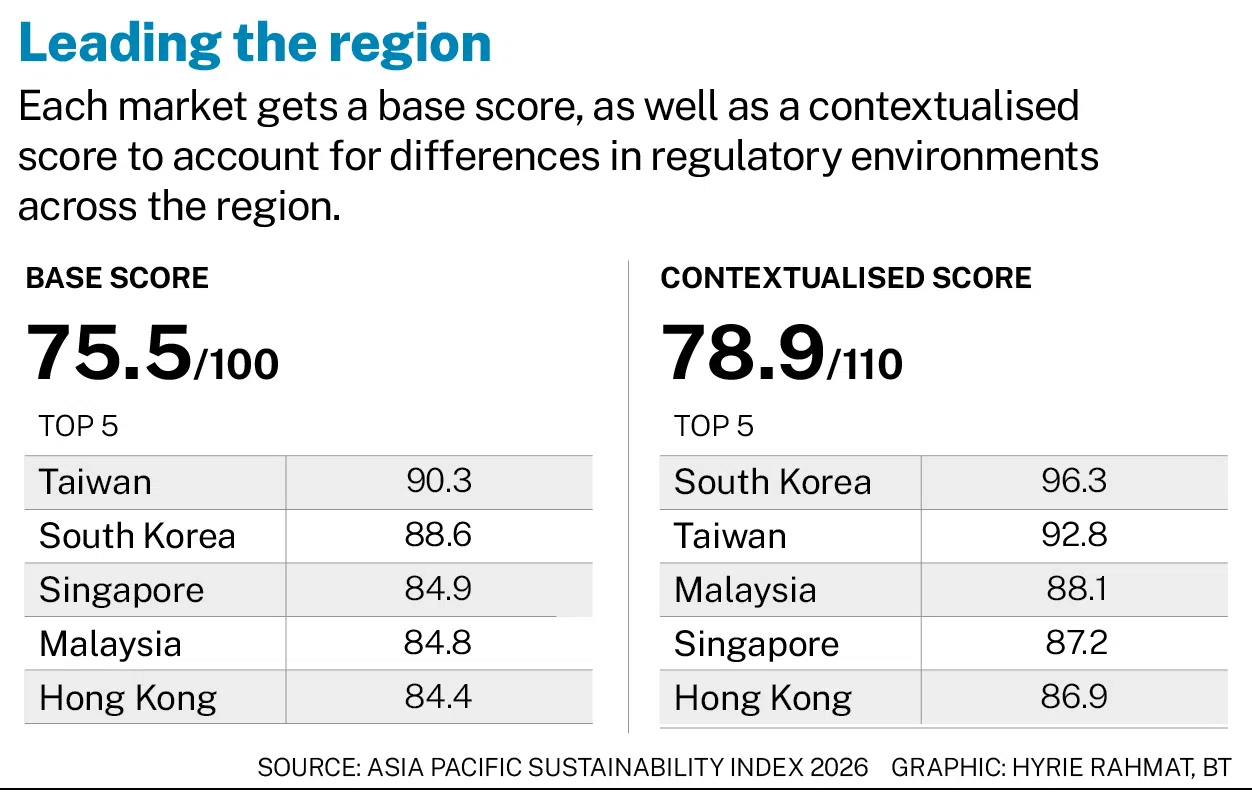
Sustainability reporting was found to be well-established among the Asia-Pacific’s top listed companies, which had a regional base score of 75.5 out of 100.

The top five markets are: Taiwan (90.3), South Korea (88.6), Singapore (84.9), Malaysia (84.8) and Hong Kong (84.4).
After adjusting for differences in regulatory environments and giving additional credit to companies that make sustainability disclosures despite operating under less demanding reporting requirements, the final score rises to 78.9 out of 110.
On an adjusted basis, the top five markets are: South Korea (96.3), Taiwan (92.8), Malaysia (88.1), Singapore (87.2) and Hong Kong (86.9).
SEE ALSO








Of the six components, disclosures on the reporting frameworks underpinning companies’ sustainability reporting were the most prevalent, at 93.8 per cent of the companies studied.
Among the various reporting frameworks currently in use, the standards developed by the International Sustainability Standards Board (ISSB) are increasingly regarded as a global baseline. They have also been incorporated into mandatory sustainability reporting requirements in several markets, including Singapore.
Assurance practices, ranging from internal reviews of companies’ own sustainability reports to external assurance conducted by third parties, were the least widespread of the six components, at 70.8 per cent.
Disclosures on climate and nature-related issues came in at 72.5 per cent, while sustainability governance scored 73.1 per cent, suggesting that reporting in these areas is relatively mature but with room to grow.
“The gap between the near-universal adoption of reporting frameworks and the lower scores across substantive disclosure areas suggests that adopting a recognised framework does not necessarily translate into comprehensive disclosure across all reporting dimensions,” read the report.
Climate-related disclosures
Large companies in the Asia-Pacific have established expertise in key areas of climate disclosures.
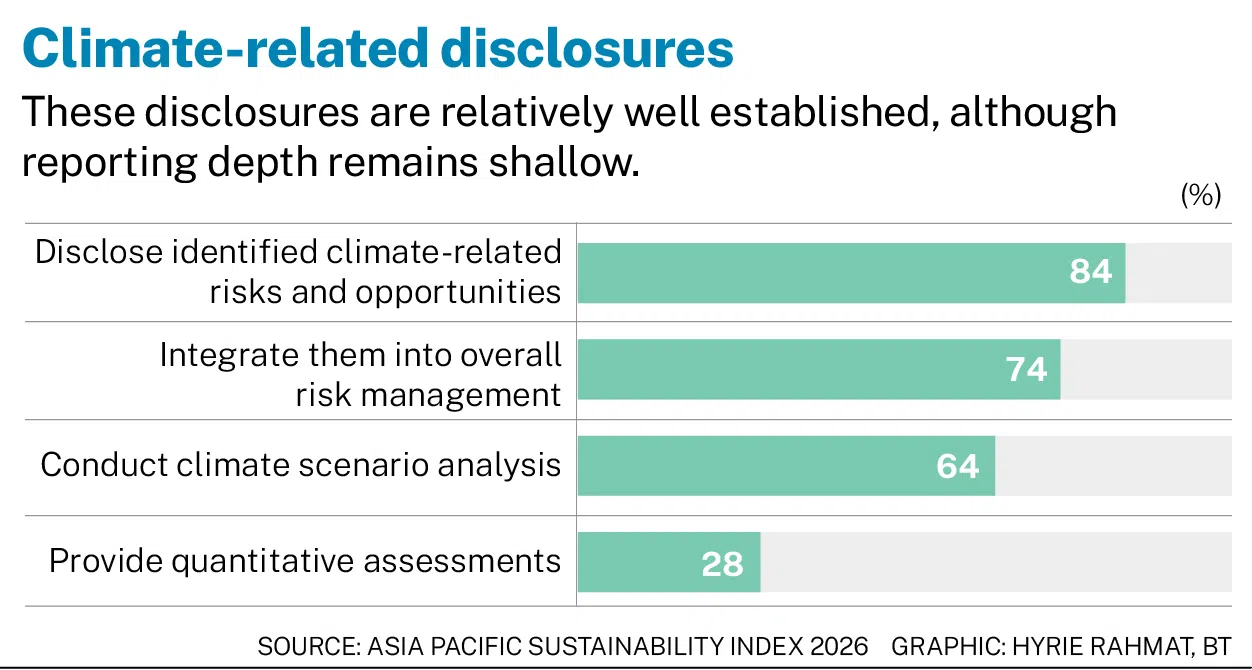
More than 80 per cent disclosed climate-related risks and opportunities, their impact on the business, as well as how it shapes their strategies.
Floods (59 per cent), followed by higher temperatures or droughts (57 per cent), were the most frequently identified physical risks.
Policy and legal risk (75 per cent), and market risk (71 per cent) were the two most-cited aspects of transition risks.
This reflects companies’ increasing exposure to evolving climate-related regulations and disclosure requirements, as well as growing awareness of shifts in customer demand, market conditions and the transition towards a lower-carbon economy.
There were also high rates of disclosure on climate-related risk management, with 79 per cent of companies reporting how they identify and assess climate-related risks, and 86 per cent explaining how these risks are managed.
Integrating climate-related risks into the company’s overall risk management, however, is less prevalent, at 74 per cent.
The widest gap in climate-related disclosures lies in quantitative assessments.
The study found that 64 per cent of companies conducted climate scenario analysis, and a smaller proportion of only 28 per cent provided quantitative assessments estimating financial or operational impact under different climate scenarios.
Sustainability professionals noted that quantitative analysis remains challenging.
The challenge often lies in translating climate pathways into company-specific financial implications, linking changing climate conditions to operational and financial drivers, said Quang Nhan, partner for climate change and sustainability services at EY.
“Companies may also face incomplete data, modelling limitations and inconsistent assumptions between scenario analysis and financial planning,” she added. “Methodologies for quantifying these effects continue to evolve.”
This is why it is still important to consider the risks and opportunities qualitatively, and what they mean for the organisation’s strategy and risk management, said Fang Eu-Lin, sustainability and climate change practice leader at PwC Singapore.
Quang added that companies should prioritise building internal capabilities progressively given these challenges.
“Hence, businesses should start progressively rather than wait for perfect data or sophisticated models, building scenario-analysis capability as their data, processes and understanding mature.”
Reporting of emissions arising from a company’s business activity (Scope 1), and its use of electricity (Scope 2) has become nearly universal.
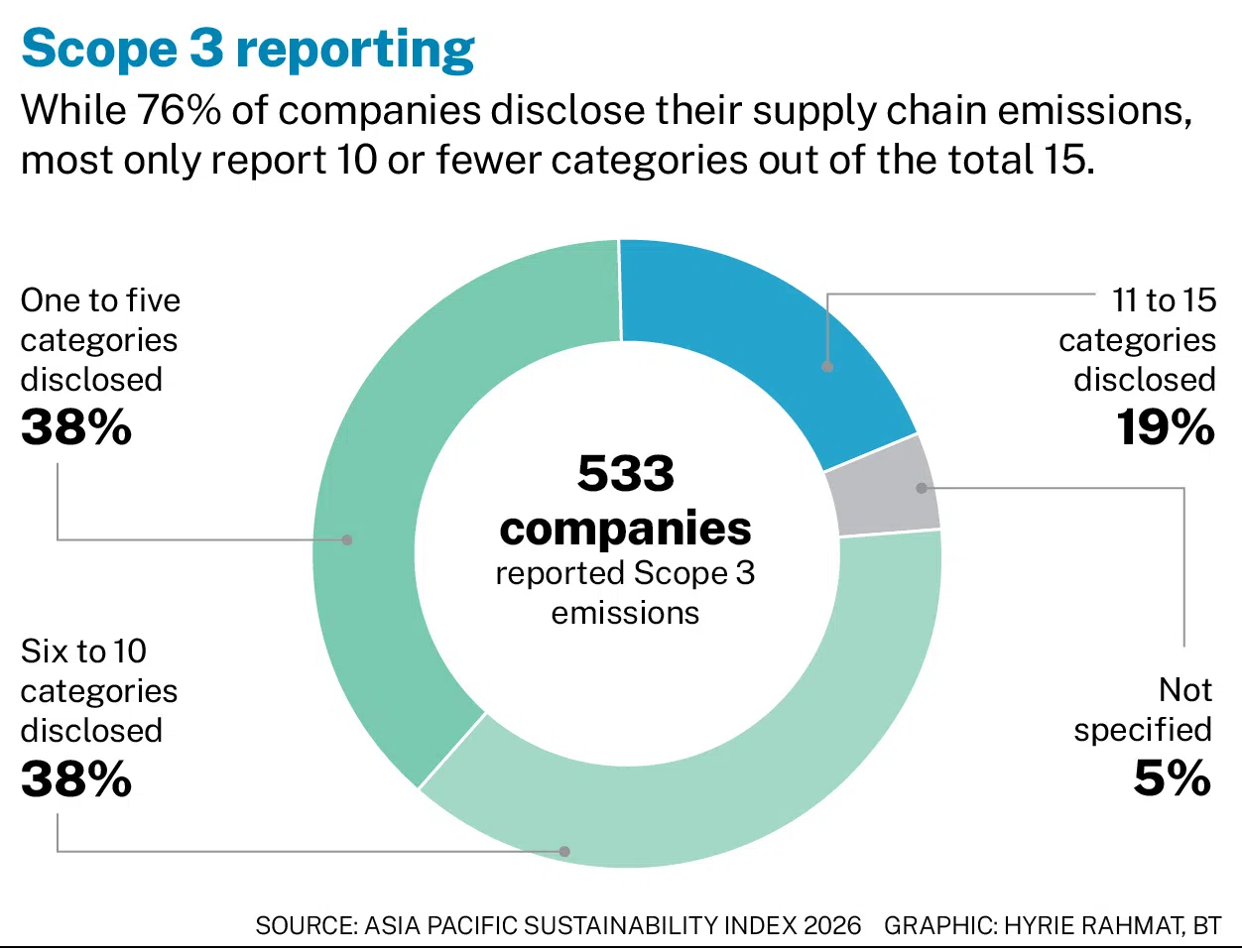
The disclosure of supply chain emissions, known as Scope 3, has also gone mainstream, with 76 per cent of companies reporting such emissions.
Among these companies, a majority disclosed 10 or fewer categories out of the total 15.
Only 19 per cent reported between 11 and 15 categories, leaving massive blind spots across upstream procurement and downstream product usage, the report showed.
Effective Scope 3 reporting does not necessarily mean reporting all 15 categories, noted Ken Ong, partner of assurance at EY.
“Rather, companies should systematically identify and assess relevant and significant emissions sources, apply appropriate estimation methods, and transparently explain data limitations and category exclusions in accordance with recognised standards,” he added.
“Without which, companies may underestimate both their value-chain footprint and the commercial implications concentrated in material emissions hotspots, including market access risks, capital access risks and operational risks.”
Sustainability governance
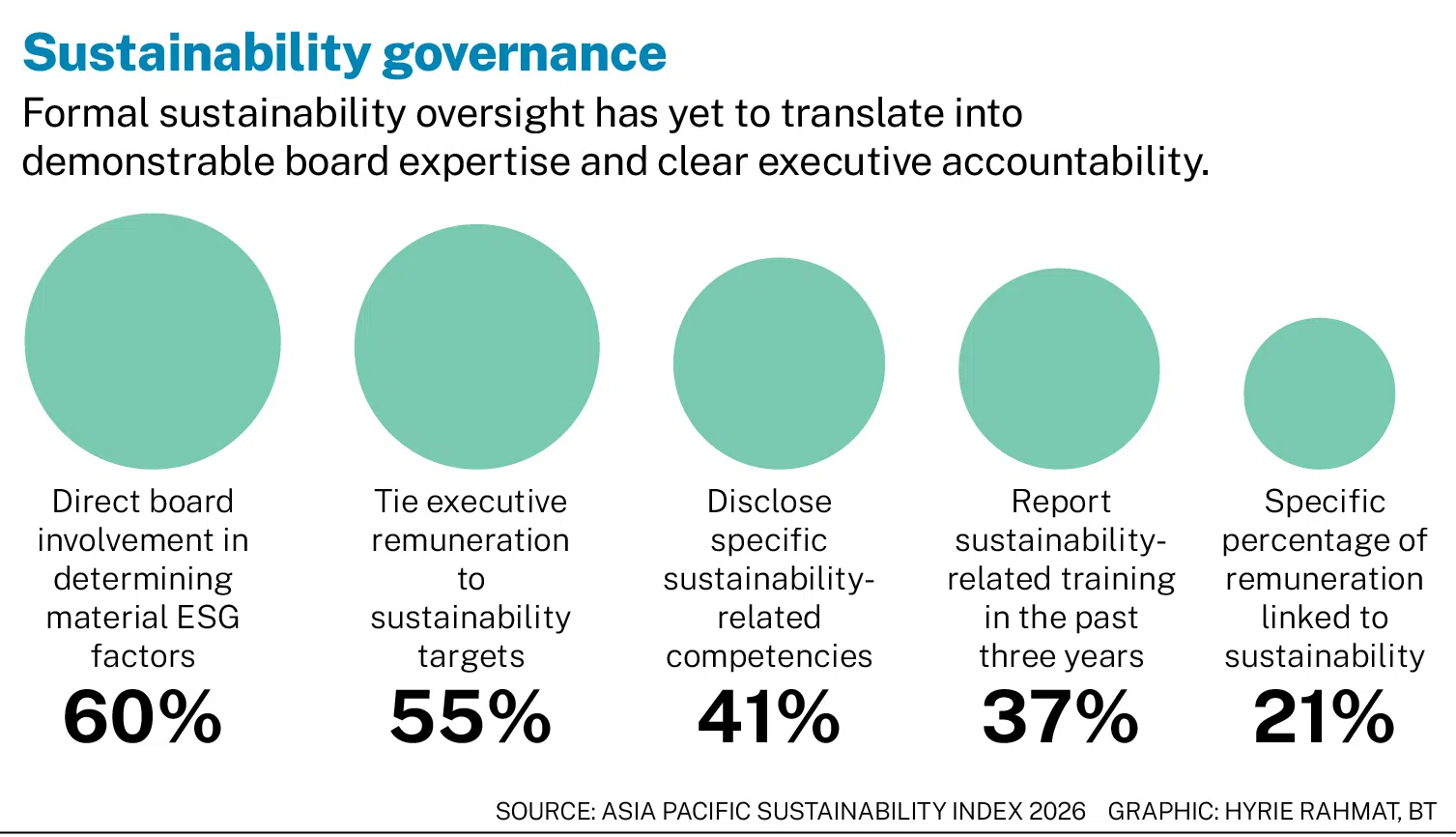
Companies across the Asia-Pacific have largely embedded sustainability into their governance structures, with 92 per cent disclosing formal board responsibility for sustainability, and 77 per cent having active board oversight.
However, disclosures on board capabilities are lacking.
Only 41 per cent of companies disclose whether their directors have specific sustainability-related competencies, and just 37 per cent report that their board members have undergone sustainability-related training in the past three years.
Executive compensation structures show a similar disconnect. Just over half of companies link executives’ remuneration to sustainability targets, and only 21 per cent specify the exact weighting of these metrics in compensation packages.
“Without clear visibility into compensation-linked metrics and director capabilities, stakeholders cannot determine whether sustainability commitments carry real board oversight and management accountability,” read the study.
Ong said that the gap is understandable given that companies are still relatively new in ISSB-aligned reporting.
“However, it’s increasingly an important gap to close,” he added. “Board accountability has risen quickly in response to listing rules, investor expectations and reporting requirements introduced by the International Financial Reporting Standards Sustainability Disclosure Standards.”
These standards raise expectations by requiring companies to explain how governance bodies assess whether they already have or need to develop appropriate skills and competencies.
“More transparent disclosure of how boards identify, evaluate and address capability gaps – through board composition, allocation of responsibilities and targeted training – would provide stronger evidence that governance structures are translating into effective oversight,” said Ong.
Nature-related disclosures
The study also found that nature-related disclosures are gaining traction, with 61 per cent of companies reporting nature or biodiversity-related data.
While climate-related disclosure standards have evolved over the years, standards for nature-related disclosures remain nascent.
The most widely recognised framework in this area are the recommendations developed by the Taskforce on Nature-related Financial Disclosures (TNFD). Alignment with the recommendations stood at only 24 per cent, the study showed, with another 3 per cent of companies planning adoption.
Given that ISSB is drawing on the TNFD recommendations to expand on its current standards to include nature-related disclosures, the report’s authors flagged that companies should start strengthening their capabilities to identify and assess nature-related dependencies, impacts, risks and opportunities across their operations and value chains.
The Business Times Insights: Asia Pacific Sustainability Index 2026
Published by The Business Times and NUS Business School’s Centre for Governance and Sustainability, the Asia Pacific Sustainability Index (APSI) benchmarks corporate reporting across the region.
Using annual and sustainability reports, it evaluates 700 listed companies – the 50 biggest in each of 14 Asia-Pacific jurisdictions – spanning 11 sectors, including finance, energy, utilities and consumer staples.
Comparing disclosures across markets with different compliance rules is tough for investors and executives. To solve this, APSI uses a contextualised methodology, the MAGNET framework, through which it determines a base score, then applies a context factor for local regulations, separating actual disclosure quality from its jurisdiction-wide mandates.
For more insights, visit bt.sg/apsi.
Decoding Asia newsletter: your guide to navigating Asia in a new global order. Sign up here to get Decoding Asia newsletter. Delivered to your inbox. Free.
Copyright SPH Media. All rights reserved.