

Issue 128: Trend reversal on ESG-linked pay; COP29’s shortfall leads us back to private capital

This week in ESG: Singapore’s top companies curb disclosure on ESG pay; fallout from climate summit’s underwhelming climate fund
Corporate governance
Going mute on ESG KPIs
Note: ESG Insights will take a break on Dec 20 and return on Jan 3.
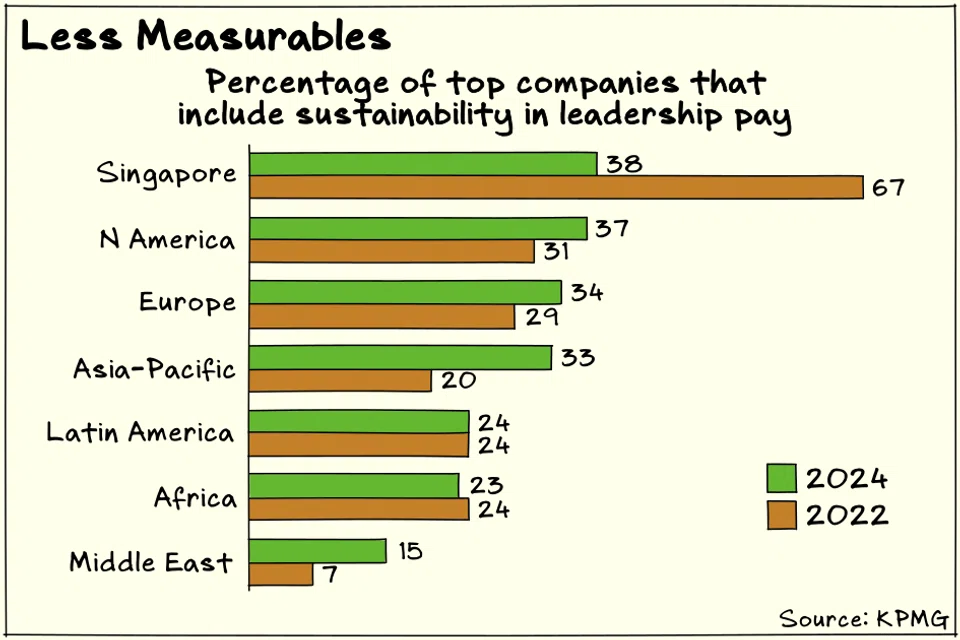
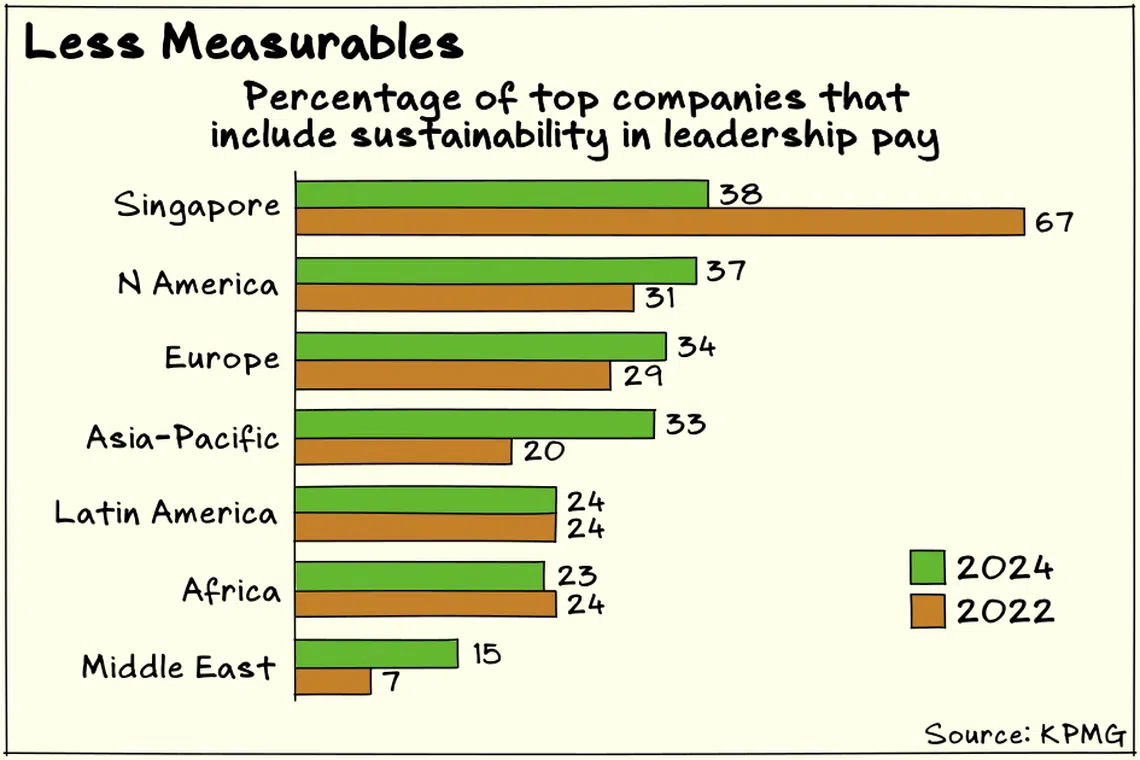
One of the more interesting findings from KPMG’s Survey of Sustainability Reporting 2024 report is the sharp drop in sustainability-based compensation among Singapore’s top companies.
The previous survey in 2022 found that 67 of Singapore’s 100 top companies included sustainability within leadership compensation, which was significantly above the 24 per cent global average at the time. In the 2024 survey, Singapore’s sustainability compensation adoption rate had a serious case of reversion to the mean, falling to just 38 per cent while the global average increased to 30 per cent.
KPMG determines the top 100 companies based on recognised national sources or, in the absence of such sources, by market capitalisation or a similar measure. The companies can be listed, state-sector, private or family-owned.
KPMG in Singapore’s ESG consulting partner Cherine Fok suggested that companies may not be disclosing their sustainability-related compensation policies as a response to changes in disclosure rules.
“The slight dip in companies tying sustainability to pay may reflect boards exercising caution around disclosure, particularly as climate-linked remuneration becomes a disclosure requirement under the ISSB framework, prompting strategic recalibrations,” she said.
It’s possible that companies are strategically keeping mum before the new international accounting standards kick in. Having invested resources to develop key performance indicators for sustainability, companies are unlikely to ditch those indicators without good reason. It’s more likely the case that companies may be doing it, but just aren’t talking about it.
In any case, the new reporting standards present an opportunity for companies to reassess how they incentivise sustainability performance among leadership. The way that sustainability is measured and rewarded is still a relatively nascent field, and policies created just a few years ago might need to be updated or fixed.
One of the major issues to be addressed is the inherent tension between what shareholders want and what the companies’ other stakeholders want.
Current research, including a literature review and an international study, suggests that sustainability-related compensation is positively correlated with a company’s sustainability performance. However, tying leadership compensation to sustainability outcomes does not appear to improve financial performance.
Such a situation could lead to perverse outcomes. As some legal scholars have pointed out, company leadership could seek to hit their sustainability targets in form but not in substance. For example, a chief executive could meet emissions targets by selling carbon-intensive assets to private buyers that sell back the same products and services to the company.
When sustainability outcomes don’t align with financial performance, company leadership will eventually be called to choose between stakeholder groups. Shareholder interests still carry the most weight in most compensation packages, not just in terms of key performance indicators, but also in the use of share-based compensation and the simple fact that only shareholders get to vote on nomination and remuneration decisions. When forced to choose, boards and executives usually side with shareholders.
The misalignment between sustainability outcomes and financial performance isn’t entirely a problem that companies can solve on their own. For a start, a substantial proportion of shareholders still have relatively short horizons, and the positive financial impact and risk mitigation of sustainability performance tend to operate on longer time scales.
Furthermore, government policy plays a huge role in shaping the playing field, and the lumbering pace of climate action policy in many of the world’s largest economies makes it difficult for many companies to decarbonise quickly without impinging on their competitiveness.
Another issue with sustainability-related compensation is a lack of transparency about sustainability-related performance indicators, which means that companies could set performance goals that are too easy to achieve.
One argument against sustainability-related compensation is that sustainability goals are inherently not in shareholders’ interests. However, this argument may not hold water when the sustainability outcomes concern planetary goals such as climate or biodiversity. Shareholders looking for dividends this year may not think global warming matters to their businesses, but stranded assets, supply chain disruptions and extreme weather damages aren’t good for business.
The fact is that shareholders with longer-term horizons exist and are not a negligible constituent. A study by shareholder proxy advisory firm International Shareholder Services (ISS) found that the number of environmental and social proposals by shareholders at US-listed companies increased over the decade between 2014 and 2024.
Although support for these proposals plunged in 2022 and 2023, ISS argued that the declining support doesn’t reflect a lack of support for sustainability issues since companies have shown progress in these areas with improved environment management programmes, advanced climate disclosures and improved social disclosures and programmes. Instead, ISS saw the drop in support as a sign that shareholder proponents have faced a tougher time amid that progress to demonstrate significant gaps in companies’ programmes and therefore generate broad support.
To keep shareholder activists at bay, companies will need to continue showing progress.
Strengthening long-term incentives will help. So too will strengthening company boards with directors who have appropriate expertise in material sustainability issues.
Companies also need to increase transparency about key performance indicators, as well as expose performance against those indicators to scrutiny and assurance.
It’s better to save sustainability-related compensation than to ditch it.
COP29
Back to the private pool
An underwhelming outcome from the recent United Nations climate summit in Azerbaijan, also known as COP29, has sent climate advocates in South-east Asia back to a familiar place: Seeking private capital.
Climate negotiators at the annual summit agreed on a pledge by developed nations to provide US$300 billion annually to fund climate action in developing countries. The amount was far short of the US$1.3 billion that scientists had estimated would be required to finance sufficient action to avoid catastrophic global warming.
Given the limits of public finance in less wealthy countries, private capital is seen as a critical piece in helping to plug the US$1 trillion annual shortfall.
Unfortunately, private capital remains far short of those targets. A report by Bain & Co, GenZero, Standard Chartered and Temasek estimates that South-east Asia needs more than US$210 billion of investment per year until 2030 – or US$1.5 trillion in total – to meet the region’s 2030 targets. Since 2021, only about US$45 billion has been put to work for dedicated green investments.
Blended finance has received considerable attention as a way to catalyse private capital for climate action, especially given its potential to finance as-yet unbankable projects that are on the verge of commercial feasibility.
While climate blended finance volumes have certainly grown, absolute quantums remain small, especially when placed against the massive funding gap. Data by blended finance think tank Convergence showed just US$18.3 billion of climate blended finance deals in 2023 worldwide.
One of the limitations of blended finance is that the concessional capital on which blended deals are built is necessarily picky. Blended projects therefore need to meet conditions such as additionality criteria to ensure the project cannot be funded otherwise. Not every project ticks those boxes.
Beyond blended finance, there’s also increasing importance for policymakers in South-east Asia to step up to the plate.
The most effective way to get private capital commitments is to provide a supportive policy environment.
Some of the policy measures required are relatively straightforward and often requested. For example, countries need to stop providing fossil fuel subsidies and shift that fiscal impulse towards renewables. It’s counterproductive to make decarbonisation pledges on one hand and continue to keep greener fuels uncompetitive against fossil fuels on the other.
Private investors also need to be confident that their investments will not go sour over the longer time periods required for many infrastructure-related investments. Governments can meet that need with robust long-term commitments and fast-tracked approval processes.
Other ESG reads
- Temasek among cornerstone investors for LeapFrog’s latest fund
- COP29 shows South-east Asia’s energy transition needs private finance; effective policies will catalyse that
- Indonesia’s renewable capacity targets not enough to meet new net-zero aim: report
- Indonesia must shut coal plants every year to hit climate goal
- Countries fail to reach agreement in UN plastic talks
- Plastics failure is a canary in the climate coalmine






