

Issue 131: Deadline year for sustainability-linked bond issuers; Singapore awards hydrogen-enabled gas plant

This week in ESG: Sustainability performance tests loom for Singapore issuers; PacificLight Power to build S$1 billion plant
Sustainable finance
Singapore SLB issuers on target
Singapore’s sustainability-linked bond (SLB) market in 2025 is likely to pass its first major test in 2025.
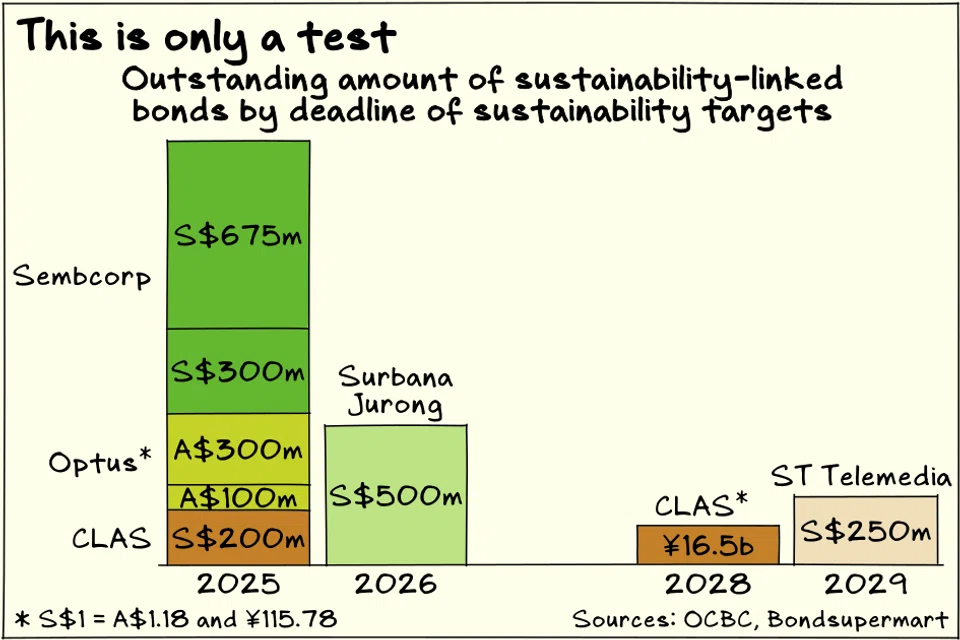
Singtel’s Australian subsidiary Optus, Sembcorp Industries and Capitaland Ascott Trust (CLAS) must meet sustainability targets this year, or they will have to pay a higher interest on their SLBs. Fortunately for those three companies, their latest emissions reports suggest that they are on track to meet those goals or have already reached them.
The first half of the 2020s has been a boom period for sustainable finance around the world, with an explosion of fundraising and innovation. One of those somewhat recent innovations is the SLB.
Earlier forms of sustainable finance constrained the use of bond proceeds in order to qualify for green, social or sustainability labels. For example, a bond used to finance the building of a solar farm can be labelled green, but not one used for general corporate purposes.
But those constraints also prevented climate-focused capital from helping to lower emissions for “brown” companies since decarbonising an entity doesn’t always fit into neat bond-friendly projects. Then came SLBs, which vary their coupon depending on whether the issuer hits sustainability performance targets. For example, a company that fails to reduce emissions quickly enough might have to pay an additional 25 basis points in interest on its sustainability-linked bonds. With such a structure, it didn’t matter if the bond proceeds were earmarked for general corporate purposes.
The potential for sustainable finance to incentivise any company willing to commit to emissions targets was exciting. Italy’s Enel started the ball rolling with the world’s first SLB in 2019, and others quickly followed.
A number of Singapore companies or their subsidiaries were among the early adopters. In 2021, Sembcorp, Surbana Jurong, Nanyang Technological University (NTU) and Optus issued sustainability-linked bonds. In 2022, CapitaLand Ascott Trust came to market twice, and Sembcorp returned for another offering. A year later, Optus came back, and in 2024 ST Telemedia and Sabana Industrial Reit had their turns.
This year, the SLBs of Optus, Sembcorp and CapitaLand Ascott Trust will be the first of those to face the deadlines – or “observation dates” – for their targets. The good news is that they will probably pass.
The first on the hot seat is Australian telco Optus, which has A$300 million of 2.6 per cent SLBs due 2028 and A$100 million of 4.577 per cent SLBs due 2028 for a total of S$400 million of notes at risk. To avoid paying an additional 25 basis points (bps) on those bonds, Optus must reduce its Scope 1 and Scope 2 emissions by at least 25 per cent from 2015 levels by fiscal 2025, which ends in March. As at end-March 2024, Optus had reduced emissions by 18.7 per cent. That’s still a gap of 6.3 percentage points, but the reduction grew 8.8 percentage points from 9.9 per cent in FY23, so it should clear the target if it can maintain the same pace.
Scope 1 emissions are directly generated by a company, while Scope 2 emissions are indirectly generated by the energy that the company purchases.
Sembcorp’s and CapitaLand Ascott Trust’s observation dates are on the last day of 2025, but both companies have already reached their targets.
Energy and urban solutions provider Sembcorp, which has S$300 million of 3.735 per cent SLBs due 2029 and S$675 million of 2.66 per cent SLBs due 2032, must reduce Scope 1 and 2 emissions intensity to 0.40 tonnes of carbon dioxide equivalent per megawatt hour (tCO2e/MWh) this year or pay 25 bps of additional interest on those bonds. Sembcorp is already safe, reporting 0.29 tCO2e/MWh intensity in 2023, a level achieved after the company sold its stake in an Indian operator of coal-fired power plants.
CapitaLand Ascott Trust, a lodging real estate investment trust, has S$200 million of 3.63 per cent SLBs due 2027. At least half of the trust’s properties’ gross floor area must be certified green by this year, or the trust will have to pay an additional 0.25 per cent of the principal amount to bondholders at maturity. As at May 2024, 51 per cent of the Trust’s gross floor area was certified green. As long as the trust doesn’t have a major acquisition of non-green properties or a major sale of some green properties in the coming months, it should be safe.
While the success of those companies in hitting their performance targets is positive news for their shareholders, it might not be enough to revive the overall SLB market.
As OCBC credit analysts Andrew Wong and Ong Shu Yi recently observed, SLB issuance is in the midst of a multi-year decline. The reason? Investors are uncomfortable with them.
SLBs face three major problems.
The first is a lack of consistency around performance targets. The Climate Bonds Initiative reckons that more than 80 per cent of SLBs are not aligned with global climate goals. Without more rigour, it’s hard to tell if a company’s achievement of its targets is due to genuine progress or a lack of ambition in target-setting.
The second problem is that the penalty for missing targets is often too little to make a difference. Researchers at the Anthropocene Fixed Income Institute, a sustainable finance think tank, advocate rewarding companies that commit to more ambitious targets.
Furthermore, the typical SLB structure rewards investors with higher interest payments when companies fail to meet their targets, which can create perverse incentive structures. In other words, bondholders might be rooting for the issuers to miss their targets.
If those were the only major problems, sustainability-linked loans would also be unpopular, but that has actually remained a relatively active area in sustainable finance. What sets the loans and bonds apart – and is the third problem for SLBs – is that the bonds’ targets are more easily found by the public than those of the loans. This opens the bonds to public scrutiny, putting issuers and investors at higher risk of allegations of greenwashing.
Specialists at the World Bank and its International Finance Corp have suggested that targets should be science-based. They also recommend that SLBs use step-downs instead of step-ups. By lowering coupon payments when companies hit their targets instead of raising them for misses, SLBs would confer a benefit only when sufficient progress is made by the borrower.
It’s definitely a rough patch for SLBs, but the sustainable finance industry has yet to come up with a better way to finance decarbonisation at an entity level. As the World Bank specialists say, “it’s too early to write off” the SLB market.
Energy transition
Priming the plants for hydrogen
Singapore has awarded PacificLight Power a contract to build, own and operate a hydrogen-ready combined cycle gas turbine (CCGT) on Jurong Island.
The total cost over three years is estimated at S$1 billion, while the expected generation capacity will be at least 600 megawatts.
This project reflects Singapore’s approach to its energy transition, which is to continue leaning on natural gas while exploring and setting up options for more sustainable alternatives.
CCGT plants have existed for a while. Fuel is burnt in a gas turbine, then the waste heat from the gas turbine exhaust is used to power the steam turbine to generate additional electricity. A PacificLight Power spokesperson said that the efficiency of its existing 830 MW plant on Jurong Island is more than 60 per cent.
Making the new plant hydrogen-ready does not significantly impact building costs. In a hydrogen-ready CCGT plant, the gas turbine either uses a natural gas-hydrogen blend or hydrogen as a primary fuel. The new plant will initially be able to use a blend with 30 per cent hydrogen, but modifications to the fuel handling and combustion system will be needed to use 100 per cent hydrogen, the spokesperson said.
The project is expected to be the first CCGT plant in Singapore to be integrated with a large-scale battery-energy storage system (BESS).
PacificLight Power, a joint venture between Hong Kong’s First Pacific and the Philippines’ Meralco PowerGen Corp, is also developing a 600 MW solar and BESS project with Medco Power Global and Gallant Venture to import renewable energy from Indonesia to Singapore.
Other ESG reads
- Trump is China’s chance to be world’s climate leader
- EU warns of ‘serious blow’ from Trump on climate change
- Power consumption growth to boost renewables and LNG sectors in 2025
- A new electricity supercycle is under way
- McDonald’s rolls back some diversity practices in head office
- Here’s why I’m optimistic about climate financing
TRENDING NOW

Once staunchly pro-China, Malaysian Chinese businesses are now distancing themselves from Beijing

Looking beyond looming CEO succession, should UOB potentially pursue a transformative merger?

Could stablecoins be the future of money?

Grab CEO’s wife Chloe Tong on life with Anthony Tan and finding her purpose

