Issue 55: Singtel emits less Down Under; Singapore breaks the mould with coal phase-out

In this issue: Singtel runs ahead of climate targets riding on the back of Optus, while Singapore looks to drop the traffic light for coal phase-out.
Singapore
Singtel’s Australian assist
Singtel is now ahead of schedule in its decarbonisation progress, and it is almost all thanks to its Australian subsidiary, Optus. The Singapore telco group has also brought its target date to achieve net zero emissions forward by five years, to 2045.
Industry convention classifies greenhouse gas emissions under three “scopes”. Scope 1 emissions are directly generated by the company; Scope 2 emissions come from energy that the company consumes; and Scope 3 emissions are indirectly caused by the company in its value chain, such as transportation and investments.
Most of Singtel’s emissions are of the Scope 3 type, but it’s the Scope 1 and 2 numbers that are most directly relevant to the company’s finances. That’s because Singtel has at least S$2 billion of sustainability-linked debt and debt facilities. These pieces of debt – a US$100 million digital sustainability-linked bond, a S$500 million sustainability-linked revolving facility and Optus’ A$1.4 billion sustainability-linked revolver – are tied to Singtel’s progress on reducing Scope 1 and 2 emissions.
Sustainability-linked structures adjust the interest that a borrower pays according to the borrower’s ability to meet sustainability targets. Whether Singtel stays on track towards its environmental targets therefore directly affects its interest expense.
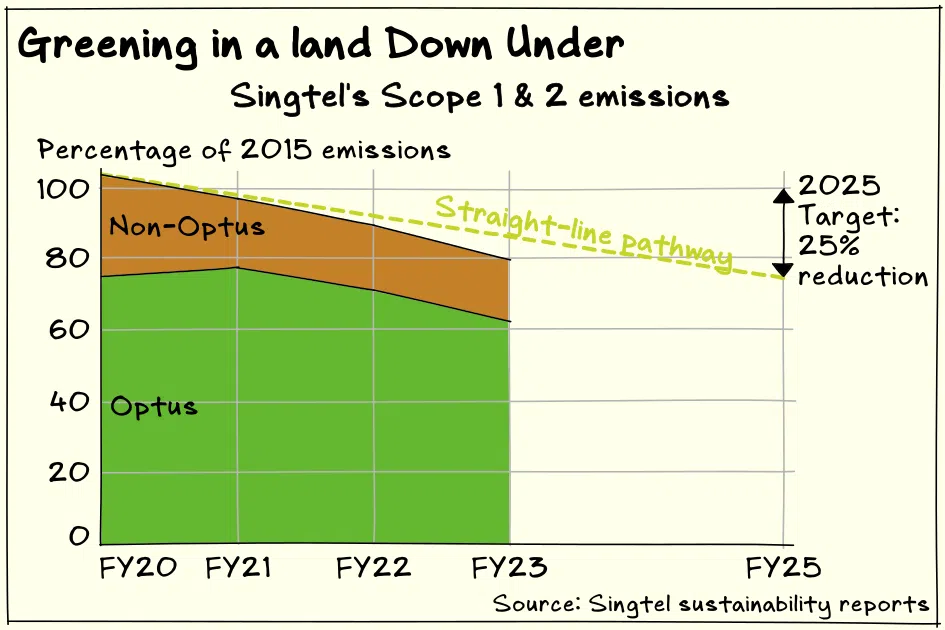
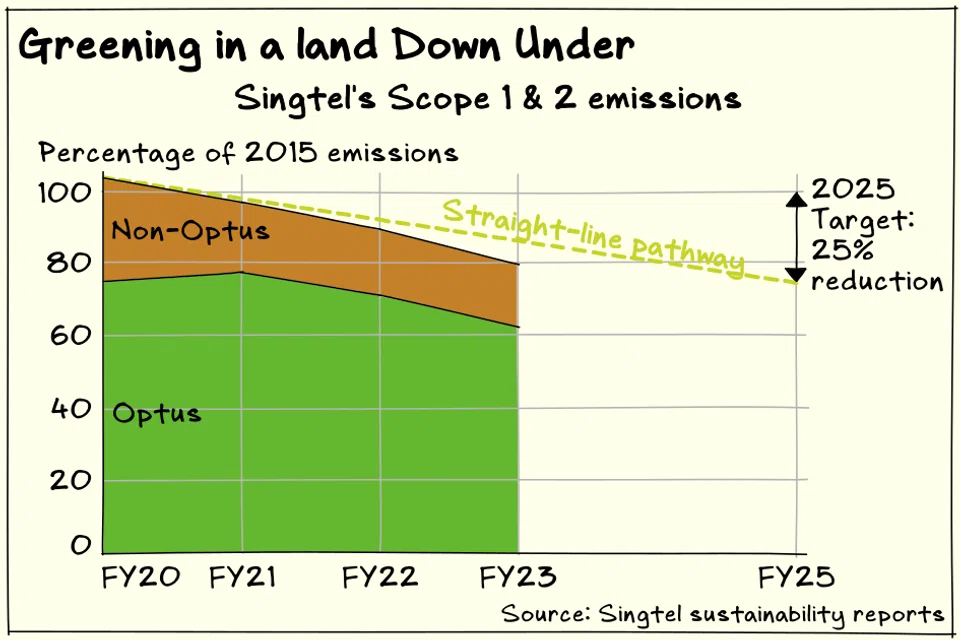
The good news for Singtel is that it lowered its combined Scope 1 and 2 emissions by 11.3 per cent to 438,957 tonnes of carbon dioxide equivalent (tCO2e) in the year ended March 2023. In absolute terms, the roughly 56,000 tonnes of emissions reduced in fiscal 2023 is the most amount of reduction in each of the past three years.
Singtel’s 2025 target – which is also the key KPI for its sustainability-linked bond – is a 25 per cent reduction from 2015 levels for Scope 1 and 2 emissions. The latest numbers mean that Singtel has reduced emissions by about 20.4 per cent from 2015 levels, which puts it ahead of schedule for hitting the 2025 target. If Singtel can keep this up, it will avoid paying higher interest rates on its sustainability-linked debt.
Singtel couldn’t have done it without Optus. Optus accounted for about 78 per cent of Singtel’s total Scope 1 and 2 emissions, but represented 90 per cent of absolute emissions reduced in those scopes between FY22 and FY23. The Australian unit achieved that feat by using renewable energy certificates or large-scale generation certificates, and by reducing its total energy consumption.
Amid this progress, Singtel has decided to bring forward its net-zero target date: to 2045 from 2050. It is also in the midst of refreshing its various emissions targets following a planned review; those targets are being assessed by the Science Based Targets initiative (SBTi), and will be released if approved.
That change is unlikely to affect Singtel’s existing sustainability-linked debt. Singtel said its 2025 target will remain, and it will not have to update the performance targets for its existing sustainability-linked debt.
But Singtel’s 2030 target – to reduce emissions by 42 per cent from 2015 levels – may yet be affected by its science-based targets review and the new 2045 net zero deadline. New sustainability-linked financing issued in the coming years might therefore have new and more ambitious targets than the current ones. If the 2030 target is not adjusted, Singtel might backload its decarbonisation efforts as it gets closer to 2045, which is not ideal from a risk perspective.
The fact that Singtel’s accelerated targets might only affect new sustainability-linked financing in the coming years buys the company some breathing room before it has money on the line for higher goals. But to stay ahead of its ambitions and to eventually reach net zero, Singtel’s non-Australian businesses will have to step up.
Other Singapore reads
- GuocoLand obtains S$974 million green club facility raised under new green finance framework
- MAS, SGX tie up with CDSC to boost global emissions reporting for companies
South-east Asia
Singapore tries something different with coal phase-out proposal
Singapore’s industry-led Green Finance Industry Taskforce (GFIT) is seeking public feedback on its proposal to include early coal phase-out in the Singapore-Asia Taxonomy for sustainable finance.
The proposal draws significantly from guidelines devised by the Climate Bonds Initiative, Climate Policy Initiative and RMI. It departs from the tried-and-true in some important ways – a reminder that the Singapore-Asia taxonomy is operating in a truly green field of regulatory innovation when it comes to coal transition. What’s notable:
- Not a traffic light. The Singapore-Asia Taxonomy’s defining feature has been its use of a traffic light system to denote what’s green (green), what’s in transition (amber) and what’s not acceptable (red). But that won’t work for coal phase-out, GFIT says, because the traffic light can tell you if an activity is OK, but not whether a transition plan is credible. Also, amber activities are brown but still required beyond 2050; whereas coal phase-out is for fast-tracking the end of an activity for which alternatives are available. Coal phase-out will therefore constitute a separate transition finance part of the taxonomy.
- Not the Asean Taxonomy. The Singapore proposal is noticeably more granular and more stringent than the existing criteria in the Association of South-east Asian Nations’ regional taxonomy. These include additionality requirements such as a plant having positive fair value (not present in the Asean version); a hard lifespan cap of 25 years (35 years in Asean); and prescriptive criteria for acceptable replacement energy sources.
- ‘Just transition’ required. The financed coal plant must have a plan to mitigate impacts on its key stakeholders. This goes to the heart of why coal phase-out criteria are needed in the first place. If coal plants in South-east Asia could be easily replaced by renewable alternatives without detriment to local communities, we would have already seen it happen.
- Carve-out for local political circumstances. If a coal plant’s electrical output cannot be replaced by renewable resources, it’s still possible to be aligned with the taxonomy provided the entire power system in which the plant operates is subject to local government commitments that are science-based and aligned with a scenario that limits global warming to 1.5 deg C.
- Short lifespan. The coal phase-out criteria must be regularly updated for new knowledge and circumstances. The current criteria will last only until 2025, after which they must be revised.
The prescriptive nature of the Singapore proposal appears to reflect persistent discomfort in the global financial sector about financing coal phase-out. For instance, the Just Energy Transition Partnership in Indonesia – a multilateral, public and private-sector coal phase-out mechanism – has faced early challenges amid disagreements and uncertainties about acceptable ways to accelerate the retirement of coal plants, even though money and intention exist. Under these circumstances, what the industry needs might not be high-level principles that could be open to different interpretations, but specific rules that give certainty to participants.
Certainty could, however, be undermined by the need to regularly update the criteria, with the first revision to come after 2025. While this ensures Singapore’s taxonomy will always incorporate best practices, it raises questions about how earlier deals that rely on one set of guidelines will be affected when those guidelines change.
Other than the Asean Taxonomy, no other major sustainable finance classification system in the world currently has specific technical criteria for coal phase-out. Considering the large need for coal transition in South-east Asia, the Singapore standards have a shot at becoming the global model if they are accepted by the sustainable finance ecosystem and are able to unlock capital.
But those are big ifs. As with most market regulations, the proof lies in whether market players use it. There’s a lot of money that could be deployed (and made) in this space; and if this taxonomy helps to move that money, it will find takers.
Other South-east Asia reads
- Global accounting standards body launches its first two sustainability disclosure standards
- Don’t aim for perfection in sustainability disclosures before getting started, says global standards body vice-chair