

Next-gen Asean leaders bet on ecosystems, tech and agility to scale across the region
Panellists discuss growth, technology, talent and more at the inaugural BT South-east Asia Growth Forum

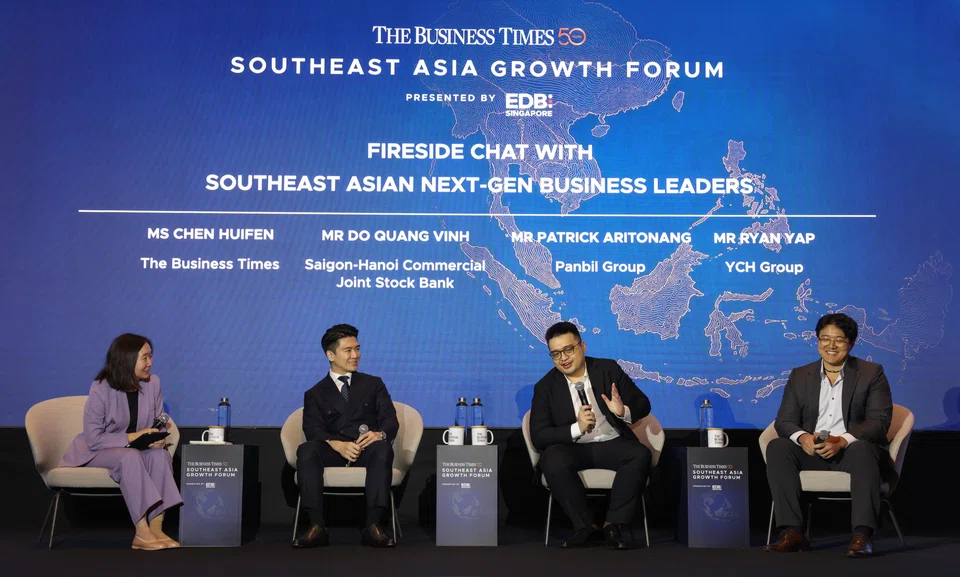
[SINGAPORE] As global supply chains shift and policy volatility clouds the outlook, scaling across South-east Asia’s market of over 700 million people is becoming increasingly complex.
Patrick Aritonang, chief operations officer and managing director of Indonesian conglomerate Panbil Group, said that the definition of speed, for example, has changed a lot; trends that once shifted over a period of months now do so in a matter of weeks.
He was speaking on Nov 18 at a fireside chat that was on the programme of the inaugural The Business Times South-east Asia Growth Forum.
His fellow participants in the discussion agreed that in this climate, as next-generation business leaders, they are betting on growth through strong ecosystem ties, tech agility and disciplined pacing.
These themes anchored the discussion in the half-day forum, jointly organised by BT and the Singapore Economic Development Board (EDB) to connect firms looking to scale.
In his welcome address at the event held at the Hilton Singapore Orchard, EDB managing director Jermaine Loy noted that South-east Asia pulled in a record of nearly US$240 billion in foreign direct investment in 2025 despite global economic uncertainty – a reflection of continued investor confidence.

“We are a region of great diversity, different cultures, different economies, different ways of doing business, but we are also deeply connected,” he said of South-east Asia.
“When our economies are better connected, our businesses become more competitive, and the region as a whole becomes stronger,” he added.
The fireside chat moderated by BT editor Chen Huifen also featured Ryan Yap, head of Cambodia, Malaysia, Laos and Vietnam and head of growth and partnerships at the Singapore-based YCH Group, and Do Quang Vinh, vice-chairman and deputy CEO of Vietnam’s Saigon-Hanoi Commercial Joint Stock Bank (SHB).
SEE ALSO



Linking sectors, crossing borders
Asked how their respective businesses flowed with Asean’s wider economy, the panellists described an interdependent value chain in which logistics, industrial real estate and banking rely on one another to move goods and capital across borders.
YCH Group’s Yap said regional supply chains work much like a football team.
“Not all 11 players do the same job, but the supply chain works only when all the players do their part, do it well, and there are perhaps one or two people that connect the whole thing together,” he said.
He added that running a business network in markets as disparate as Cambodia, Laos, Malaysia and Vietnam takes pairing regional coordination with local execution, and that “a one-size-fits-all solution” does not work in South-east Asia’s varied terrain.
YCH prefers to work with local partners on “the last mile”, the final leg of a product’s journey from a local distribution hub.
Referring to these local partners, he said: “They know the retail spots, they know the traffic, and they have their own little cross-docks across (the country).”
Cross-border corridors such as the Singapore-Johor-Riau growth triangle – which links Singapore, Johor and Indonesia’s Batam – show how manufacturing hubs are evolving with greater collaboration.
Aritonang said that, as companies scale and rethink where their production centres should be, they are demanding faster financial flows along with rapid physical activation.
In Batam, where the Panbil Group runs industrial parks and signed a 2024 memorandum of understanding with Sembcorp for low-carbon parks, clusters have expanded beyond factories.
“We have seen data centres coming in. We have seen more medical facilities coming in at a scale that we have not seen before,” Aritonang said, noting that these projects create long-term jobs for thousands of locals, even for those without formal qualifications.
Underpinning trade and industrial growth is cross-border capital. As more South-east Asian firms aim to expand globally, Vinh of Vietnam’s SHB said that banks act as the “backbone for businesses”.
“When (companies) expand globally, the bank provides the financial [support], but we also help companies restructure their balance sheets, provide knowledge of international standards, and guide them on risk management.”
To diversify its own funding, SHB recently became Vietnam’s first bank to issue Singapore-dollar bonds.
“It’s a good strategy for us to diversify our pool of funds, but I also think that it will open up the investor base for us. We believe that we can reach out not only to Singapore, but also to other countries in South-east Asia, and the rest of the world,” he said.
Tech, data and talent as resilience drivers
Beyond physical networks, sustaining competitiveness hinges on continuous innovation and workforce capability. Technology, in particular, was the word of the day at the event.
For YCH, adaptability was born of the drive to survive: Yap said the group had at first been in passenger transport, but found it had to pivot to supply chain management in the 1970s when its passenger-transport arm suffered a steep revenue drop with the debut of SBS Transit.
“The only way to really achieve resilience is through adaptability, which means that you have to continuously innovate,” he said.
YCH was selected for Singapore’s Artificial Intelligence (AI) Champions programme, a national flagship initiative led by Enterprise Singapore and Digital Industry Singapore. Yap cited that such opportunities “unlock a lot of capabilities” for the group and enable it to “punch a bit higher, aim a little more ambitiously”.
Vinh called technology and digitalisation the main growth catalyst of the century. It was this that prompted SHB to partner global tech providers such as Huawei, Oracle, SAP and Amazon.
“Data now is the most valuable thing for any organisation to build,” he said.
Developers, too, can no longer rely on bricks and mortar alone, Aritonang agreed.
“Change is constant, and to not change is stagnation. Just being good at physical spaces today is not enough,” he said, adding that tapping Asean’s hungry young workforce requires pairing digital infrastructure with talent.
Pacing amid policy volatility
Riding the growth wave in Asean also demands calibrating investments and shielding operations from shocks.
Asked how YCH resolves the chicken-or-egg dilemma of building ahead of demand, Yap noted that premature expansion carries risks.
“There are many kinds of eggs, but not all of them result in chickens, so you have to make do,” he said.
“We try not to be too ahead of the curve. We try to be just behind it, because that’s actually the meat and potatoes of our business.”
Pacing proves vital when policy shifts jolt markets, as did those shifts that resulted in changes in US tariffs and chip export controls.
On political volatility, Aritonang said regulatory shifts are constant, noting that each province carries its own character and risks, requiring firms to define risk appetite and choose partners carefully.
Vinh, too, emphasised preparing for risk: “The best way to manage it is to forecast, foresee all the risks in the worst-case scenario,” he said.
Ahead of Asean’s 60th anniversary next year, panellists agreed that deeper policy coordination will determine how fast regional firms scale.
Asked what might be on their wish list for greater Asean collaboration, Aritonang said he wanted migration policies to ease the movement of talent.
Yap urged Asean to create a regulatory sandbox, so firms can test new models faster, and chase deeper innovation.
Vinh said he hoped Asean would remove cross-border barriers for more seamless transactions.
“Maybe Asean can use the same currency at some point,” he joked.
“My wish would be for new policies, and new regulations that support all businesses in reaching out to each other, and in getting connected easier. The most important thing will be being united, to actually expand our business further outside of Asean, especially to other countries in Asia, and to the world,” he said.

Decoding Asia newsletter: your guide to navigating Asia in a new global order. Sign up here to get Decoding Asia newsletter. Delivered to your inbox. Free.
Copyright SPH Media. All rights reserved.
TRENDING NOW

Nvidia reinstates Jensen Huang as CEO; Trump says move poses no national security risk

Beyond the greenback, Vietnam’s big borrowers turn to Asian-currency bonds

Indonesia’s coal tycoon Low Tuck Kwong replaced as Bayan Resources president-director

Six workers file employment claims against Crystal Jade Food Manufacturing

