Building bridges in the spaces between
These Emerging Enterprise Award finalists saw where existing systems stop short – and built businesses around it


ONE reconstructs real worlds into digital replicas for enterprise and education. Another empowers employees to succeed retiring business owners. A third helps distinguish between the real from the artificial. A fourth transforms workplace chatter into actionable data.
Together, they operate in the spaces between: connecting the physical and digital, founders and successors, the real and the synthetic, as well as conversation and action.
What they share is not an industry, but a way of seeing. They spotted inefficiencies, blind spots, unmet needs and gaps between how things are and how they could work. They found the places where existing systems stopped short. And they built businesses around it.
They are among the finalists of this year’s Emerging Enterprise Award.
The awards, in its 19th run, recognise young businesses across Asia that have demonstrated an entrepreneurial spirit.
Jointly organised by The Business Times and OCBC, the 2026 edition is supported by Mastercard, RSM Singapore, A*Star, Enterprise Singapore and Paia Consulting.
Turning chatter into action
OnSite is an intelligent work chat app for field teams
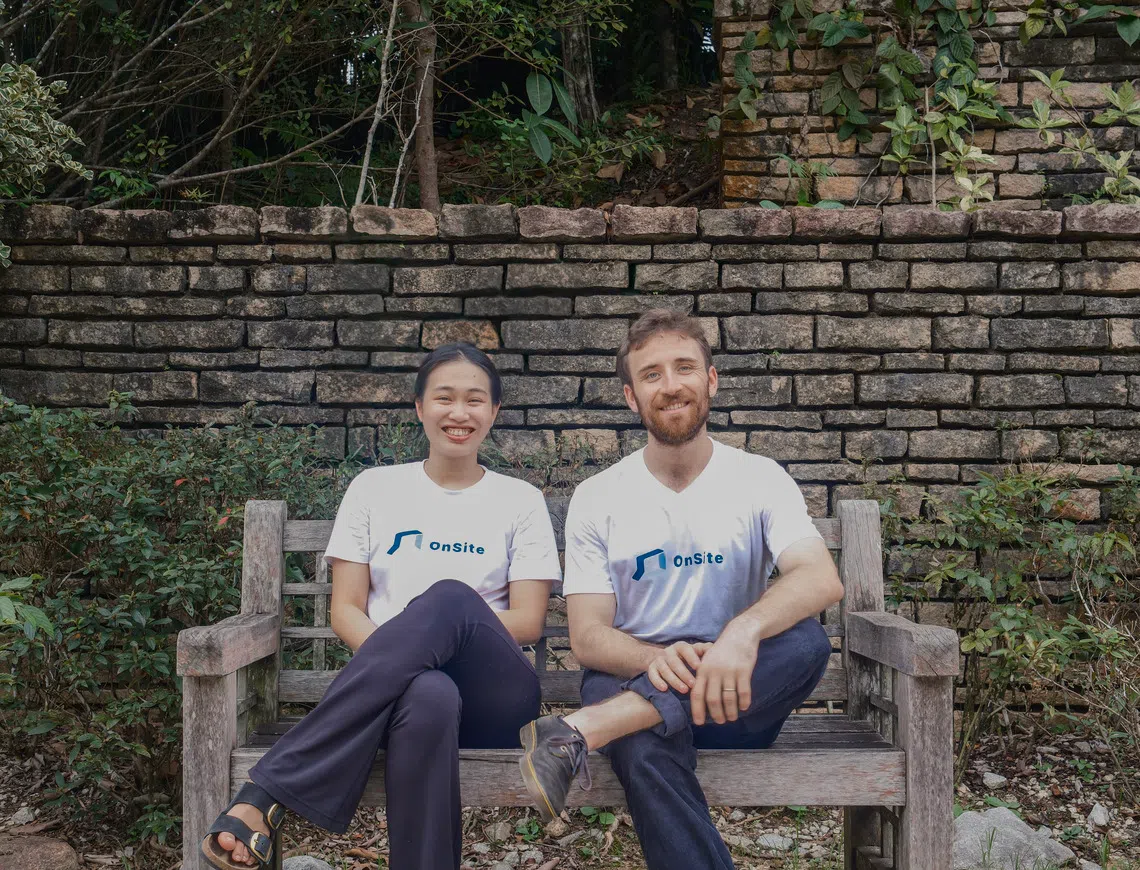
It looks like any other messaging app. It works like one too.
But OnSite, the intelligent work chat app we built for field teams, continues doing the work for you even after conversations end.


We designed it to handle messy field data: think voice notes in five languages, Singlish texts and blurry photos shared across multiple groups.
OnSite turns all of that into tasks, evidence, reports and daily logs – without requiring a human to dedicate hours to sort through pictures and piece together updates.
We wanted to meet people where they already are, in chat, and turn their unstructured conversations into structured data, without asking them to change how they work.
Incorporated in Singapore in 2024, OnSite primarily serves the built environment, having powered more than 100 projects across Singapore and Hong Kong. We are doubling down on Singapore, with Hong Kong as a second market.
We build for how sites actually run because we have been on them.
Both of us co-founders grew up in construction families: one in a wood shop in New York, the other in a renovation business in Singapore.
The moment you need to find something, it’s gone – someone deleted the photos to free up space – or buried under hundreds of messages you scroll through by hand.
We want OnSite to be the chat app for field workers: the hub every messaging app plugs into, so a team has one place where its communication lives and works for it.
Underneath that is a social mission: deskless workers are most of the workforce yet get the least software.
Success looks like nobody doing duplicate data entry, disputes settled by looking at records, field workers who feel protected because everything is on file – and artificial intelligence that serves not just the person holding a laptop, but one holding a drill.
Keeping the fakes at bay
Deepfaic, incorporated as Leapwave, builds technology that checks whether a voice, video, image or document has been generated or manipulated by AI

A cloned voice on a call. Manipulated media submitted during customer onboarding. An impersonator hiding behind digital communications.
These threats are what Deepfaic sets out to detect.
We build technology that checks whether a voice, video, image or document is generated or manipulated by artificial intelligence (AI).
Most security systems check who has access; but do not verify whether the content being relied on is real.
Our platform combines signals across audio, video, images and documents, and can run inside clients’ own environments, which is key to financial institutions and government teams that cannot simply send sensitive material to a public cloud.
We also pay close attention to Asian languages and real-world conditions.
Today, we work chiefly with banks, telecommunications, government agencies and technology partners.
Deepfaic’s immediate priority is to turn pilots into production deployments.
Singapore is our base, but the wider Asia-Pacific region – including Australia and New Zealand – is an important growth market for us.
We are building through technology and hardware partners, so detection can be embedded in systems already used. We are also building for private and secure deployment.
Generative AI moves incredibly fast, which means a detection project started 18 months ago could already be out of date.
We built our platform such that we can update and combine specialist models as new attacks appear, and test against languages and conditions our customers encounter.
Success for us would mean a bank or telecommunications company spotting an impersonated call; a company can verify who really is in a videoconference; and families are less exposed to AI scams. I would like authenticity checks to become a norm in digital communications, just as verifying identity and access is today.
If Deepfaic can make these protections work quietly, in real time, across Asia and beyond, that would be deeply meaningful.
Reconstructing the real world
Finute is a gamification and simulations company that builds digital worlds for education, enterprise, and defence
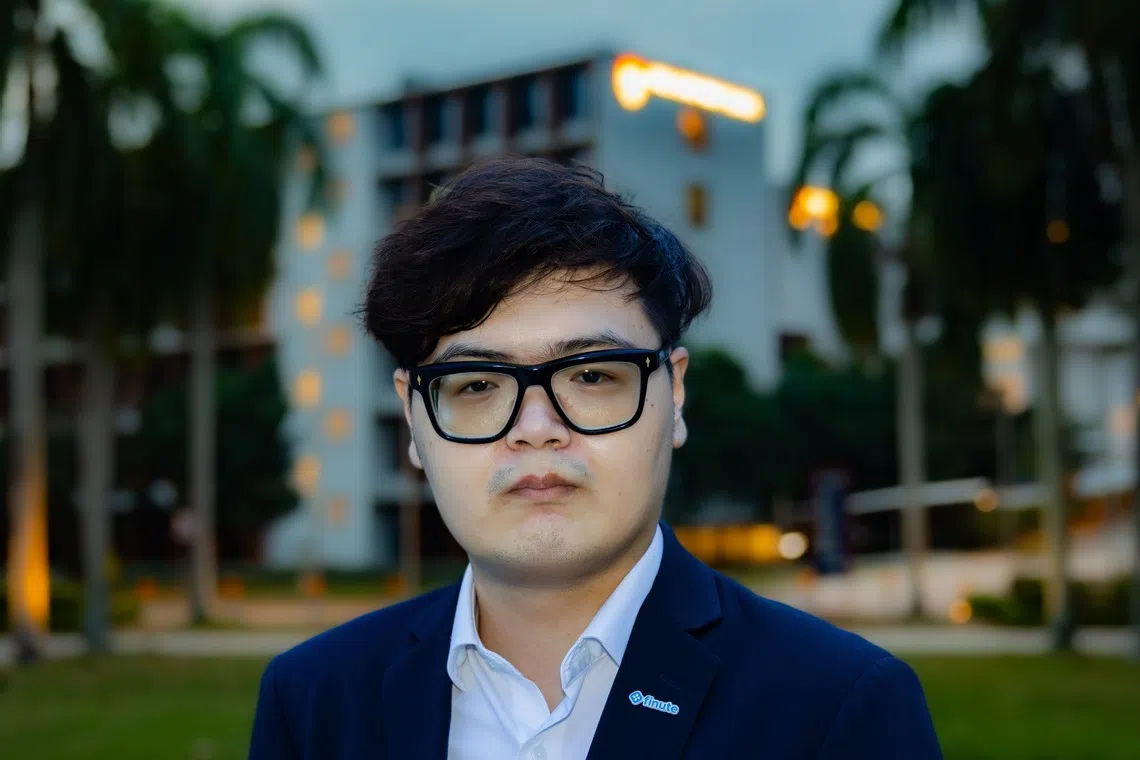
Step into one of our digital worlds and you may find yourself behind the wheel of a Singapore public bus, following real-world routes. In another, you patrol the streets as a police officer with rendered tactical vehicles and K-9 companions. In yet another, you can navigate a sprawling university campus directly to individual rooms.
At Finute, we build digital reconstructions of real places and processes, and develop bespoke solutions for education, enterprise and defence.
The idea was birthed out of a simple belief: people learn far more from doing than from being told. Organisations have important things to teach, and traditional formats rarely have the ability to scale. The gap we fill is reach, and so we set out to build digital worlds where play becomes learning.
What sets us apart is fidelity and our track record.
For one thing, we understand what drives people to engage, and what government and defence clients need in security, accountability and delivery.
For another thing, we rebuild real places faithfully in that a building in our world reads just as it does on the ground. We run our own artificial-intelligence pipeline that reads existing site data and generates the three-dimensional geometry, accomplishing in days what would take a modelling studio months.
We want Finute to be the company regional institutions turn to when they need people to understand a place, a system, or a procedure.
Success to me is when someone – via Finute’s work and without realising they are being taught – learns to, say, identify a scam call; find their way through an unfamiliar hospital; or prepare for a mission.
Commercially, it also means a Singapore-built company is exporting that capability to markets well beyond home.
I want to show the world that one can run a successful, thriving business while still being in school.
Helping towkays exit, employees step up
Oneteam is a tech-enabled acquirer of SMEs from retiring owners
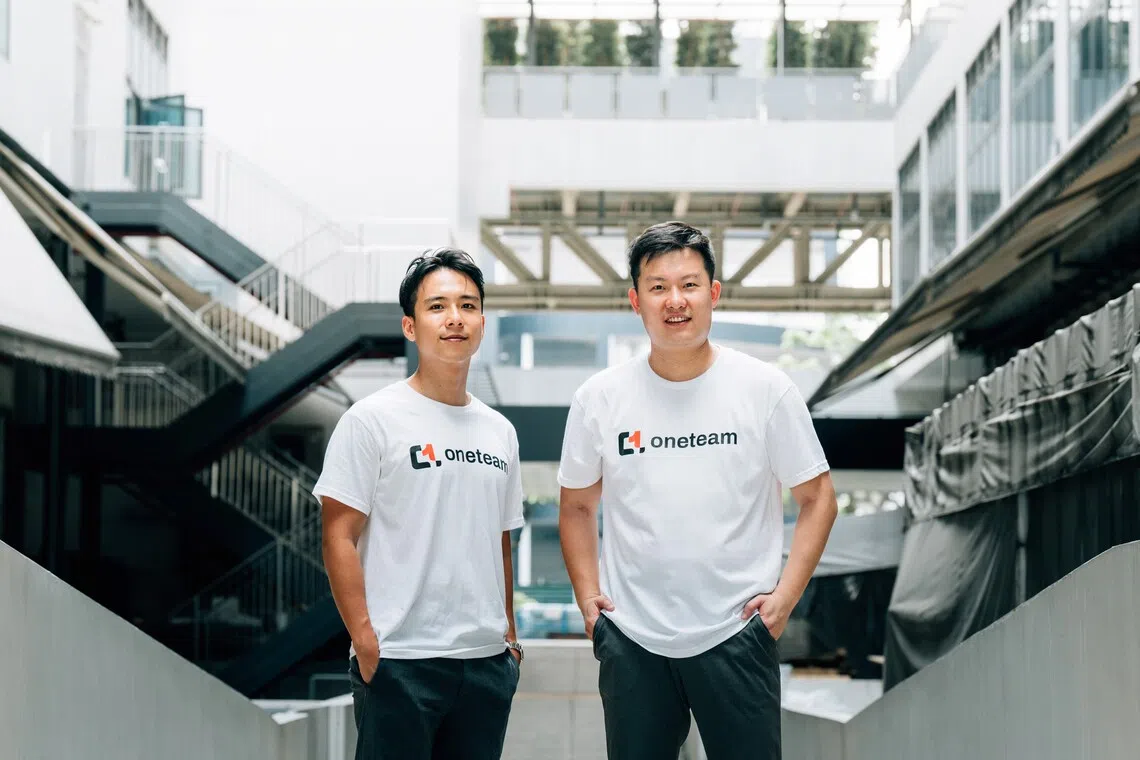
Retirement always raises a difficult question for owners of small and medium-sized enterprises (SMEs) that lack succession plans and whose businesses are not typical targets of traditional private equity or strategic buyers.
Who will step in when they are ready to step out?
This is where Oneteam comes in. Our mission is simple: reward one generation of business owners, empower the next.
At the heart of our model is the belief that employees who have quietly driven businesses for years should have the opportunity to lead them and share in their future growth.
We acquire SMEs from retiring owners and transform founder-led businesses into employee-owned, tech-enabled global enterprises. We do this with mentorship, structured leadership development, technology, capital and meaningful long-term ownership incentives.
Incorporated in 2024, Oneteam currently focuses on business-to-business service companies in the built environment, including but not limited to: security, commercial laundry, lift and escalator maintenance, fire safety, waste management, pest control and cleaning.
As testimony to the success of our proprietary operating system, our acquired companies consistently achieve double-digit revenue and operating profit growth in their first post-acquisition years.
Our ambition is to transform local SMEs into tech-enabled, highly digitalised regional and global brands positioned for long-term scale.
We see tech adoption as a competitive moat against rising costs and structural workforce constraints, and so we leverage enterprise software, artificial intelligence, automation and robotics extensively across our headquarters and portfolio companies.
To us, success means creating credible career opportunities with clear paths for employees to upskill, take on leadership roles and eventually gain ownership, sharing in the value they helped create.
In time, our goal is for Oneteam to go public and become South-east Asia’s first-choice succession partner for retiring SME owners, recognised for continuing their legacies, preserving jobs and sustaining the essential services these businesses provide.
Decoding Asia newsletter: your guide to navigating Asia in a new global order. Sign up here to get Decoding Asia newsletter. Delivered to your inbox. Free.
Copyright SPH Media. All rights reserved.