

Berge Bulk charts a path towards more sustainable shipping
Carbon emissions, plastic pollution, seafarer health are high on the agenda
Annabeth Leow
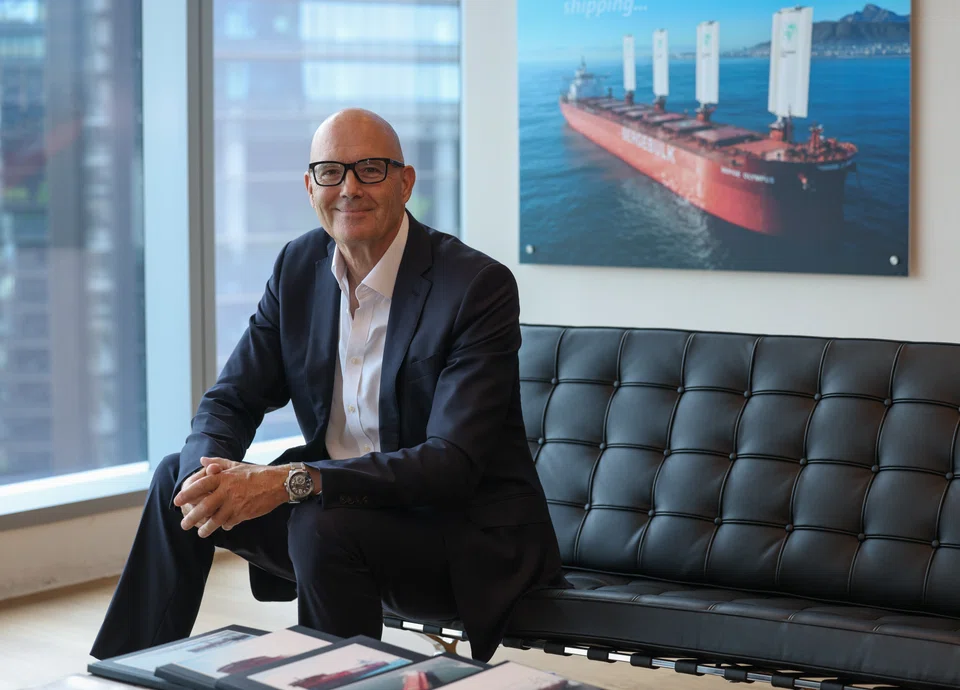
[SINGAPORE] Dry bulk shipping firm Berge Bulk’s fleet of more than 100 ships may sail the ocean blue, but the company is also investing in developing a greener maritime industry.
It has tapped innovative technology to reduce carbon emissions and cut pollution and waste – all part of a broader mission to take care of local communities and environments.
For its efforts, Berge Bulk was named Impact Enterprise of the Year (Large Enterprise) at the Sustainability Impact Awards 2026, jointly organised by The Business Times and UOB.
Companies can demonstrate a credible approach to sustainability and responsible business by “showing progress through real action and measurable results”, James Marshall, founder and chief executive of Berge Bulk, told BT. “Ultimately, sustainability has to work in the real world. That is how it becomes part of a stronger and more competitive business.”
High-tech carbon cuts
Berge Bulk sees technology as a crucial tool to meet its corporate sustainability goals, which include a target of net-zero emissions by 2050, across a fleet of more than 100 vessels.
Ongoing investments include retrofitting ships to reduce water resistance, or drag, when sailing – which, in turn, lowers the amount of fuel that has to be consumed.
Besides switching to new propeller and fin designs, Berge Bulk is also investing in novel ways to keep hulls free of the marine algae and barnacle growth that contribute to drag. For example, hull cleaning robots and ultrasonic pulse emitters can prevent algae and barnacle build-up while at sea – keeping the hull shipshape, even between tune-ups in port.
At the same time, Berge Bulk is readying for a transition away from fossil fuels, as it aims to build and operate a zero-emissions vessel by 2030 and have a zero-emissions fleet by 2050.
Though the company has made carbon credit commitments to balance its emissions, Marshall affirms that carbon credits are not a substitute for decarbonisation.
SEE ALSO












“Our priority remains reducing emissions from our operations through efficiency, technology, lower-emission fuels, and carbon capture,” he said.
To reach these zero-emissions targets, he believes that shipping needs to move progressively away from conventional fossil fuels.
Biofuels have been identified as an important alternative, “because they are one of the few lower-emission fuel options that can be used in existing vessels today”.
“They help us reduce lifecycle emissions while also giving our crews and shore teams practical experience with bunkering, handling, documentation, fuel quality, and performance at sea,” he elaborated.
Since 2021, Berge Bulk’s ships have not only made trial voyages powered entirely by biodiesel, but are also testing different blends – which can be made up of vegetable oil, animal fat and waste cooking oil – as a near-term substitute for conventional fuel.
Said Marshall: “These trials matter because they show how future fuel choices will need to balance emissions reduction, feedstock availability, safety, cost, regulation, and operational practicality.”
Berge Bulk has also committed to other alternative methods for powering its fleet, as it prepares for longer-term fuel transitions and the development of future fuel supply chains and regulations.
Two ammonia-ready ships are on order, with handover set for 2028, and the company is exploring the commercialisation of floating molten salt nuclear reactors for the maritime industry.
Sustainability at sea – and on land
Meanwhile, who says the age of sail is over?
Wind propulsion also features prominently on Berge Bulk’s long-haul carriers.
Marshall noted that the scalability of wind propulsion depends on factors such as vessel type and trade route: “It will not be suitable for every ship or every voyage. But where the conditions are right, it can make a real contribution.”
Berge Bulk now deploys wind-assisted propulsion on three vessels that sail primarily between Brazil and China – a route known for favourable wind conditions, he observed.
The company installed “WindWings” developed by British marine engineering firm BAR Technologies on the 210,000-tonne Berge Olympus in 2023, with the high-tech trifold mega-sails able to cut annual carbon emissions by more than 1,600 tonnes.
Rotor sails – towering deck-mounted columns that spin at high speed to help steer the vessel – were also rolled out on the Berge Neblina in 2024 and the Berge Meru in 2025.
By consuming less fuel, this system can yield carbon savings of more than 1,000 tonnes a year.
“Wind is certainly one of the areas where we see genuine potential because it can deliver savings now, using energy that is freely available at sea,” Marshall explained.
Noting that Berge Bulk sees wind-assisted propulsion as “one of many solutions that will be needed to reduce emissions from shipping”, he added: “We need efficiency, technology, new fuels, and carbon capture working together.”
Carbon capture technology is another key pillar of Berge Bulk’s sustainability road map.
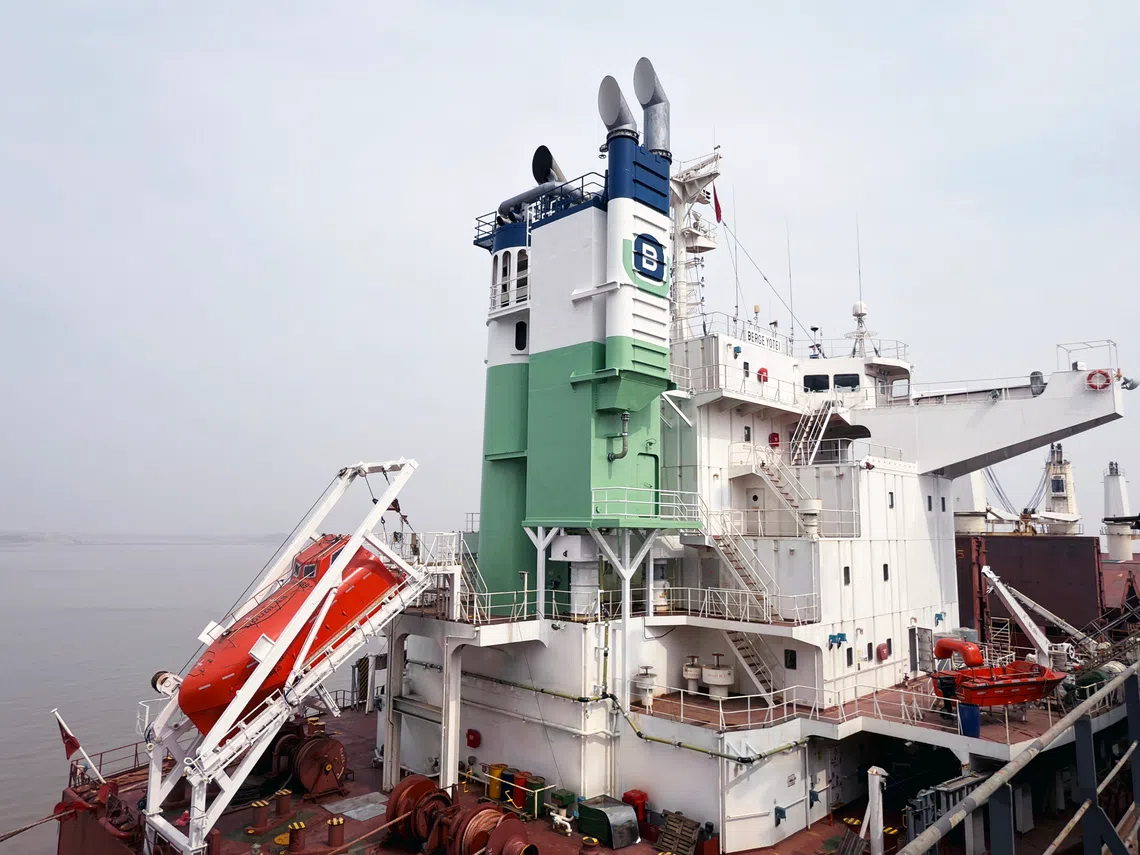
Its 63,000-tonne Berge Yotei was fitted in 2025 with a system to remove up to 15 tonnes of carbon dioxide from the ship’s exhaust each day, or 30 per cent of emissions.
The chemical solution that absorbs the carbon dioxide can later be reused for industrial purposes.
Shipboard carbon capture complements Berge Bulk’s land-based reforestation, which focuses on mangroves that can act as carbon sinks.
More than 20 million trees have been planted in Africa and Asia under this initiative, with a target of 25 million by end-2026.
Growing healthy communities
Other than cutting carbon emissions from its shipping operations, Berge Bulk’s sustainability mission extends to curbing the amount of waste produced, and to tackling marine pollution.
“As a shipping company, our business is directly connected to the ocean,” said Marshall. “That means we have a responsibility to reduce our impact on the marine environment and support practical action where we can.”
Berge Bulk is a founding member of the Maritime Association for Clean Seas (MACS), which was established in late 2025 to address the millions of tonnes of plastic polluting the ocean.
Said Marshall: “This is not separate from our business. It is part of operating responsibly in an industry that depends on healthy oceans.”
The company has funded the recovery of 100,000 kg of plastic from waterways so far, while employees have removed more than 1,800 kg of litter in volunteer beach clean-ups.
Nearby Batam is emerging as a key site for its plastic recovery efforts, as the company aims to effectively prevent marine pollution from reaching the Singaporean coastline.
“We see nature-based solutions as a complement to, not a replacement for, emissions reduction,” said Marshall.
Even seafarers’ families have been roped into Berge Bulk’s corporate volunteering.
Through the Families Ashore programme, which organises gatherings for seamen’s loved ones, family members can join green activities such as mangrove-planting and coastal clean-up.
“We still need to keep improving vessel efficiency, deploying new technologies, testing lower-emission fuels, and preparing for carbon capture on board,” Marshall said.
“But restoring ecosystems is also part of the answer, especially in places connected to the communities and environments that shipping depends on.”
Family-based coastal restoration is just one way that Berge Bulk has found to incorporate environmental practices into initiatives intended to support employees’ wellbeing.
Berge Bulk supports its seafarers, who spend long periods separated from their families, by training volunteer peer counsellors, organising wellness activities, and providing the Internet connectivity needed to communicate with loved ones at home.
“Looking after the wellbeing of our seafarers helps us attract and retain good people in an industry facing a growing workforce challenge,” Marshall said.
The company also tries to both reduce waste and improve crewmembers’ physical and mental health by getting them involved in on-board hydroponics farming.
Having rolled out a programme to grow fresh produce at sea in 2019, Berge Bulk’s fleet achieved a harvest of more than 1.4 tonnes in 2025.
Lettuce and chillies are some of the vegetables, herbs and spices grown in the soil-free shipboard environment, as part of a bid to improve crew nutrition and cut packaging waste.
The initiative comes amid ongoing practices to reduce waste from operations, such as conducting waste audits, engaging suppliers, and improving procurement.
Food waste per ship came to less than 4.1 cubic metres in 2025, down by 20 per cent on four years before, even as plastic water bottles have been almost completely eliminated across the fleet after Berge Bulk began installing water purification units on ships in 2019.
Doing good pays off
Decarbonisation, marine conservation and workforce wellbeing all contribute to Berge Bulk’s long-term business strategy, which sees sustainable shipping as a source of value.
“Many of our environmental, social, and governance (ESG) initiatives have clear commercial and operational benefits,” Marshall told BT.
For instance, decarbonisation can improve operational efficiency, while preparing for the physical impacts of climate change helps us manage risk to staff and operations.
“Looking ahead, our focus is on continuing to embed sustainability into how we operate and make investment decisions … We will continue to invest where there is a sound business case, where the impact can be demonstrated, and where solutions can be implemented safely and effectively at sea.”
Marshall also highlighted that no single actor in the maritime sector – whether shipowners, charterers, or regulators – can tackle challenges like decarbonisation alone.
“The industry will move faster if we are prepared to collaborate, test, share what we learn, and be honest about what works and what does not,” he said.
Decoding Asia newsletter: your guide to navigating Asia in a new global order. Sign up here to get Decoding Asia newsletter. Delivered to your inbox. Free.
Share with us your feedback on BT's products and services
TRENDING NOW

Companies still in search of AI use cases with worthwhile ROI, says Broadcom’s CEO

Malaysian king buys stake in Singapore-listed mining firm expanding into rare earths

Once staunchly pro-China, Malaysian Chinese businesses are now distancing themselves from Beijing

Singapore’s wealth management success should extend to everyday families

