How Singapore built a startup ecosystem from scratch

BACK when Grab's poster boy Anthony Tan still slept on the office floor during crunch-time, a venture capitalist tried, as they always do, to see into the future.
He told Mr Tan that his scrappy startup could one day be worth much more than his father's company Tan Chong Motor, a household name in Malaysia.
But only if he played his cards well. And one of those cards was to cross the Causeway.
It wasn't very difficult to convince him, recalls Chua Joo Hock, a managing partner at Temasek-backed Vertex Ventures. Singapore shone as a financial hub, and its government was doing all it could to build a startup ecosystem worthy of envy.
Seven years on, Grab is going public in a record-breaking deal that values the company at US$39.6 billion, putting Singapore and South-east Asian tech in the global spotlight.
Grab also has vaunted peers based here. Consumer internet company Sea is now the world's best performing stock, intellectual property platform PatSnap became a unicorn, and enterprise software startup TradeGecko was sold to US major Intuit for reportedly over US$80 million.
Two decades ago, Singapore's startup scene was a ghost town compared to Silicon Valley. What changed?
It began with ambition. Singapore wanted to replicate America's success in tech, and in 1999, the government put out a US$1 billion fund to attract venture capital (VC) fund managers with proven track records.
Then, Singapore was growing its research hub, and wanted to diversify away from foreign direct investment. It also had industries that could benefit from new ideas.
No U-turn, no entrepreneur
But any hope of an instant "Silicon Valley'' was quickly dashed.
Although more than US$40 billion of private equity funds were catalysed through the programme, under 2 per cent were invested in Singapore, a Straits Times commentary in 2013 noted.
"You could say that it was an idea ahead of its time," says Edwin Chow, assistant chief executive of Enterprise Singapore, the government agency in charge of helping local businesses grow. "They thought what was missing were the VCs who could smell the deals."
The problem was that no one wanted to be an entrepreneur.
A Global Entrepreneurship Monitor study in 2000 suggested just 2.1 per cent of Singapore's adult population were recently involved in starting up or running their own new businesses.
In 2003, at least five Members of Parliament cited the "No U-Turn Syndrome", or NUTS, as the biggest hurdle in fostering entrepreneurship.
Coined by Creative Technology co-founder Sim Wong Hoo in his 1999 book, NUTS described Singaporeans' fear of doing anything unless they had express permission - like how Singapore drivers, in contrast to other markets, can't make a U-turn if a sign isn't present.
To build a groundswell, the National University of Singapore started a programme to send students to the entrepreneurial hubs of the world. It has birthed some of the most recognisable consumer apps in Singapore today, such as Carousell and ShopBack.
"Frankly, it started out as an experiment. We were not sure what we were doing," says Wong Poh Kam, one of the professors who helped launch the NUS Overseas Colleges (NOC) programme in 2001.
Come together
That experiment has now produced over 800 startups founded by NOC students and alumni. A trip to Silicon Valley in the programme's eighth year gave Royston Tay and his co-founders the confidence to gatecrash a pitch event in Singapore with legendary investor Tim Draper. Mr Tay eventually sold his live-chat startup Zopim in 2014 to Zendesk ahead of the latter's US listing.
"We went to a place no bigger than Singapore, with a population no larger than Singapore, and within this tiny little area was the birth of everything from Intel to HP to Yahoo to Google," says Darius Cheung, co-founder of property marketplace 99.co and mobile security startup tenCube, one of the ecosystem's earliest success stories.
"We got to meet many of these founders and see that they were mere mortals with nothing more than a vision and determination. That gave many of us the confidence that we can do it too."
Singapore's openness to foreign talent also helped attract TradeGecko's Cameron Priest.
He always knew he was going to be an entrepreneur but couldn't find anything for him in New Zealand. So Mr Priest moved with his brother and another co-founder to join JFDI, a pioneer accelerator in Singapore.
These initiatives were new ground even for investors. On day one of a 90-day programme, JFDI turned the tables, and made all investors go to the front of the room to pitch to the startups.
"I remember being nervous," says Vinnie Lauria, a managing partner at Golden Gate Ventures. "Like, oh, I'm a VC now. We hadn't even had the first close on our fund."
But that meeting led to Golden Gate's investment in TradeGecko.
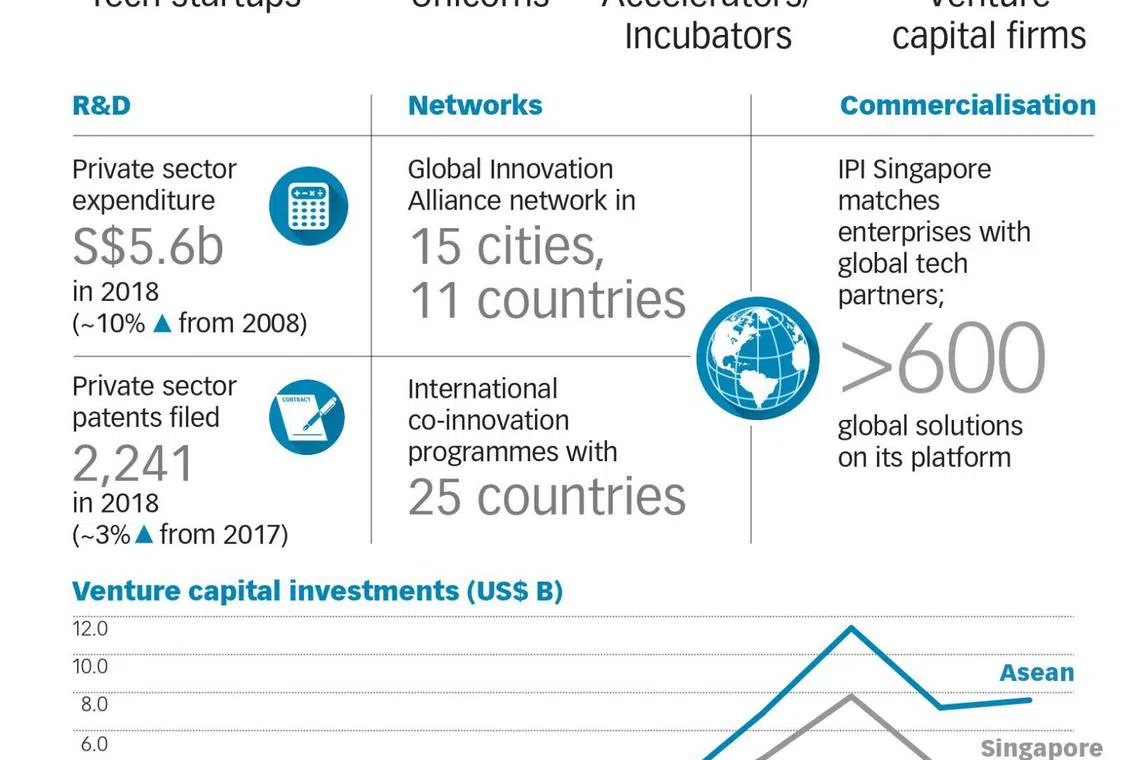
The networks kept growing. There was access to regional markets, intellectual property protection, research and development, all the key ingredients of innovation success.
Universities continued pushing too.
Nanyang Technological University has supported startups such as Singapore-listed Nanofilm and media company Our Grandfather Story. Singapore Management University wants to build Singapore's own version of Sand Hill, the road leading into Stanford University known for housing Silicon Valley's VC elite.
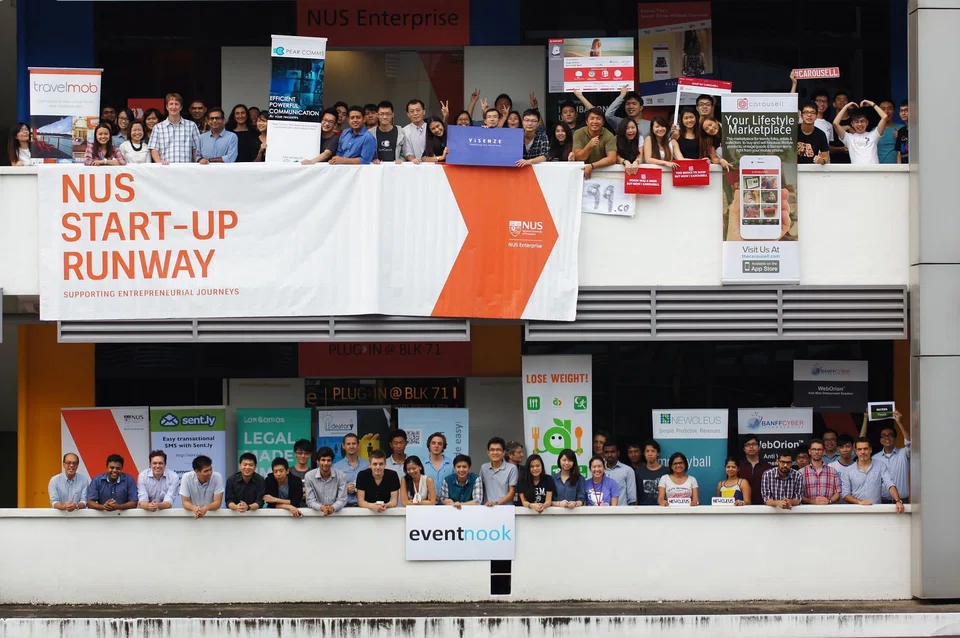
In 2011, NUS Enterprise, Singtel Innov8 and the then Media Development Authority of Singapore turned an industrial building slated for demolition into a place for startups with cheap office rent. At Block71 in Ayer Rajah, startups like ShopBack, 99.co and Travelmob spurred one another on.
Excuse me, where is Singapore?
Singapore's second shot at attracting VC firms came in 2008, when the National Research Foundation (NRF) launched the Early Stage Venture Fund. It contributed S$10 million on a matching basis to seed funds that invest in Singapore startups.
NRF also launched the Technology Incubation Scheme to co-invest up to 85 per cent of the investment with tech incubators, adapting a page from Israel's playbook.
Still, in a Clubhouse session last month, Insignia Ventures founder Tan Yinglan recalled how tricky his NRF job was.
"I was trying to persuade VCs to come to South-east Asia and you had to have come up with hundred-page slide decks introducing where South-east Asia is, where Singapore is, how the local venture landscape is doing," he said.
But local investors like Wavemaker Partners and Monk's Hill Ventures were sold. This gave a boost to Singapore companies including HungryGoWhere and Ninja Van, now a multimillion-dollar regional company.
International funds began to take interest, while Temasek began investing in Singapore-based VC funds.
Since then, investments into Singapore-based startups have grown from US$100 million across 38 deals in 2010 to US$3.8 billion over 257 deals in 2020, according to data provider Preqin.
And it seems few have trouble identifying South-east Asia on a map today. Asean tech giants are here to stay, thanks to the region's young population so surgically attached to their smartphones.
When Google and Temasek launched their first research report on South-east Asia in 2016, the region's internet economy was due to grow to about US$200 billion by 2025. By the fifth edition in 2020, that projection had jumped to US$300 billion.
Singapore is now home to about 3,800 startups and 190 incubators and accelerators, showed figures from the Department of Statistics and Enterprise Singapore.
Companies are also attracting an influx of capital from family offices, sovereign wealth funds and tech giants from the US and China. Funding rounds are getting larger and done at later stages.
Band-Aid effect
Singapore's startup scene has no doubt been dealt with setbacks. Online grocery and food delivery service honestbee collapsed, and some startups have buckled under the pressure of Covid-19.
When Sea, Razer and Grab all chose to list on foreign exchanges, it ignited debate over whether the Singapore Exchange will ever become attractive enough for tech companies. And with pioneer VC funds reaching the end of their lives, the jury is out on whether the ecosystem can see more meaningful exits.
The large amount of liquidity is also sparking concerns that VCs are sticking a band-aid on the cracks of lousy businesses. Some observers have noted that the "SoftBank effect" of massively funding startups could have trivialised cash-burning.
"It will be bumpy - it always is," says 99.co's Mr Cheung. "But it's all part of a 5-step-ahead, 1-step-back process of building an ecosystem."
FULL STORY: Build it, and they will come