



Asean must retain more value as its digital economy races towards US$2 trillion: Indonesian minister
The region’s 680 million consumers give it leverage to negotiate with tech and AI firms, says Meutya Hafid

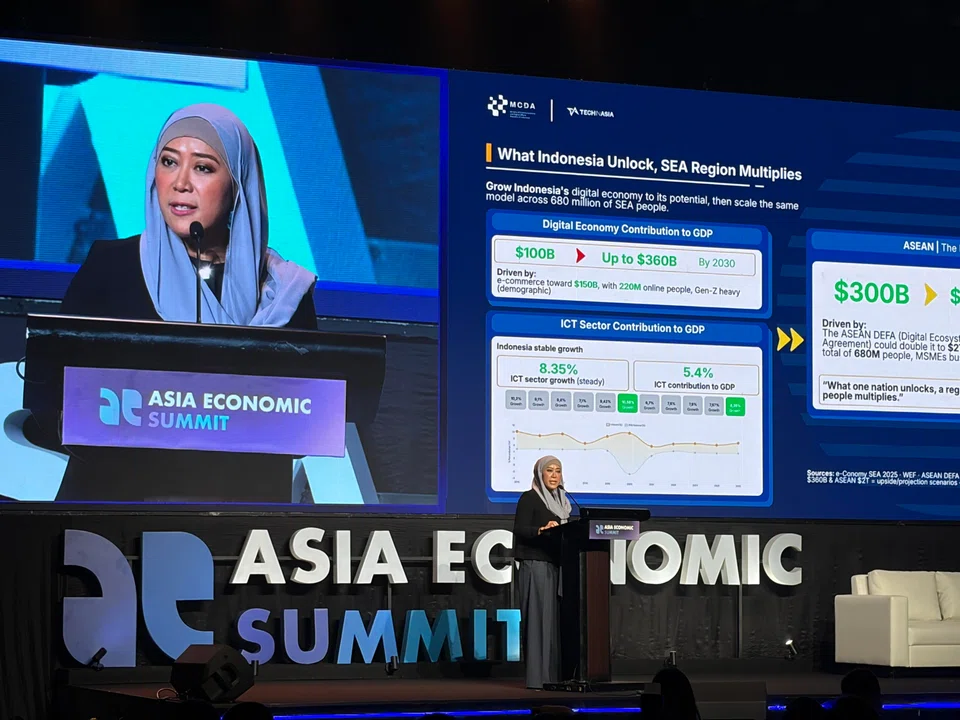
[JAKARTA] Indonesia’s communications and digital affairs minister has called on South-east Asian nations to focus on retaining more of the economic value generated by their rapidly growing digital economies.
Meutya Hafid said that Asean countries should move beyond simply expanding Internet access and digital connectivity, and ensure that a greater share of the wealth created by digital platforms, data and artificial intelligence remains within the region, rather than flow overseas.
Speaking at the Asia Economic Summit held at the Fairmont Jakarta hotel on Wednesday (Jun 17), she said: “We have seen regions grow their digital economies while the real value looks out to platforms headquartered far away.
“This is the chapter where South-east Asia stops being just a market and becomes a region that helps shape the world’s digital economy.”
Her comments come as Asean’s digital economy is set for rapid growth; the region’s leaders estimate it could expand from about US$300 billion currently to as much as US$2 trillion by 2030 if the Digital Economy Framework Agreement (DEFA) is successfully implemented.
Asean is aiming to finalise the agreement in November. The framework is expected to set common rules and standards for digital trade, data flows, online transactions and emerging technologies among the 10 member-signatories, and enable businesses to operate more seamlessly across borders.
Meutya said Asean’s 680 million-strong market gives the region considerable bargaining power with global technology firms and AI providers, especially if the member states act collectively.
“Asean is one of the fastest-growing digital economies in the world, so we are confident that we have the leverage to speak to other countries and to big tech companies,” she said.
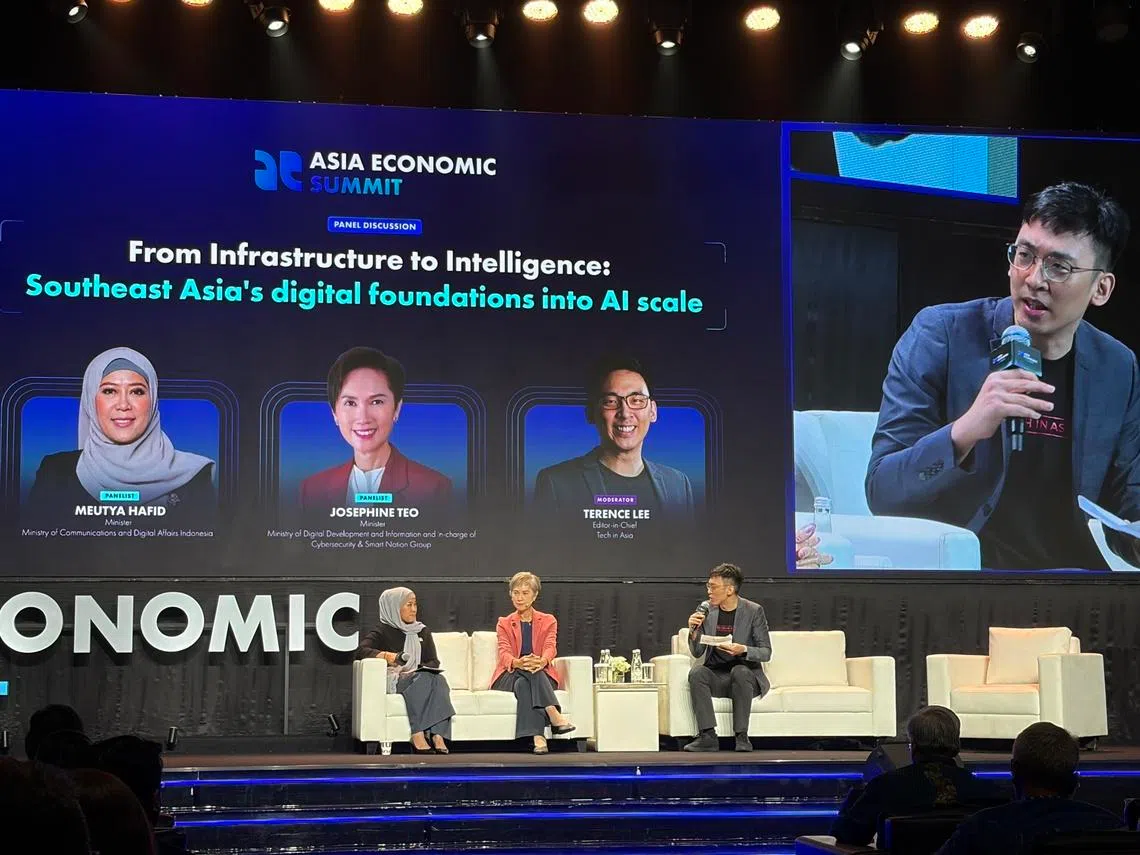
She was in a panel discussion with Singapore’s Minister for Digital Development and Information Josephine Teo and Terence Lee, editor-in-chief and head of editorial at Tech in Asia.

The summit was organised by the technology media and events company, and supported by SPH Media titles, the Chinese news daily Lianhe Zaobao and The Business Times.
Indonesia’s Creative Economy Minister, Teuku Riefky, also delivered a speech at the summit.
Indonesia, South-east Asia’s largest economy, has been actively positioning itself as a key destination for foreign investment in digital infrastructure, AI and data centres.
The country’s fast-growing digital economy, powered by a large and tech-savvy population, has drawn significant investment from global technology companies such as Apple, Google, Microsoft and Nvidia.
The government has sought to attract global technology companies and promote domestic digital development and stronger local participation in the value chain.
Jakarta’s goal is to ensure that the value created by digital activity is shared more fairly among technology firms, infrastructure providers and the broader economy.
“Put simply, we intend to keep more of what we build,” said Meutya, who linked the strategy to President Prabowo Subianto’s broader economic agenda of maximising domestic benefits from Indonesia’s resources and industries.
A key element of this strategy, she said, is ensuring Asean develops its own approach to AI sovereignty.
“Sovereignty, when done well, is not about building walls,” she said. “It’s about having control at home and the confidence to cooperate abroad.”
She stressed that, as AI adoption accelerates in the region, AI sovereignty would go beyond building data centres and digital infrastructure. Ensuring access to data is equally important, she said.
Decoding Asia newsletter: your guide to navigating Asia in a new global order. Sign up here to get Decoding Asia newsletter. Delivered to your inbox. Free.
Copyright SPH Media. All rights reserved.
TRENDING NOW

Once staunchly pro-China, Malaysian Chinese businesses are now distancing themselves from Beijing

Stocks to watch: HPL, Aims Apac Reit, Zico, Advanced Systems Automation, ComfortDelGro
‘How many will survive?’: Bubble fears arise as China’s humanoid robotics face reality check
Smaller board lots can’t fix a market run by three banks

