Asean Business logo
SPONSORED BYUOB logo

Batam’s data centre boom is just getting started, with caveats

Global backers, private equity firms, and telecom operators are pouring capital into the area
Summarise
    • Batam hosts 18 data centre facilities in operational, under-construction, and planned stages.
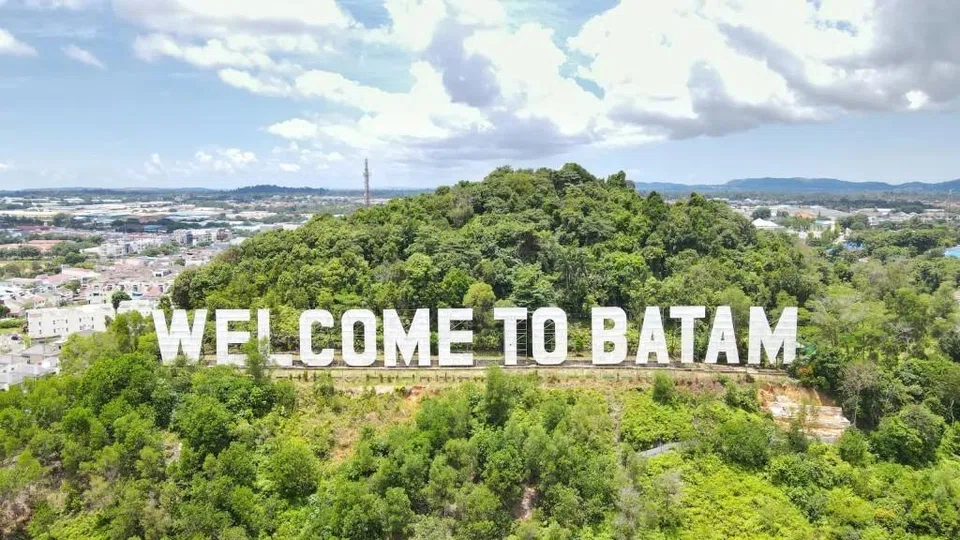
    • Batam hosts 18 data centre facilities in operational, under-construction, and planned stages. PHOTO: AKUT WIBOWO/ SHUTTERSTOCK
    Published Fri, Apr 17, 2026 · 04:28 PM

    BATAM is having a tech moment.

    Once known primarily as an industrial outpost and a weekend getaway for those living in Singapore, the Indonesian island about 45 km from the city-state is now emerging as South-east Asia’s newest data centre destination.

    Global backers, private equity firms, and telecom operators are pouring capital into Batam. Investment in nine data centres in Nongsa Digital Park, the island’s special economic zone, was at 38 trillion rupiah (S$2.82 billion) as of April 2025, local media reports say. No official figures have been disclosed, however.

    While Jakarta remains the top choice for Indonesian data centre with a 56.72 per cent market share as of 2025, Batam is rapidly expanding to take the No 2 spot with about 10 per cent market share, according to GlobeNewswire. It is expected to expand at a 21.7 per cent compound annual growth rate through 2031, per a Mordor Intelligence report.

    Last year, Singapore-based DayOne built its data centre with a total capacity of 72 megawatts in Nongsa Digital Park.

    Another major data centre project underway on the island is state-owned Telkom’s NeutraDC Nxera, which is building a hyperscale-ready facility. This will have an initial capacity of 18 megawatts, to be expanded in phases to 54 megawatts.

    Currently, four data centres are operational in Nongsa Digital Park, while three are under construction and five are in the planning stage. Meanwhile, Batam hosts 18 data centre facilities in operational, under-construction, and planned stages.

    Batam owes its status to Singapore’s data centre moratorium, which prevented new data centre constructions in the city-state from 2019 to 2022 and drove investments to the island. Even after lifting the ban, Singapore remains highly selective, prioritising only sustainable projects.

    However, Batam’s ambition to become South-east Asia’s top data centre destination faces tough competition from Malaysia, particularly Johor, which hosts major developments. The country’s capacity stood at 690 megawatts last year, with planned additional capacity reaching up to 2,415 megawatts.

    Capturing the spillover

    Unlike Indonesia’s data centre on Java, Batam is well-positioned to capture “spillover demand” from Singapore, says Alexander Kheder, a TMT analyst at Fitch Solutions’ BMI. He adds that the island’s proximity to Singapore – only 45 minutes by ferry – makes it an “ideal extension” for regional digital infrastructure.

    Kheder likened the arrangement to those of data centres in Mexico like MDC Data centres. Located along the US-Mexico border, these facilities serve cities in Texas. Therefore, they are strategically positioned to cater to users across the border with low latency, taking advantage of their proximity to major US connectivity hubs.

    “It reflects the same dynamic in Batam – the market can provide low-latency access to what is effectively one of the most attractive regional markets globally,” he explains.

    Johor Bahru is also close to Singapore, only about 30 minutes away by car. However, data centre development in Johor has faced challenges posed by rising water tariffs and tighter regulations.

    Because of power and water concerns, Malaysia has even frozen the development of new data centres not used for AI for almost two years.

    Similar to Singapore, the Johor government is also pushing data centre operators to use renewable water and energy, as heavy water use is straining local supplies.

    Batam has another advantage: It sits along major subsea cable routes, with more than 15 cables either operational or planned.

    Marco Bardelli, chief business officer at Nongsa Digital Park, says a new submarine cable connecting Singapore and Nongsa is expected to be operational by Q2 or Q3 this year.

    The cost of operating data centres in Batam is also relatively lower compared to Singapore and Johor.

    Gidion Suranta Barus, chief cloud officer at ICT solutions provider Lintasarta, says water and electricity tariffs in Batam are cheaper than in Singapore and Johor. The company does not have a data centre in Batam, but it does have an office on the island.

    Johor charges US$0.135 per kilowatt-hour of electricity, while Batam charges US$0.053 to US$0.04 per kilowatt-hour.

    For water, data centre operators in Johor are charged 5.33 Malaysian ringgit per cubic meter. In Batam, there is no specific tariff for data centres, but the rate for large industrial users stands at around 10,500 rupiah per cubic meter as of 2023.

    Water crisis looming

    Despite Batam’s growth rate, it also faces critical constraints. One of the main concerns surrounding data centre development on the island is the availability of freshwater.

    Large data centres can consume up to 5 million gallons of water per day, equivalent to the water usage of a town with a population of 10,000 to 50,000 people, according to the Environmental and Energy Study Institute.

    Batam relies heavily on rainfall for its freshwater supply, with limited natural reserves. The island’s population reached 1.29 million in 2024, per official data.

    “Water is arguably the single most serious long-term constraint,” says BMI’s Kheder. “Its existing population already experiences water scarcity and rationing.”

    Indeed, water shortages were reported in around 18 locations across Batam as of February 2026. This has raised concerns that the rapid development of data centres on the island could further worsen the situation.

    Batam’s clean water production capacity stands at 3,487 litres per second, supplied by six reservoirs across the island.

    Clean water demand across Batam, as well as neighbouring islands Rempang and Galang, is projected to face a deficit by 2030 if no mitigation measures are taken, as stated in the Batam Free Zone Authority’s (BP Batam) 2025–2029 strategic plan.

    The government agency emphasises the need to develop alternative raw water sources, such as seawater desalination plants, and build new reservoirs.

    BP Batam began exploring desalination in March, with the construction of such facilities estimated to require around 3 trillion rupiah in investment. These installations are expected to produce about 2,600 liters per second of clean water.

    BW Digital, which is developing a 144-megawatt data centre in Batam, is addressing water concerns by adopting modern cooling technologies like direct liquid cooling. The company’s CEO, Ludovic Hutier, says this improves efficiency and reduces overall resource consumption.

    “We are also evaluating water recycling and conservation strategies to minimize environmental impact,” he adds.

    Johan Batubara, director of investments at sovereign wealth fund Indonesia Investment Authority (INA), says Batam’s water issues predate the growth in data centre development. He adds that it can potentially be addressed, in part, through cooling system design. INA itself has invested in DayOne to build data centres on the island.

    Power is still holding up

    Energy shortage is another challenge Batam faces.

    The island’s power supply is managed by PLN Batam, a dedicated entity separate from mainland Indonesia’s national grid.

    While this setup provides some flexibility, it also means the island cannot easily draw on the broader national grid during supply shortfalls, BMI’s Kheder argues.

    So far, Batam’s power supply has largely kept pace with the demand. However, much of Indonesia’s energy mix remains fossil fuel-based, and on the island, electricity is predominantly generated from gas-fired power plants.

    This presents a challenge for hyperscalers and investors with strict ESG commitments.

    “There is strong pressure from investors to demonstrate credible renewable energy pathways,” says Kheder.

    He adds that “Microsoft, Google, Amazon, and Meta all have net-zero targets.”

    Hutier of BW Digital says that to tackle this concern, the company is exploring sustainable power solutions, including rooftop solar panels and advanced energy management systems.

    In Batam, solar projects have been proposed in and around the island, but large-scale implementation has yet to materialise.

    Bardelli of Nongsa Digital Park points out that green energy will be a key factor in attracting more international industrial investments to the island, which will also create jobs.

    While power supply appears sufficient for now, concerns are emerging over potential backlash tied to water issues in the short term. There is a risk that communities may begin to blame data centre development if water issues remain unresolved.

    Fuelled by demand

    For now, Oracle is the only hyperscaler that has committed to Batam. This raises questions about whether supply is getting ahead of demand.

    BW Digital’s Hutier says most hyperscalers have chosen to first concentrate their Indonesia presence in Jakarta. That said, the “build by anticipation” critique – often raised by analysts and investors – applies to most emerging data centre markets, including Johor in its early years.

    In Batam, operators are “essentially building into a supply constraint next door, not into a vacuum,” he says.

    However, Nongsa’s Bardelli argues that hyperscalers are only one part of a broader ecosystem.

    “I’m not fixated on hyperscalers,” he says. “You also have cloud providers, colocation players, and independent AI factories.”

    BMI’s Kheder shares this view, noting that Indonesia’s data centre market is already supported by a mix of telco operators, private equity-backed platforms, and enterprise demand.

    He also notes that local players account for only about 10 per cent of the country’s live capacity, highlighting the growing role of international companies.

    But for Batam to emerge as a data centre hub on par with – or even surpassing – Johor, it may still need to attract more hyperscalers. The latter already hosts several, including Oracle, Microsoft, and ByteDance.

    “The question of who brings the chips is real and underappreciated,” says BW Digital’s Hutier.

    He explains that, unlike colocation infrastructure, GPUs don’t flow automatically to where the buildings are – they flow to where demand, relationships, and supply chain access exist.

    “GPU-as-a-service operators from various countries are showing increasing interest in Batam,” Hutier adds.

    Lintasarta’s Barus says there is actually a shortage of large-scale data centres in Indonesia, including in Batam. Most data centres that have already been built are fully occupied, even those that were announced recently.

    “That’s why many operators are racing to build in Batam,” he adds.

    Meanwhile, INA’s Batubara adds that interest in the island is increasingly oriented toward AI-ready data centre development. One reason, he suggests, is that cloud businesses tend to require more human interaction, making locations closer to Singapore – such as Batam and Johor – more attractive.

    Bintan is emerging

    As Batam gains traction, the neighbouring island of Bintan is also getting attention.

    DCI Indonesia and Salim Group’s Gallant Venture are jointly developing a gigawatt-scale data centre complex in Bintan, spanning 700 hectares. This so far remains the only major data centre project on the island.

    At the same time, Batam itself is far from full, despite Nongsa Digital Park being crowded. Development is now expanding into other areas, including the Kabil Integrated Industrial Estate, where the NeutraDC data centre is being built.

    “It (Bintan) definitely has potential,” BMI’s Kheder says. “But it has to come with more ambitious renewable energy plans.” TECH IN ASIA