



Can Vietnam’s small-business backbone survive a compliance squeeze – all at once?
Pressure is mounting from an IP crackdown, origin-of-goods checks and tax reforms


[HO CHI MINH CITY] Vietnam’s push to become a higher-value economy is colliding with one of the foundations of its private sector: millions of small operators, whose businesses have long relied on low costs, loose documentation and informal workarounds.
A tougher intellectual property (IP) crackdown, driven by the US’ Vietnam-specific trade probe, is now unfolding alongside wider tax reforms and a closer scrutiny of origin rules.
This is creating a three-front compliance squeeze for local small and medium-sized enterprises (SMEs), household businesses and export companies.
The campaign has become more sweeping. Practices that once helped small businesses stay flexible and competitive in a low-margin economy are increasingly becoming formal business risks.
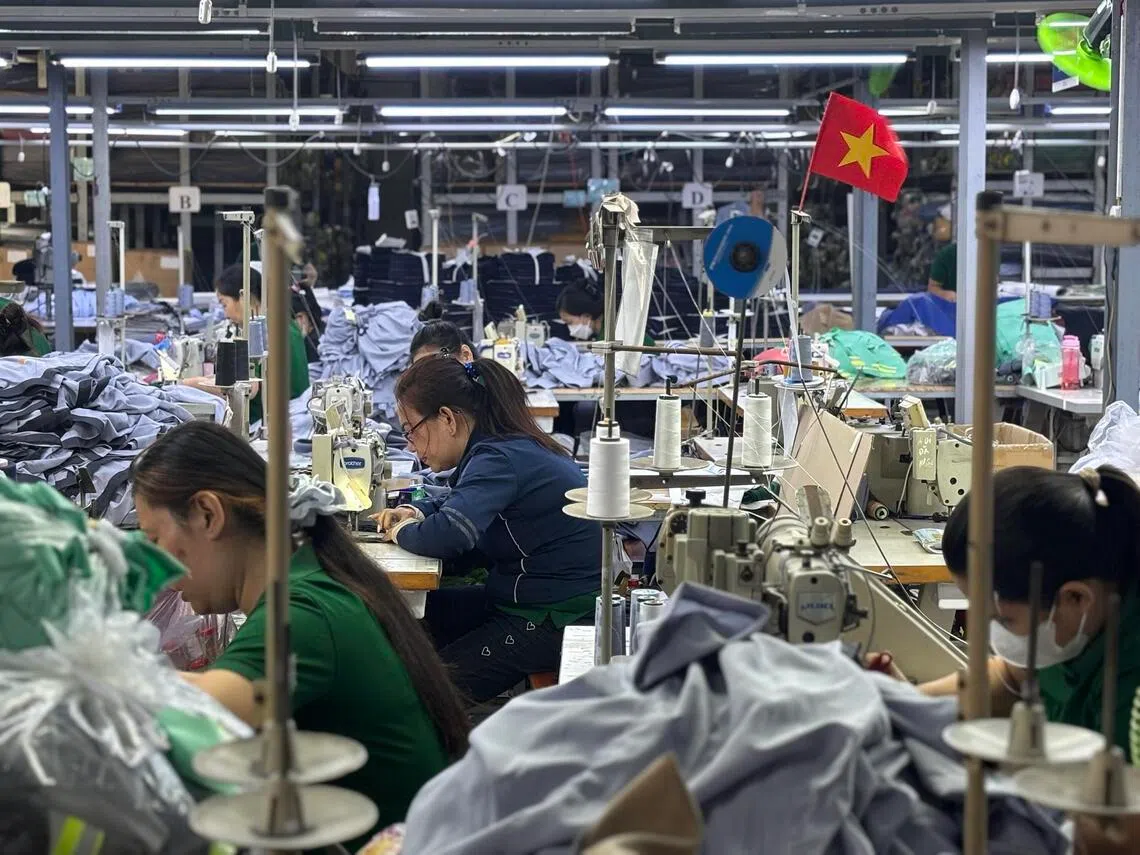
SMEs make up about 97 to 98 per cent of Vietnam’s active businesses, whose number exceeded 1.1 million by end-2025.
The country also had an estimated 6.1 million household businesses, while informal employment stood at 33.1 million people, or 63.1 per cent of total employment.
Informal practices, formal risks
The latest IP squeeze is particularly straining IP-reliant businesses across digital content, technology, e-commerce and retail.
Dang The Duc, managing partner at Indochine Counsel, and Vo Hoang Ha Thu, the firm’s head of IP, said a key challenge is that many still treat unlicensed software, the unauthorised use of digital content and the sale of copied goods or products bearing another party’s trademark as “common practice”, without fully recognising that such conduct is unlawful and carries legal risks.
Foreign buyers are exposed too, they said. IP inspection or infringement findings against their Vietnamese suppliers could disrupt production or services, as well as trigger reputational damage or regulatory scrutiny.
SEE ALSO




In April, the Office of the United States Trade Representative designated Vietnam a Priority Foreign Country in its 2026 Special 301 Report, the most serious designation in its annual review of IP protection and enforcement among trading partners.
Hanoi responded with a nationwide enforcement push against copyright piracy, counterfeit goods and trademark violations.
Between May 7 and 30, the authorities uncovered more than 2,000 suspected violations, with the number of cases handled increasing 370.6 per cent year on year. Administrative fines rose 315 per cent, while the value of seized evidence and goods surged 828 per cent.
Still, Washington on May 29 followed up with a Vietnam-specific Section 301 investigation into the country’s IP practices.
That came on top of two broader US trade probes that already included Vietnam: one into alleged manufacturing overcapacity and another over imports linked to forced labour. These were moves that could pave the way for fresh US tariffs against Vietnam’s goods.
The anti-piracy campaign has since been extended. Deputy Prime Minister Ho Quoc Dung ordered the authorities to increase the number of IP violations detected and handled this year by at least 20 per cent.
The effort was “not only a domestic requirement, but also a basis for Vietnam to demonstrate to international partners its determination and substantive effectiveness in protecting IP rights”, Dung said, based on a government portal post on the May campaign’s results.
Industry watchers said that the intensity of the campaign may fluctuate, especially if US pressure eases. But they do not expect Vietnam to return to the widespread piracy levels of the past.
Tran Thi Kieu Hoa, head of trademark practice at BMVN International, in alliance with Baker McKenzie Vietnam, noted that the country’s anti-piracy effort is increasingly tied to “broader domestic regulatory modernisation” rather than a one-off campaign.
But implementation risk is rising. If compliance obligations are “adopted faster than smaller suppliers can reasonably adjust”, she said, some businesses may face disruption, higher costs and procurement delays.
“These pressures may be felt most strongly by smaller enterprises with limited compliance infrastructure,” Hoa added. “(It) may involve short-term adjustment costs but also create opportunities for more transparent and sustainable business practices over time.”
Three-front compliance squeeze
The IP campaign also comes along with an ongoing tax reform that began intensifying last year.
Household businesses were required to adopt digital invoicing systems, improve cash-flow tracking and become more accustomed to regular interactions with the tax administration.
The broader direction is to move millions of household businesses away from presumptive taxation and towards declared revenue, with clearer input invoices and documentation to verify the origin of goods.
That is already creating stress.
The Vietnam Chamber of Commerce and Industry’s survey of more than 1,000 household businesses across 34 provinces and cities in early 2026 found that 73.3 per cent cited legal and compliance issues as a difficulty – higher than market, input or resource constraints.
Meanwhile, pressures are piling up against small-scale export companies in Vietnam, whose reliance on Chinese inputs has already drawn closer US scrutiny in targeted sectors to origin compliance, duty evasion and alleged transhipment.
In fact, domestic exporters have been losing ground even as Vietnam’s overall exports expand at double digits, with the domestic sector’s exports falling 6.1 per cent in 2025 and a further 16.6 per cent in the first quarter of 2026.
Meanwhile, exports from foreign-direct-investment firms have continued to dominate the country’s trade performance.
SHS Research attributed the weakness to lower competitiveness and limited ability to meet tougher rules-of-origin requirements.
“Many Vietnamese exporters lose market share when origin standards tighten,” the firm noted in its analysis last December. “At the core of the problem is the low level of domestic value added in Vietnam’s exports.”
Beyond a low-cost hub
This year’s IP crackdown may leave a more structural mark on Vietnam’s business environment.
“Vietnam’s actions are not solely externally driven,” Indochine Counsel specialists said.
“IP protection now forms part of its broader strategy to attract high-quality investment, support the digital economy, meet (free trade agreement) commitments and strengthen its role in global supply chains.”
In fact, the pressure is not only coming from Washington, but also from the economics of global technology giants.
Lang Minh, a researcher and educator in media and digital literacy, said that the latest enforcement wave has exposed a long-running problem that global players, especially US tech giants including Alphabet’s Google and YouTube, Netflix and Microsoft, have pushed back against for years.
“Vietnam is a large digital market, yet it has generated too little formal revenue for global platforms,” he noted.
That matters because Vietnam is no longer asking Big Tech only for access to software, cloud tools and digital platforms. It also wants the next layer of investment to target sectors beyond low-cost manufacturing.
These would include data centres, chip factories and artificial intelligence R&D, which would also bring in jobs and expertise, Minh said.
For now, the optimistic case is that Vietnam is finally building a level playing field. For compliant firms, enforcement can help reduce unfair competition from businesses that evade tax, use pirated tools or sell counterfeit products.
“The government is using this moment to tighten areas that had long been loosely enforced,” Minh said.
“Without that pressure, businesses will not change. And without business transformation, the broader growth agenda cannot be realised.”
Decoding Asia newsletter: your guide to navigating Asia in a new global order. Sign up here to get Decoding Asia newsletter. Delivered to your inbox. Free.
Copyright SPH Media. All rights reserved.






