



Chasing Seoul’s ‘Han River miracle’: Inside Hanoi’s 736.9 trillion dong Red River bet
The project serves as the centrepiece of a 100-year master plan to redesign the entire capital city of Vietnam

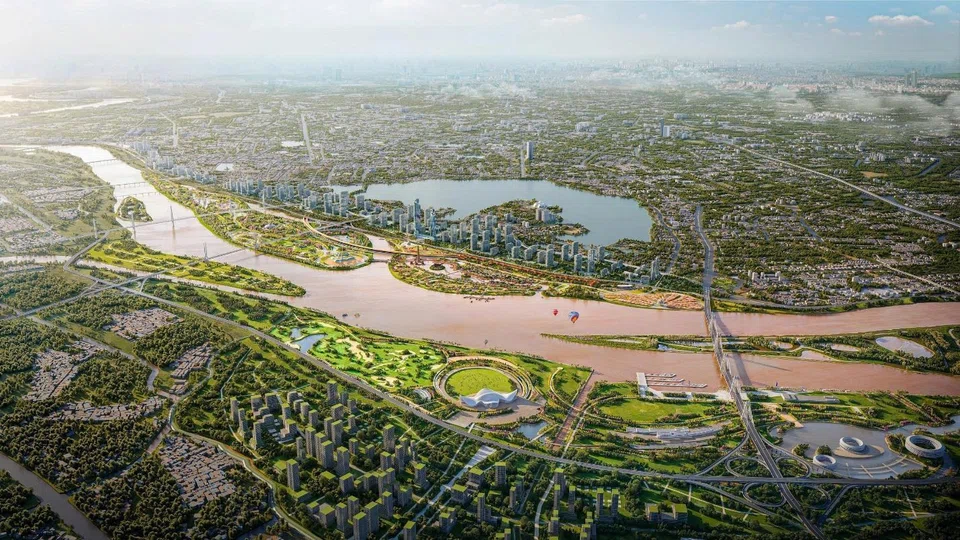
[HANOI] Vietnam’s capital is moving closer to realising its ambition of replicating Seoul’s “Miracle on the Han River” along the banks of its Red River.
Authorities this week approved a 736.9 trillion dong (S$35.6 billion) mega project that will become the spine of Hanoi’s century-long urban transformation.
The Hanoi People’s Council on Monday (May 11) signed off on the investment policy for the Red River Scenic Boulevard project, a development spanning 11,418 hectares. It includes an 80 km scenic boulevard, riverside parks, embankments and flood-control works, as well as urban resettlement areas.
The city wants to turn the Red River – long treated primarily as a flood-control corridor running close to Hanoi’s historic and urban centres around Sword Lake and West Lake – into the new economic, ecological and cultural backbone of the capital.
The ambition echoes Seoul’s transformation of the Han River from a polluted industrial waterway into a globally recognised urban centerpiece. Visiting Seoul in August 2025, Vietnam’s top leader To Lam said he admired South Korea’s “Miracle on the Han River” and was determined to create a “Miracle on the Red River”.
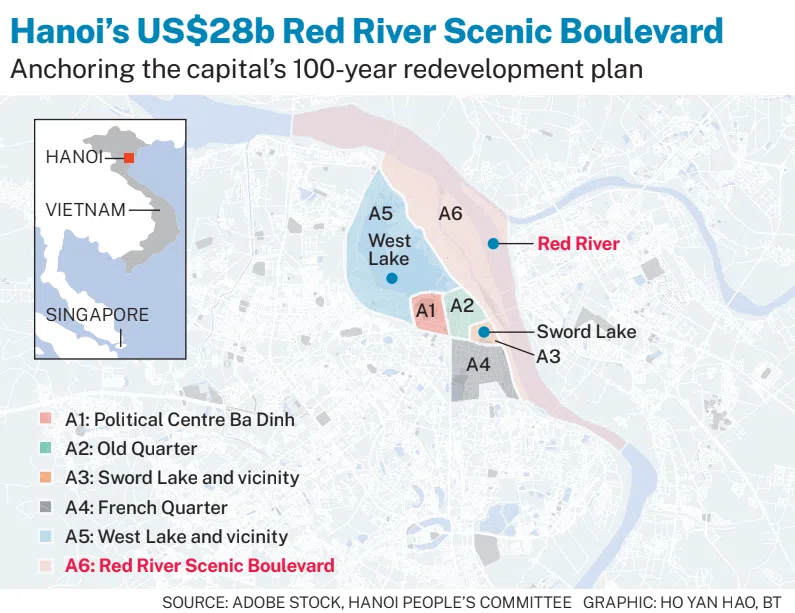
The project, which broke ground on an independent park component last December and is slated for full completion in 2038, is being developed by a consortium that includes automotive giant Thaco and steelmaker Hoa Phat, with Thaco’s real estate arm Dai Quang Minh, or Thadico, serving as the lead investor.
Hanoi’s People’s Committee said in a May 10 report that the investment will help ease pressure on the city’s budget and diversify investment resources, contribute to the city’s targeted double-digit economic growth; and align with policies promoting private-sector development and public-private partnership models in infrastructure construction.
At Hoa Phat’s 2026 shareholder meeting in Hanoi, Tran Dinh Long, founder and chairman of the steelmaker, said he believed the project could fundamentally reshape Hanoi’s urban identity, comparing its ambitions to riverfront transformations along Shanghai’s Huangpu River, Paris’ Seine River and Seoul’s Han River.
“The project will completely transform this area into a major architectural complex and create an urban district as beautiful as those in South Korea and China,” Long said, noting that the company is “proud to contribute” as part of the capital’s 100-year vision.
SEE ALSO



A century-long blueprint
The scenic boulevard project forms part of Hanoi’s master plan, officially approved on Mar 28, to transform the city into a globally connected metropolis and a “cultured, smart, innovative and ecological” megacity. Its population is projected to reach up to 19 million people by 2065, from around 8.8 million today.
Unlike Hanoi’s previous urban plans focused on incremental growth, the new blueprint stretches across a century.
At its core is a sweeping effort to redesign Hanoi into a “multi-polar, multi-centre and multi-layered” urban system aimed to address longstanding urban challenges, including traffic congestion, flooding, pollution, weak food safety, as well as ageing apartment buildings and substandard residential areas.
The scale of investment is staggering, with the first ten years needing an estimated 11 quadrillion dong – roughly three times Vietnam’s total social investment in 2025. The following 30 years would require possibly 12 times the first-phase amount, underscoring the scale of financial mobilisation required.
To fund the transformation, the city has laid out aggressive mechanisms rarely used at this scale in Vietnam, including transit-oriented development land auctions, international municipal bonds and expanded public-private partnership models.
However, the most jarring concern is the relocation of hundreds of thousands of residents, many of whom have lived and worked in the area for generations and now face uncertainty as they are moved to new urban zones further from the city centre.
Under earlier restructuring proposal of the Hanoi People’s Committee in January, it is estimated that more than 860,000 residents could be affected by redevelopment projects between 2026 and 2045, including roughly 200,000 people living near the Red River.
The city later sought to soften public alarm, saying the figure was only a planning scenario rather than a formal relocation target.
In fact, Hanoi has recently accelerated land clearance and site preparation for long-delayed infrastructure projects, including the Tran Hung Dao and Tu Lien bridges across the Red River as well as ring road expansions.
With some riverside plots among Hanoi’s most valuable land, concerns over transparency, compensation and public accountability are intensifying.
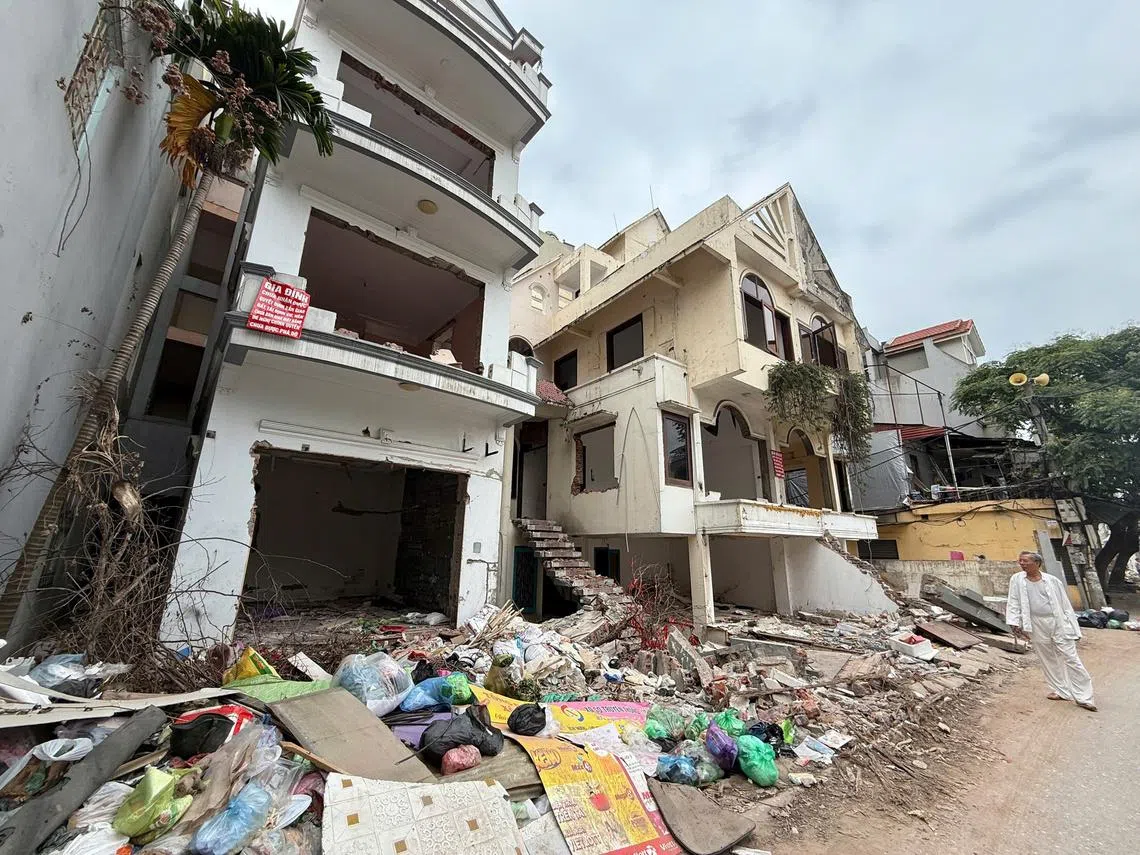
A March report from the city noted that during the public consultation phase of the master plan, residents had expressed deep concern over plans to clear roughly 2,100 hectares along the river corridor, warning that mass relocation could cause social welfare instability and disrupt the sustainable livelihoods of local residents.
“The massive scale of resettlement required will put a huge question mark on the project’s execution feasibility,” said Le Truong Giang, an analyst at the Singapore office of London-based risk consultancy Control Risks.
“The likelihood of social tensions and unrest creates reputational risks for investors besides commercial viability uncertainty,” he added.
Investors, exits and lessons learned
The Red River project’s investor reshuffling has also cast doubt on execution risks.
The original consortium included MIK Group, Van Phu Invest, T&T Group and Deo Ca Group, but these firms later withdrew.
Last December, Deo Ca – which was one of the earliest backers of the project in 2025 – exited, noting that the project extended beyond its core expertise in transport infrastructure into highly complex urban redevelopment.
MIK Group also withdrew days after groundbreaking in the same month, followed later by Van Phu Invest and T&T Group this May.
That left Thadico increasingly dominant within the consortium.
The company has rapidly increased its charter capital this year, raising it three times to 26.1 trillion dong by April.
The firm was previously involved during the 2010s as an investor in several infrastructure projects within Ho Chi Minh City’s Thu Thiem New Urban Area, also located directly across the Saigon River from District 1, the city’s central business district.
In 2019, the Government Inspectorate concluded that the use of build-transfer or land-for-infrastructure arrangements in Thu Thiem involved multiple procedural violations, including non-transparent investor selection and land valuation, creating risks of state budget losses.
Critics note that the same model is now being used again for the Red River project – only on a much larger scale, with a public-private partnership in which private developers finance and construct infrastructure, and are compensated by the state through the allocation of land use rights.
Under Hanoi’s latest resolution on the project, the investor consortium will receive about 2,655 hectares of land within and outside the Red River project area as payment for their works.
Meanwhile, even though Thaco and Hoa Phat are among Vietnam’s largest and most capable business groups, the absence of conglomerates with proven experience in developing mega-scale integrated developments such as Vingroup and Sun Group has sparked scepticism.
“They might not view the project as commercially attractive, even with land compensation,” Giang noted.
Hoa Phat’s Long told shareholders earlier that the firm maintained a cautious investment stance, avoiding short-term real estate cycles.
However, the project was selected due to its exceptionally rare location and long-term value creation potential, including the ability to attract 30 million to 40 million visitors annually.
“Hoa Phat does not put profit first when implementing this project, but we also won’t do it at all costs,” Long told shareholders.
He also acknowledged the enormous technical and social risks involved in the Red River project, particularly the relocation of residents and the challenge of flood management along the river.
“These are extremely difficult challenges,” Long said. “But if we cannot do it this time, perhaps we will never be able to do it.”
Decoding Asia newsletter: your guide to navigating Asia in a new global order. Sign up here to get Decoding Asia newsletter. Delivered to your inbox. Free.
Copyright SPH Media. All rights reserved.
TRENDING NOW

Once staunchly pro-China, Malaysian Chinese businesses are now distancing themselves from Beijing

Looking beyond looming CEO succession, should UOB potentially pursue a transformative merger?

Could stablecoins be the future of money?

Grab CEO’s wife Chloe Tong on life with Anthony Tan and finding her purpose

