



China touts significant progress tackling South-east Asian scam syndicates
But international law enforcement and human rights monitors warn of crime networks rapidly adapting
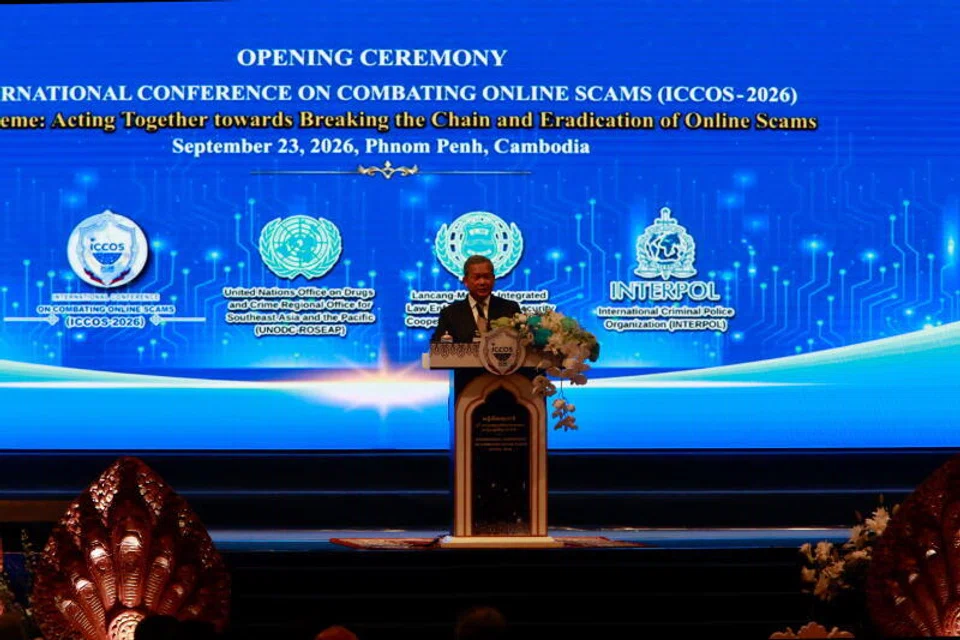
[SINGAPORE] A senior Chinese security official said joint law enforcement operations across South-east Asia have successfully curbed the region’s multibillion dollar cybercrime crisis.
“After years of arduous practice, we have successfully explored a Chinese approach to solving this problem,” Yang Weilin, Vice-Minister of Public Security, said at an international conference on combating online scams in the Cambodian capital Phnom Penh on Wednesday (Sep 23).
Yang claimed joint crackdowns in South-east Asia have “significantly improved the situation”, adding that Beijing’s work with counterparts in Myanmar succeeded in “completely eliminating large-scale telecom fraud dens” in the country’s northeast.
Yang described the “Chinese approach” in his comments as being “people-centred” and including a focus on improving specialised research and technology and deepening international cooperation.
Beijing has spent years working with regional governments to repatriate tens of thousands of cybercrime suspects and Chinese President Xi Jinping has personally urged leaders to tackle the issue.
Those efforts include high-profile extraditions of alleged scam masterminds, including Prince Group chairman Chen Zhi, who was arrested in Cambodia and returned to China in January.
The US had also sought his arrest and sanctioned related companies over alleged ties to cyber fraud.
China’s claims of success contrast with warnings from international law enforcement and human rights monitors that criminal networks are rapidly adapting.
While regional authorities say major compounds in Cambodia and Myanmar have been cleared, syndicates have increasingly fragmented and shifted operations to West Africa and South Asia, while stealing an estimated US$440 billion globally.
SEE ALSO






The US-China Economic and Security Review Commission, which monitors and advises Congress on national security issues in US-China ties, said recent crackdowns on scam centers in countries like Cambodia had seen Chinese criminals return home to start smaller-scale operations targeting only foreigners.
Addressing the same forum, Nicholas Court, the director of taskforce coordination at Interpol based in Lyon, France, said the the number of agency notices relating to fraud has increased by more than 50 per cent in the last two years.
“Scam centres, especially in this region, are increasingly being moved from large centres into much smaller ones, which are harder to trace,” he said.
“What that tells us is that law enforcement efforts are having an impact here. However, fraud remains the most significant crime type by volume in the world.”
Cambodian Prime Minister Hun Manet urged the international community to “firmly reject finger-pointing, politicisation, and unilateral coercive measures” during the conference.
Cambodia has accused Thailand of using cybercrime narratives to justify unlawful territorial incursions over their border.
“These would undermine state sovereignty and fracture the collective unity required to dismantle complex criminal networks,” the Cambodian leader said. BLOOMBERG
Decoding Asia newsletter: your guide to navigating Asia in a new global order. Sign up here to get Decoding Asia newsletter. Delivered to your inbox. Free.
Share with us your feedback on BT's products and services
TRENDING NOW

Once staunchly pro-China, Malaysian Chinese businesses are now distancing themselves from Beijing

Looking beyond looming CEO succession, should UOB potentially pursue a transformative merger?

Could stablecoins be the future of money?

Grab CEO’s wife Chloe Tong on life with Anthony Tan and finding her purpose

