China’s Li Auto makes Asia-Pacific push announcing entry into Singapore, Hong Kong, Thailand, Vietnam
Automaker enters right-hand-drive markets with first model being the Li Mega multi-purpose vehicle

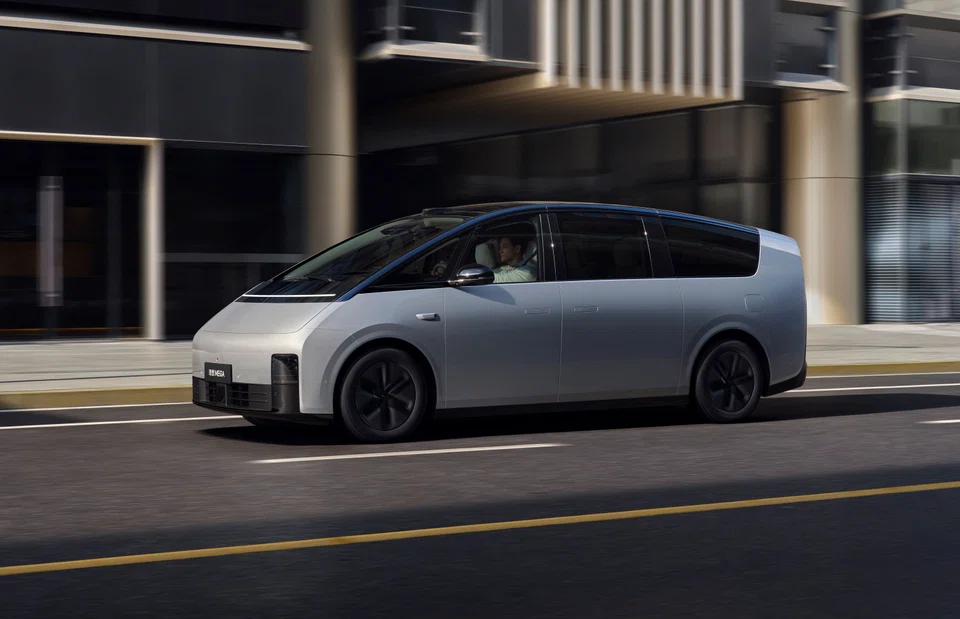
[SINGAPORE] China carmaker Li Auto announced its entry into a number of Asia-Pacific markets on Tuesday (Nov 10), including right-hand-drive markets such as Singapore, Hong Kong and Thailand for the first time.
At a ceremony in Beijing, the Hong Kong Stock Exchange-listed company signed deals with distributors in Singapore, Thailand, Hong Kong, the Philippines, Vietnam and Myanmar.
Sales in the Philippines began earlier this year, with sales for all other markets to start in 2027.
In Singapore, Wearnes Automotive has been appointed as distributor with a showroom to be located at 45 Leng Kee Road and the first deliveries expected in January or February 2027.
For right-hand-drive markets, the first model will be the Mega, a large multi-purpose vehicle launching in 2027. The company’s first fully electric vehicle, it is 5.4 m long and has space for seven people.
Dual motors give a maximum of 400 kilowatts (kW) of power, and a 103 kilowatt-hour battery delivers a quoted range of up to 700 km. The car has an 800 volt EV system and can charge at a maximum rate of up to 520 kW, from 10 to 80 per cent in around 10 minutes.

Premium tech carmaker
This builds on comments chairman and CEO Li Xiang made at an earnings call in September, where he said the company would enter right-hand-drive markets and position itself as a premium brand abroad.
The second model for right-hand-drive markets will be the i6 sport utility vehicle. For the first eight months of the year, the i6 has been the third best-selling car in China, behind the Geely EX2 and Tesla Model Y.
Founded in 2015 by Li, the company has emerged as a maker of premium, high-tech new energy vehicles – the China market term for electric and hybrid cars – alongside rivals such as Nio and XPeng.
SEE ALSO




The company listed on the Hong Kong Stock Exchange in 2015, and on Nasdaq in 2020, through American depositary shares.
As China’s domestic car market becomes increasingly competitive and unprofitable due to “involution”, its carmakers are increasingly banking on export sales.
Earlier this year, Li Auto announced plans for Cambodia, Laos and Macau, while industry reports say the company is poised to enter Malaysia and Australia soon. It is also ramping up its presence in the Middle East and Europe, and aims to enter the UK in 2027.
While it has produced EVs in recent years, Li Auto first gained traction with its range-extended EVs. These are hybrid petrol-electric cars with a smaller battery pack than full EVs, recharged by a small petrol engine, a set-up that potentially offers better efficiency than conventional hybrid cars.
The company is also involved in automotive technology, including autonomous vehicles, and spun off an auto chip venture in June this year.
However, like Nio and XPeng, the manufacturer has achieved impressive sales but not been consistently profitable.
For the second quarter ended June 2026, Li Auto reported a net loss of 1.7 billion yuan (US$251.3 million) compared with a net loss of 1.1 billion yuan the previous year.
Revenue for the quarter was 25.7 billion yuan, a 15.1 per cent reduction year on year, while profit margin on vehicles was down to 9.4 per cent, from 19.4 per cent.
Free cash flow was negative 1.3 billion yuan, compared with negative 3.8 billion yuan the year before.
Decoding Asia newsletter: your guide to navigating Asia in a new global order. Sign up here to get Decoding Asia newsletter. Delivered to your inbox. Free.
Copyright SPH Media. All rights reserved.