Faster delivery, easier credit fuel South-east Asia e-commerce: survey
Existing shoppers spend more online, prioritising product authenticity and purchase protection


[KUALA LUMPUR] South-east Asia’s next wave of e-commerce expansion will not come from winning over first-time buyers, but from getting existing digital shoppers to spend more, said data analytics firm Cube Asia.
Speaking at a media briefing in Kuala Lumpur, Malaysia on Tuesday (Oct 20), Cube Asia co-founder Simon Torring noted that the regional market has moved past its initial user-acquisition phase.
Instead, future expansion will depend on current digital shoppers shifting more of their traditional retail spending online, he added, citing the firm’s 2026 eCommerce Savvy Shopper Report: South-east Asia.
Torring highlighted that regional e-commerce growth this year meaningfully outperformed Cube Asia’s original forecasts due to a faster-than-expected transition from brick-and-mortar stores.
“Faster delivery, including expanded same-day options, is encouraging consumers to buy online what they previously bought at physical malls,” he added.
He said that buy now, pay later schemes serve as a major catalyst in Malaysia and the broader region, noting shoppers often secure financing more easily online than offline.
Cube Asia forecasts annual online spending on physical goods in South-east Asia to reach US$400 billion by 2031.
Philippines leads in savviness
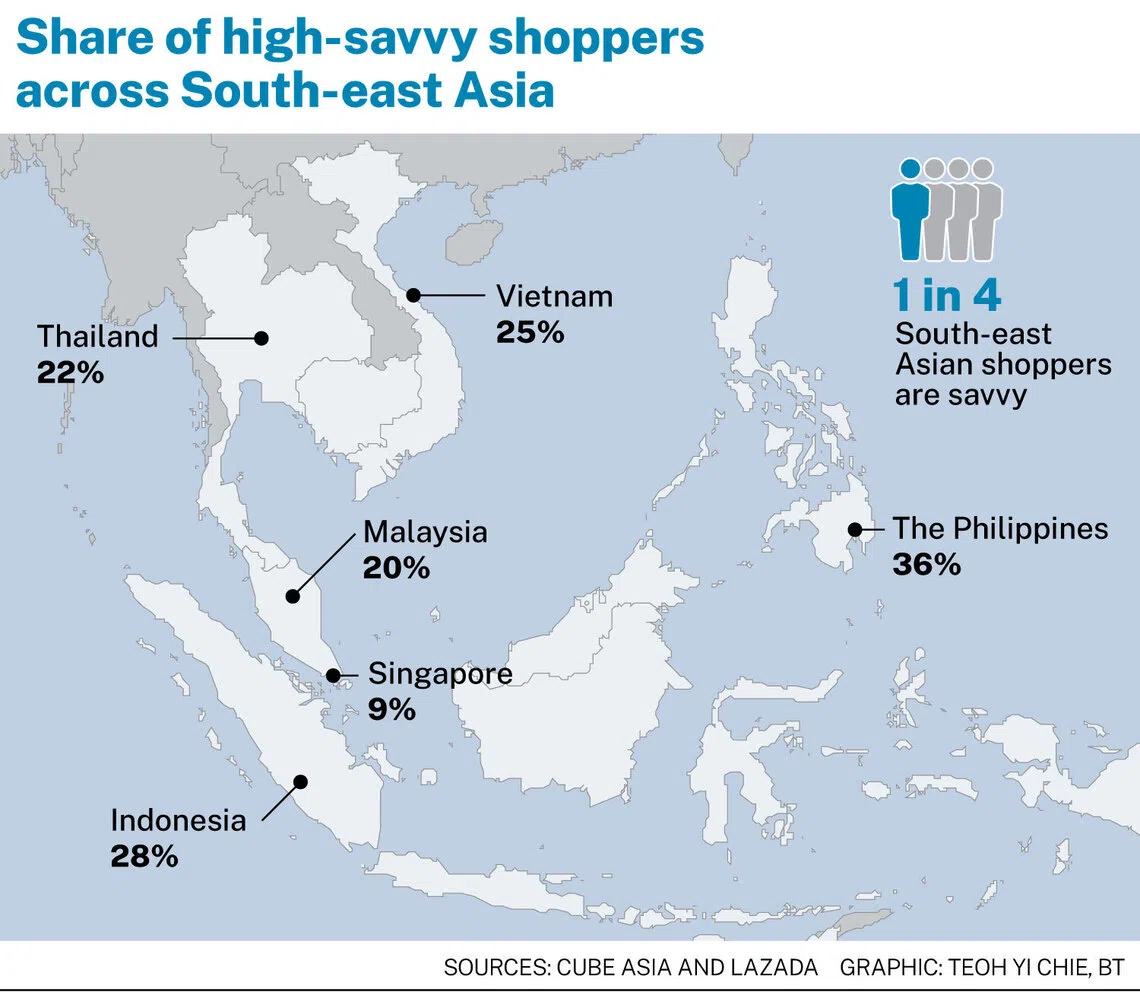
The Philippines leads South-east Asia in e-commerce savviness, and Singapore ranks lowest, the report by Cube Asia and Lazada showed.
Based on a survey of 6,000 respondents across six markets, the study defines “savvy shoppers” as those scoring above the regional median in four areas: verification, value optimisation, purchase protection and digital fluency.
SEE ALSO







These cover activities such as checking reviews and authenticity information, comparing offers, assessing return policies and using external information or artificial-intelligence tools.
Overall, one in four respondents in South-east Asia met the benchmark.
The percentage of shoppers above the regional median for all four dimensions was led by the Philippines (36 per cent), followed by Indonesia (28 per cent), Vietnam (25 per cent), Thailand (22 per cent), Malaysia (20 per cent) and Singapore (9 per cent).
These savvy consumers spend 31 per cent more monthly than average shoppers, representing an estimated US$11.5 billion in annual marketplace spending.
The spending difference was largest in the Philippines, where savvy shoppers reported a monthly expenditure 47 per cent higher than that of other respondents.
Vietnam followed at 44 per cent, Malaysia at 36 per cent, Thailand at 27 per cent, Indonesia at 19 per cent and Singapore at 13 per cent.
Singapore’s smaller cohort likely stems from lower marketplace usage: Only 48 per cent of respondents shop on marketplaces weekly, compared with 66 per cent regionally.
Torring explained that fewer interactions on these platforms give Singaporeans fewer chances to become familiar with the trust signals, value mechanisms and digital tools that drive savvy shopping behaviours.
In Malaysia and Vietnam, verification was the primary gap, suggesting that platforms should make seller credentials and authenticity details easier to verify.
Confidence and protection contrastingly posed the biggest hurdle for shoppers in Singapore, Indonesia and the Philippines.
Lazada taps trust and authenticity
For Lazada Malaysia, the findings reinforce a longer-term strategy centred on trust, authenticity and a smoother shopping experience, said Lazada Malaysia CEO Kaya Qin.
While subsidies could support low prices and market-share growth, the company also needed a durable competitive proposition, she said in response to a question about expanding its market share.
Central to that approach is strengthening LazMall, which functions like an online department store, bringing official brands and authorised sellers together with authenticity assurances and purchase safeguards.
During Lazada Malaysia’s 9.9 campaign, 46 per cent of shoppers bought from LazMall, accounting for 40 per cent of all orders made, said Qin.
Based on the figures she presented, Lazada Malaysia’s average order value increased 22.4 per cent from the previous year’s campaign, and spending per purchasing shopper rose 7 per cent.
The campaign figures illustrate purchasing behaviour on one platform, rather than changes in regional demand.
Qin described higher-value and trust-sensitive categories, including jewellery, electronics and contact lenses, as a “torture test” of shoppers’ confidence in buying products they could not inspect physically.
Growth in those categories did not mean Lazada was limiting its offering to premium goods, she said. The e-commerce company continues to serve different budgets and support local, international and cross-border sellers.
Its trust safeguards span seller credential checks, authenticity guarantees, verified buyer reviews and robust return policies.
According to Qin, building these protections has been a multi-year effort, which accelerated over the past two to three years through the expansion and fortification of LazMall.
The regional survey highlighted that consumers are selective about the trade-offs they are willing to make for discounts: While 43 per cent would accept slower delivery for a lower price, only 13 per cent would compromise on warranties, returns or refunds.
Decoding Asia newsletter: your guide to navigating Asia in a new global order. Sign up here to get Decoding Asia newsletter. Delivered to your inbox. Free.
Copyright SPH Media. All rights reserved.