



Hanoi breaks ground on five metro lines worth 1,315 trillion dong, targeted for 2030
Vinhomes, VinSpeed are named EPC contractors for the capital city’s public-investment metro push

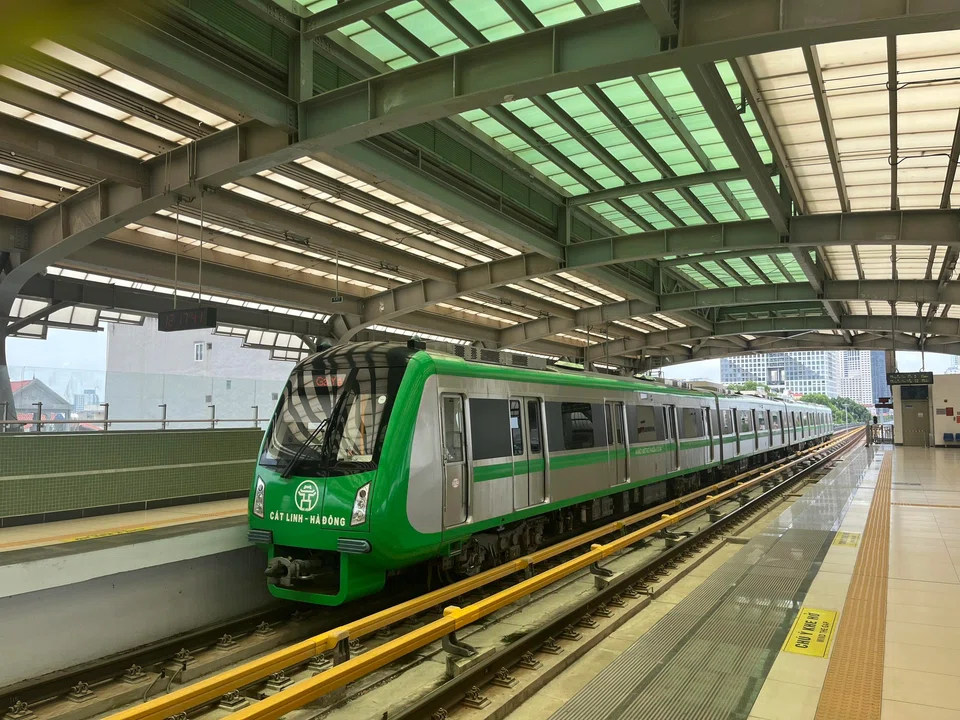
[HO CHI MINH CITY] Hanoi started work on five new metro lines simultaneously on Monday (Jun 22), marking its biggest urban-rail investment programme to date as the capital of Vietnam seeks to ease chronic congestion and reshape urban growth around mass transit.
The five lines, targeted for completion by 2030, will span a combined length of more than 300 km, with preliminary investment estimated at more than 1,315 trillion dong (S$64.6 billion).
The projects are being advanced under Vietnam’s public-investment framework. The Hanoi Metropolitan Railway Management Board has been assigned as project owner and a Vinhomes-VinSpeed consortium – part of the ecosystem of Vietnam’s largest private conglomerate Vingroup – has been selected as the engineering, procurement and construction (EPC) contractor.
Funding is expected to be mobilised from multiple sources, including central and local budget capital, concessional loans, local government bonds and other financing channels under special mechanisms approved for urban railway development in Hanoi and Ho Chi Minh City.
The new metro lines in Hanoi – No 1, 2, 8, 10 and 14 – will connect major transport hubs and growth areas including Noi Bai International Airport, Hanoi railway station, Hoa Lac Hi-Tech Park and the capital’s outlying areas of Dong Anh, Gia Lam and Ngoc Hoi.
They will also pass through or near several new urban zones, including some linked to Vinhomes’ existing developments.
Along with Hanoi’s two operational metro services – the Cat Linh-Ha Dong line and the elevated section of the Nhon-Hanoi Station line – the new routes are expected to link with Line No 3 and No 5, both under development, to form the backbone of the capital’s urban railway network.
Seen as a key tool
The move comes as Hanoi faces rising pressure from rapid urbanisation, worsening traffic congestion and growing demand for more efficient public transport.
City authorities have identified metro development as a key tool to support transit-oriented development using rail stations as anchors to reorganise urban space and create new growth corridors.
SEE ALSO


Under Hanoi’s 100-year master plan, the capital aims to develop 18 urban railway lines with a total length of about 979 km by 2045. About 500 km are targeted for completion by 2035.
Vietnam is under pressure to accelerate public investment disbursement to draw down its large state budget surplus, return liquidity to the banking system and support its double-digit growth targets for this year and next.
As at Jun 11, public investment disbursement had reached more than 245 trillion dong, equivalent to only 24.2 per cent of the 2026 plan of more than 1,000 trillion dong.
Meanwhile, private-sector participation in Vietnam’s railway sector is expanding.
VinSpeed is the investor in Vietnam’s first two high-speed railway projects: the 54-km Ben Thanh-Can Gio line in Ho Chi Minh City and the 120-km Hanoi-Quang Ninh line in the north.
In Ho Chi Minh City, a Truong Hai Group Corp-led consortium is involved in the development for Metro Line 2’s Ben Thanh-Tham Luong section and the Ben Thanh-Thu Thiem extension.
Other private groups, including Sovico, Becamex and Masterise Group, have proposed urban rail projects in the city.
Decoding Asia newsletter: your guide to navigating Asia in a new global order. Sign up here to get Decoding Asia newsletter. Delivered to your inbox. Free.
Copyright SPH Media. All rights reserved.
TRENDING NOW

Government to bring forward raising of retirement age, give employers more financial support to create flexi-load jobs
If Europe goes to war, the fallout will be felt in East Asia

Indonesia stocks suffer worst plunge in nearly 30 years as MSCI proposes standalone status

Vietnam’s northern provinces, not Hanoi or Ho Chi Minh City, are powering near 10% GDP growth

