Vietnam loosens bank safeguards to spur growth, stoking prudential concerns
Regulatory relief may be ‘pragmatic’, but analysts warn of systemic risks

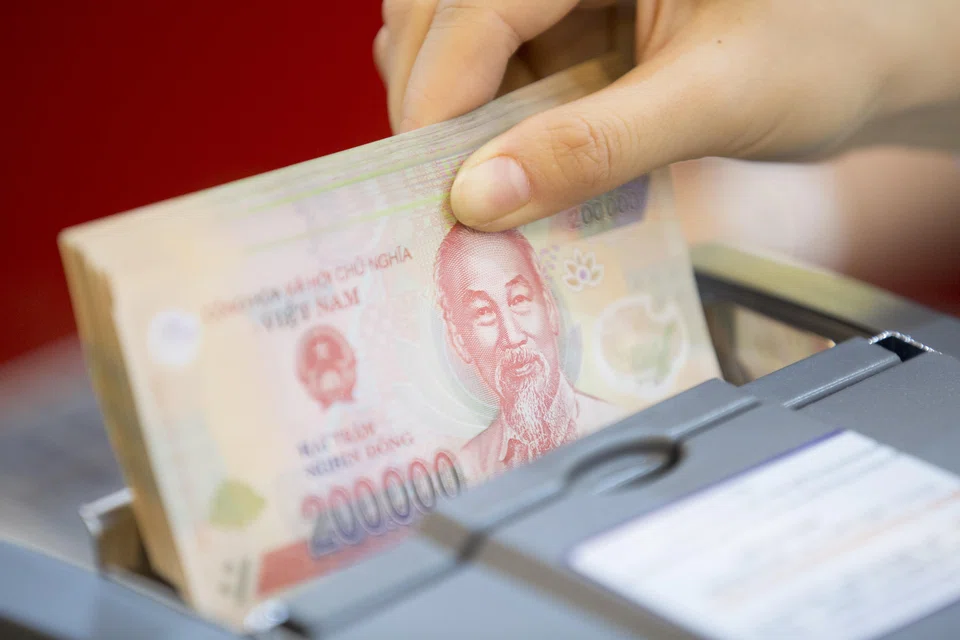
[HO CHI MINH CITY] Vietnam is seeking to ease some of the safety rails around its banking system, as policymakers try to keep credit flowing to priority sectors and major projects.
This comes as part of a broader push to achieve double-digit growth targets for this year and next.
In recent months, the State Bank of Vietnam (SBV) – the country’s central bank – has moved on several fronts to ease funding constraints for lenders, including reversing funding caps, recognition of Treasury deposits in regulatory ratios, and carving out of certain projects and sectors from lending limits.
Analysts said the shift may support near-term growth, but could weaken financial discipline and add pressure on Vietnam’s sovereign credit rating profile, which remains below investment-grade.
Safety rules give way to growth
On Monday (Jun 22), SBV issued a rule change that raises the cap on short-term funding used for medium and long-term lending to 40 per cent from 30 per cent from Jul 1 this year.
This has reversed part of a multi-year tightening path that had gradually lowered the cap from 40 per cent to 37 per cent, then 34 per cent, before reaching 30 per cent from October 2023.
Analysts at Ho Chi Minh City Securities Corporation (HSC) described the proposal as “a direct liquidity and credit-support signal for banks”.
Returning the ceiling to 40 per cent would give lenders more room to fund longer-tenor loans with short-term deposits, potentially supporting sectors with large capital needs such as real estate, infrastructure, manufacturing and household mortgages.
“The trade-off is liquidity risk,” they said on Thursday, noting that Vietnam’s banking system still relies heavily on short-term deposits, while much of the economy’s borrowing demand is longer term.



“A higher cap can help credit growth in the near term, but it also increases maturity mismatch if deposit competition intensifies or liquidity conditions tighten,” they added.
Earlier in June, the regulator also enabled 25 commercial banks to carve out loans for social housing, industrial parks and export processing zones from their 2026 real estate credit growth limits.
The move comes even after SBV asked banks to rein in credit growth from the start of 2026, capping first-quarter lending at no more than 25 per cent of their full-year quota against a system-wide credit-growth target of about 15 per cent this year.
Last month, SBV also partly reversed a tightening of how State Treasury deposits are treated in banks’ loan-to-deposit ratio (LDR) calculations. In effect, the change allowed banks to count 20 per cent of State Treasury term deposits as a funding source.
Before that, Treasury deposits had been fully excluded from banks’ LDR calculations under a tightening road map.
The same easing pattern is also visible in credit-concentration rules. In a separate proposal introduced in March, SBV laid out a framework that would allow credit institutions to extend above-limit credit to developers of large, socially significant projects in Hanoi.
The maximum exposure could be set at 38 per cent of a bank’s equity for a single borrower and 52 per cent for a borrower and related parties.
Those thresholds would stand far above 2026 ordinary limits of 13 per cent and 21 per cent, respectively, under the Law on Credit Institutions.
Quan Trong Thanh, head of research at Maybank Investment Bank Vietnam, said that rather than blanket monetary loosening, the current approach of SBV represents a “laser focus” – channeling capital into projects that remain within the state’s strategic priorities.
“This can be seen as pragmatic,” he said. “It reflects an understanding of the situation and the need to meet growth demand, while still trying to keep things within control.”
However, he pointed out a downside in the concern investors may have when looking at Vietnam’s banking regulatory framework.
Fitch Ratings sees the recent measures as evidence of Vietnam’s dependence on domestic banks to finance growth.
The economy’s need for long-term funding for infrastructure and emerging sectors is immense, while alternatives such as deep local capital markets or affordable international borrowing remain limited for many domestic borrowers.
“The regulators also continue to set precedents for how prudential settings can be flexible to achieve broader economic outcomes, which does not help to build confidence in prudential supervision,” said Willie Tanoto, senior director in Fitch Ratings’ Asia-Pacific financial institutions analytical group.
“While (SBV’s moves) may facilitate banks’ compliance with required ratios on paper, risks on banks’ funding profiles have risen,” he added.
Liquidity stress exposes limits of paper relief
The regulatory easing comes as system liquidity is already under pressure.
Viet Dragon Securities Corporation (VDSC) in a Jun 8 analysis said SBV is “in a difficult position” in managing banking system liquidity and interest rates.
By the end of May, system-wide credit had grown 5.71 per cent from the start of 2026, while deposits had increased only 2.98 per cent.
The gap between outstanding credit and Market 1 deposits, or funding raised from households and companies, was estimated at more than 2,500 trillion dong (S$122.5 billion).
This pushed the year-to-May Market 1 LDR ratio to about 115 per cent, up from 109 per cent at the end of 2025 and 106 per cent at the end of 2024.
VDSC said this was “not a temporary development”. Liquidity pressure has persisted since the fourth quarter of 2025, pushing up interbank rates and household deposit rates despite regulatory attempts to contain funding costs.
“SBV’s intervention measures only address the symptoms and do not resolve the fundamental supply-demand imbalance in the system,” it added.
That imbalance has several roots.
The brokerage pointed out that credit demand has accelerated, especially for medium-term and long-term loans. Deposit growth has lagged as a large state budget surplus and rising cash in circulation pulled money away from the banking system.
At the same time, SBV has also had limited room to inject large-scale VND liquidity because of pressure on foreign-exchange reserves, the currency and inflation, which accelerated to a six-year high in April.
That leaves fiscal policy as the more important release valve. VDSC said the “only liquidity anchor” left is faster public investment disbursement, to reverse the state budget surplus and return money to the banking system.
However, as at Jun 11, public investment disbursement had reached just over 245 trillion dong, equivalent to only 24.2 per cent of the 2026 plan of more than 1,000 trillion dong. The state budget surplus, meanwhile, stood at nearly 495 trillion dong.
Pressures on sovereign credit profile
Given the elevated liquidity pressure, along with the economy’s high leverage level – at more than 150 per cent of gross domestic product, triple the median level of the sovereigns at the same rating category – Fitch Ratings’ Tanoto noted that SBV will have increasingly narrower space to loosen monetary policy settings without jeopardising financial stability.
Persistently high credit growth, especially in the absence of robust prudential guardrails, would raise the risks of credit misallocation, asset bubbles and liquidity stress, he added.
“In the event of an economic shock that causes banking system risks to crystallise, Vietnam’s economic prospects may substantially weaken, which would weigh on the sovereign rating,” Tanoto said.
Maybank’s Thanh said that despite the short-term loosening, Vietnam is still moving towards a more modern regulatory framework closer to Basel III standards.
Whether the latest easing is viewed positively will depend on whether the final rules come with clear guidance and a credible road map.
“Without that, the easing could be seen as a step backward in Vietnam’s effort to improve financial governance and strengthen its sovereign credit profile,” Thanh added.
Decoding Asia newsletter: your guide to navigating Asia in a new global order. Sign up here to get Decoding Asia newsletter. Delivered to your inbox. Free.
Copyright SPH Media. All rights reserved.