‘In hospitals, even cleaners are critical’: IHH Group CEO says leadership starts with the people no one sees
Every role matters – empathy, not strategy alone, determines success, says group CEO

The strategies and stories that shape today’s leaders
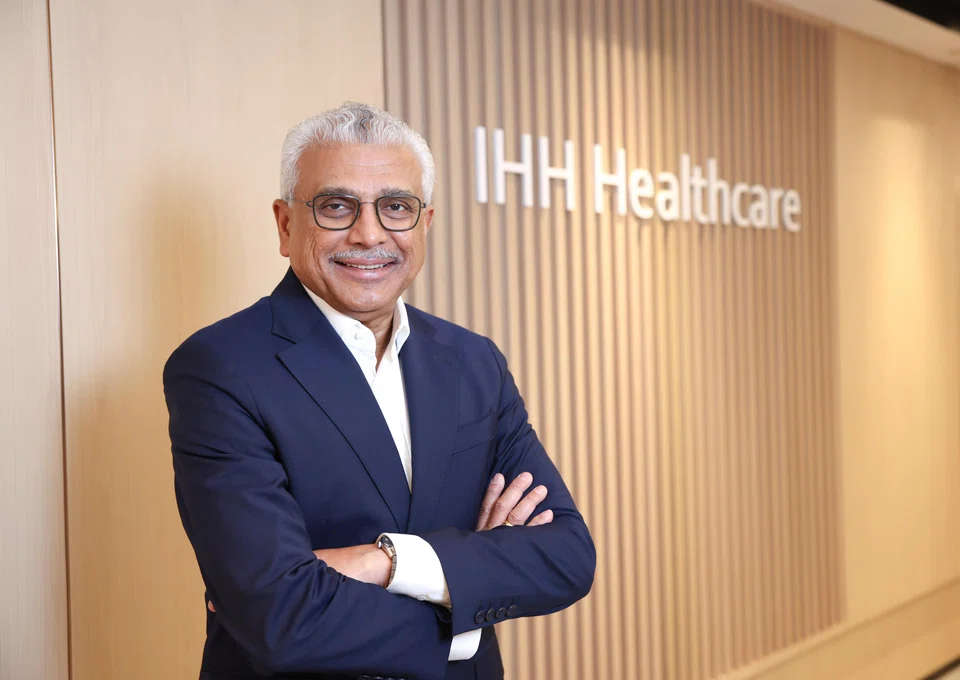
[KUALA LUMPUR] Dr Prem Kumar Nair did not grow up dreaming of a career in only medicine. Law too appealed to him for the same reason healthcare eventually did: both are, at heart, about people.
That instinct, more than any grand doctrine, now sits at the centre of how he runs IHH Healthcare – one of the world’s largest private-hospital operators.
The group, which has a market capitalisation of RM77.2 billion (S$25 billion), reported a revenue of RM25.7 billion last year, up nearly 6 per cent from FY2024. It operates 89 hospitals and more than 140 healthcare facilities across 11 markets.
For Dr Nair, leadership is not an abstract management theory but one that is intensely human. It is about whether one can speak with equal ease to a specialist, a patient’s family member and the cleaner keeping a ward safe.
“I like being with people,” said the group chief executive of IHH. “Ask me to speak to anyone, from the office cleaner to a specialist, and I am very comfortable. I enjoy it.”
His entry into medicine was, by his own telling, almost accidental. After pre-university studies, he applied for medicine, dentistry and law, not entirely certain where he belonged. Medicine came through.
“I stumbled into medical school,” he recalled, noting that his parents were more certain about the choice than he was.
Dr Nair was serving national service in Singapore when the enrolment letter arrived. He called his parents -– who were in Malaysia – to inform them of his acceptance into medical school.
“I still remember my mother’s reaction. She said: ‘You don’t sound very happy about it,’” he laughed.
That has since hardened into one of his bluntest pieces of advice for young people considering healthcare as a career: If you do not like dealing with people, it is probably the wrong industry.
“When youngsters ask me for advice, I ask them what they do in their free time. Are they out playing sports and meeting people, or are they focused solely on technology? It’s a quick assessment, but a vital one. Even at the most junior level (in a healthcare setting), your day is filled with talking to patients and families. You have to be comfortable in those moments.”
People-first policy
While training as a family physician, Dr Nair, a Singapore citizen, became drawn to the machinery around medicine – how healthcare systems are organised, financed and delivered at scale.
That interest eventually pulled him beyond clinical care and into management, leading him to pursue a Master of Business Administration (MBA) – a step he now sees as career-defining.
“Most doctors are not naturally managers; their training is intensely specialised, focusing on narrow sub-specialities,” observed the 64-year-old, who grew up in Malaysia.
Drawing from his own dual perspective as a National University of Singapore-trained physician and a Manchester Business School MBA holder, he understands the rare balance required to lead a global healthcare giant.
Dr Nair believes leadership in healthcare cannot be reduced to strategy alone. “One thing I’ve learnt is that leadership is far more about people than anything else.”
While business schools emphasise financial metrics and strategic frameworks, he argues that the most critical skill – people management – is often underplayed.
Empathy, he noted, is the constant across all levels of leadership.
“In a hospital, even cleaners are critical. Without them, the system simply cannot function.”
Resilience overcomes forex volatility

Despite the group’s strong revenue performance, currency headwinds had an impact on its bottom line in the 2025 financial year, with net profit declining by 21 per cent to RM2.1 billion.
This decrease was largely attributed to a stronger ringgit leading to unrealised forex losses, alongside rising depreciation and staff expenses.
Dr Nair said IHH’s core earnings have expanded at double-digit rates in recent years, both at the top line and bottom line, when measured in local currencies across its operating markets.
The group’s diversified footprint spanning Asia, Europe and the Middle East – provides a natural hedge against volatility in any single market, although reported earnings can fluctuate due to foreign-exchange movements.
IHH – which is dual-listed on the Singapore Exchange and Bursa Malaysia – reports in ringgit. Thus, currency-translation effects, particularly from markets such as India, Turkey and Singapore, can result in non-cash translation losses, even when underlying operations remain strong.
“We emphasise our core earnings,” the group CEO said, noting that this is the metric most closely watched by investors and analysts.
IHH’s scale also allows it to extract efficiencies, particularly through centralised procurement.
Almost all major capital expenditures, including for magnetic resonance imaging or MRI scanners, linear accelerators and patient-monitoring systems, are negotiated at the group level, allowing IHH to secure some of the most competitive pricing across its markets.
“That has become a very important lever,” he pointed out, as hospitals face constraints in passing on rising costs to patients.
Expansion pace continues
Even in uncertain times, IHH remains on the hunt for growth opportunities.
According to Dr Nair, the focus is on economies of scale and targets that add immediate or near-term value to earnings. Key requirements include scalability and the potential for operational synergy in areas such as IT and procurement.
Yet, he maintains a flexible approach, noting that since every market is different, there is no “one size fits all” strategy.
In emerging markets such as Malaysia, India and Turkey, the group continues to drive organic growth by expanding bed capacity and upgrading facilities to meet rising demand.
The chief highlighted the 2024 acquisition of Island Hospital in Penang as a pivotal turning point.
This initially boosted Malaysia’s contribution to IHH’s medical tourism business, from low single digits to nearly 10 per cent last year. “That contribution has since climbed to approximately 15 per cent, closing the gap with more established markets.”
He emphasised that Malaysia’s growth potential remains significant, and that the company continues to seek strategic opportunities.
“Klang Valley and Johor remain attractive hubs. While we have a dominant presence in Penang, we aren’t everywhere yet. We are also seeing robust growth in Melaka, fuelled by medical tourism from Sumatra.”
Unlike emerging markets, mature markets such as Singapore and Hong Kong have strict regulatory caps on new private hospital licences.
In such places, IHH has chosen to focus on community-based care, by adding numerous ambulatory centres, including surgical, medical, endoscopy and comprehensive facilities, such as its new one in Shanghai.
“This aligns with a global healthcare trend towards right-siting care outside capacity-strapped hospitals, and improving patient experience,” he added.
Complementing this localised approach is a push towards consolidating IHH Laboratories’ regional businesses into a unified platform, enabling the lab services division to expand into high-value genomics and precision medicine.
“Currently, many of these tests are sent abroad to institutions such as the Mayo Clinic. To capture this, we are establishing our own reference and genomic laboratories – starting in India, with plans to expand across South-east Asia.”
Shifting landscape
Even as IHH expands, it continues to navigate a complex operating environment shaped by geopolitical tensions, rising costs and shifting patient behaviour.
Dr Nair noted that such pressures are affecting medical tourism flows, particularly through travel disruptions and affordability constraints.
However, the sector’s underlying resilience remains intact. “You can defer, but you cannot avoid many treatments,” he added.
This dynamic supports relatively stable demand, with patient volumes typically rebounding once external pressures ease.
Insurance coverage is also strengthening the industry’s resilience, with more patients covered across key markets, reducing reliance on out-of-pocket spending.
From business to healthcare leadership
For Dr Nair, the evolution of IHH is not just about scale or financial performance, but about redefining leadership in healthcare.
When he took on the role in 2023, the group was widely seen as a strong business operator. But he pushed for a broader identity.
“We needed to be seen as a healthcare leader,” he said, noting that the leadership requires setting global standards and expanding patient access rather than merely chasing growth.
In an industry where margins, manpower and expectations must be balanced, Dr Nair’s philosophy remains unwavering. “Behind every number is a patient. Healthcare, at its core, is always about people.”
Three questions with IHH Healthcare group CEO Dr Prem Kumar Nair
Q: Was there a pivotal moment in your career or personal life that changed your approach to leadership?
It evolved over time. My background – growing up in Malaysia during the 1960s and 1970s, and my time in national service and studying medicine in Singapore – all of that shaped me.
I have always taken the view that it’s very difficult for one individual to know everything. When I took over this role, I also had a hard look at how IHH was perceived. We were seen as a strong business leader, but I felt that wasn’t enough. We needed to be seen as a healthcare leader.
Q: What is one piece of “unconventional wisdom” you swear by that most business schools would tell you is wrong?
Business schools teach you strategy, financial results and growth, but they don’t teach people management very well. People skills are one of the most important things; you can’t really pick them up in a 15 or 18-month MBA course.
I have to be very honest, many doctors may not be good managers because their training is very narrow and focuses on sub-specialities. To be a leader, you need to have strong people-management skills, and also different types of leadership skills as you move up the career ladder.
Q: When you feel burnout creeping in, what’s your non-business-related routine that helps you reset?
I have always believed in staying active and resting well. Healthcare is a relentless 24/7 business. I urge my staff to rest whenever possible and pursue hobbies to de-stress.
I’m lucky enough to be able to sleep anywhere – hotels, planes or home – and I only need about four or five hours of solid rest.
I maintain my energy through daily walking and weekend cycling, but it’s my passion for football that truly allows me to disconnect. It is the perfect way for me to shift gears and relax.