



Indonesia revokes APRIL Group unit’s Riau forestry permits over alleged peatland fires, violations
The enforcement push comes amid heightened scrutiny of firms linked to forest fires and transboundary haze

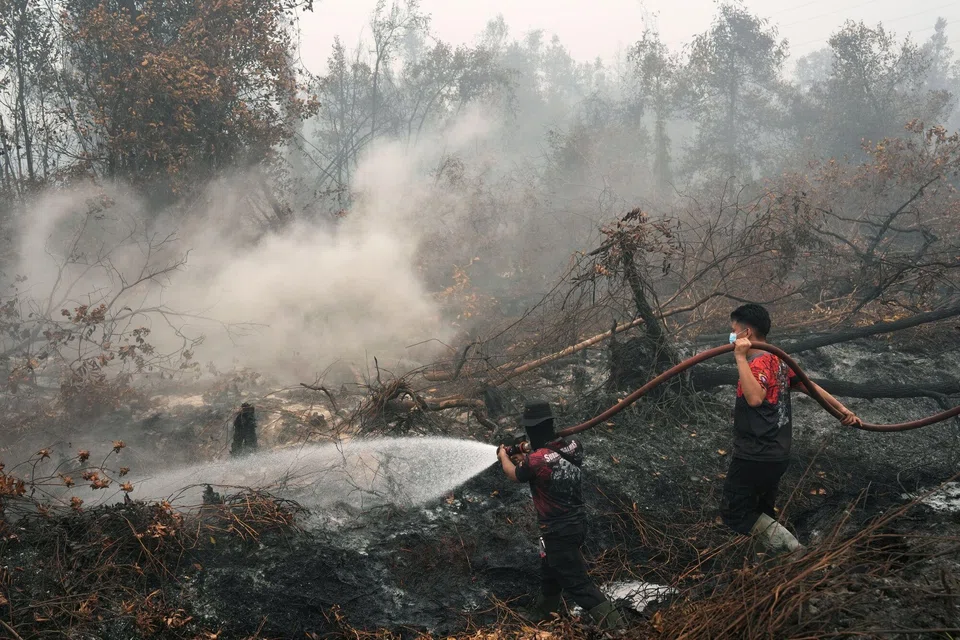
[JAKARTA] Indonesia has revoked forestry permits covering 338,536 hectares (ha) held by Riau Andalan Pulp and Paper (RAPP), a subsidiary of Asia Pacific Resources International Ltd (APRIL) Group.
The move, which affects an area about 4.5 times the size of Singapore, was taken over alleged environmental violations, including recurring peatland fires, illegal plantations and damage to protected areas, the government’s forest enforcement task force said on Friday (Nov 20).
The enforcement push comes amid heightened scrutiny of companies linked to forest fires and transboundary haze; the latest move marks a significant crackdown on major corporate players in the forestry sector.
The permits were revoked under a Forestry Ministerial Decree dated Thursday (Nov 19), with the entire concession area in Riau province returning to state control, said the Forest Area Enforcement Task Force, known as Satgas PKH, in a statement on Friday.
“All activities within the revoked concession areas have been halted, while the government has taken back control of the land,” it added. “The revocation does not absolve the company of its environmental restoration obligations or potential legal liabilities.”
The task force cited recurring peatland fires, oil palm plantations spanning 18,362.74 ha, unauthorised mining activities covering 541.46 ha, and damage to protected areas spanning 211.54 ha as grounds for the revocation.

It also raised concerns over the protection of areas surrounding Tesso Nilo National Park, which provides habitat for endangered Sumatran elephants.
APRIL Group said that it learnt about the government’s decision through media reports.
It noted that it was awaiting formal notification and further clarification from authorities.



“We respect the authority of the government and will continue to communicate constructively with the relevant authorities,” the company said in a statement. It added that it would respond through the appropriate channels once it received formal notification.
RAPP said that responsible forest management is central to its operations, adding that it manages industrial plantations while conserving forest areas and supporting peatland restoration initiatives.
The company said that its immediate priority is to safeguard the welfare of communities dependent on its operations, as well as to minimise disruption to contractors, customers, suppliers and other business partners.
RAPP, which has operated in Riau for more than three decades, is a major producer of pulp and paper products.
Its operations are centred around Pangkalan Kerinci in Pelalawan regency, where its industrial complex has helped drive the development of the surrounding town.
The company is part of APRIL Group, a pulp, paper and forestry business owned by Indonesian conglomerate Royal Golden Eagle, founded by billionaire Sukanto Tanoto.
The group produces fibre-based products for customers in more than 100 markets worldwide, with more than 85 per cent of its output exported, according to the company.
Broader forest enforcement
Indonesian authorities have stepped up investigations into suspected corporate involvement in forest and land fires, as transboundary haze from the blazes has spread to neighbouring countries, raising regional concerns over air quality.
The haze also prompted Singapore authorities to step up enforcement.
The National Environment Agency in October issued preventive measure notices to 10 companies in Indonesia, and notices seeking information from 10 Singapore-based companies.
On Nov 4, Singapore passed sweeping changes to its haze law, which will increase financial penalties and allow restrictions on business dealings with certain companies.
Established by Indonesia’s President Prabowo Subianto, Satgas PKH was formed as part of the government’s sweeping crackdown on the illegal exploitation of forest areas, tasked with reclaiming land encroached upon for commercial activities and restoring state control over forest assets.
The task force took action against another company in Riau, Gemilang Sawit Lestari, after finding indications that its non-estate palm oil mill in Kuantan Singingi regency bought and processed palm oil sourced from plantations operating illegally inside forest areas.
Authorities pointed out that the mill’s operations may have encouraged further encroachment into surrounding forests.
The task force recommended rejecting the company’s pending application to release about 32 ha of forest land and reclaiming the area.
Decoding Asia newsletter: your guide to navigating Asia in a new global order. Sign up here to get Decoding Asia newsletter. Delivered to your inbox. Free.
Copyright SPH Media. All rights reserved.
TRENDING NOW

What shattered Crystal Jade? How the culinary empire shrank from 120 to just 9 outlets

Could Jensen Huang work for Elon Musk? It would be ‘a titanic ego death match’, says biographer

‘We’ll wait and see’: Investors wary after STI sinks below 5,000 amid global AI selldown

South-east Asia has lost Nvidia’s best salesman

