



Singapore, Indonesia reach political commitment to address transboundary issues
With agreement achieved at the highest levels of government, plans must now be executed: Vivian Balakrishnan


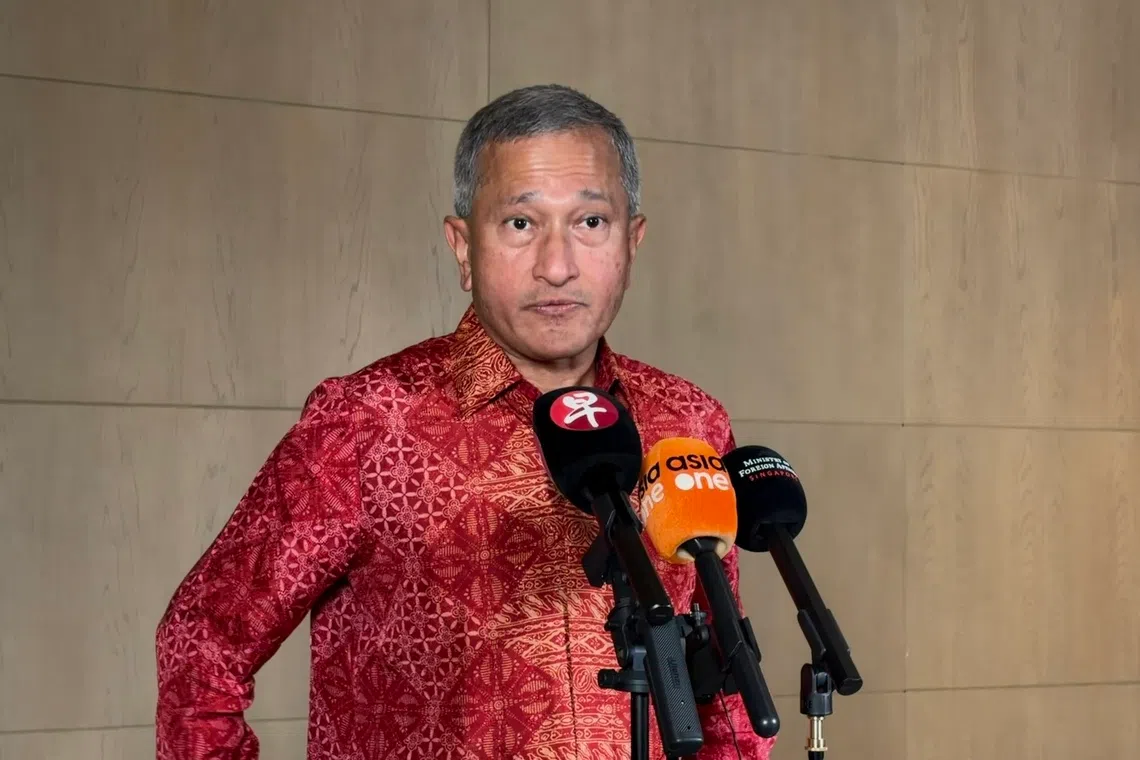
[JAKARTA] Singapore and Indonesia share a political commitment at the highest level to address transboundary issues including the haze, but must now turn that commitment into action by implementing agreed plans, said Singapore’s Foreign Minister Vivian Balakrishnan.
The remarks followed his meeting with Indonesian President Prabowo Subianto at his private residence in Hambalang, Bogor, on Wednesday (Oct 28). While declining to disclose details of the meeting, he said that there has been communication “at the highest level” between the two countries.
“Let me give you the assurance that communication has occurred at the highest level between my prime minister and President Prabowo,” he said in a media briefing.
“So it sets the political commitment on both sides to do what is necessary. And now we have to implement those plans, execute that commitment.”
Balakrishnan’s meeting with Prabowo came a day after his meeting with Indonesian Foreign Minister Arrmanatha Nasir in Jakarta, where the two countries agreed to set up a joint task force to facilitate information-sharing and coordination between their authorities, and to coordinate efforts to identify and hold accountable companies linked to the forest fires.
Balakrishnan said the recent haze episode underscores the importance of maintaining constructive cooperation even when issues become politically sensitive.
Face-to-face engagement allows governments to explain their concerns directly and seek solutions, he said, particularly when transboundary events affect people on the ground in both countries.
“But it is essential in times like this to keep looking out for cooperative, collaborative, constructive solutions. And that’s really what occupies the bandwidth,” he said.
Referring to the joint task force, he said he could not yet provide details of its composition and staffing, but added that the commitment at senior levels means it should be implemented quickly and effectively.

He also said Singapore is exploring stronger legislative and policy tools to hold companies accountable for their role in the haze, which has persisted in South-east Asia for almost three decades.
Beyond the haze, Balakrishnan said the episode offers Singapore a broader lesson in preparing for disruptions before they occur, including by diversifying energy supplies and building up reserves.
The comments come as Singapore navigates cuts to Indonesian gas exports, highlighting the importance of alternative supplies for the city-state, which relies heavily on imported energy.
Balakrishnan said that Singapore and Indonesia have reaffirmed their commitment to the sanctity of contracts amid the cuts. He said the principle is important not only to the gas supply issue, but also to the credibility and competitiveness of both economies.
The minister added that Singapore is approaching the situation from a position of strength, having prepared liquefied natural gas terminals and diversified its energy sources.
He cited Singapore’s exploration of a strategic oil storage facility on Jurong Island with Saudi Arabia as an example of its efforts to strengthen energy security.
Resource nationalism
Rising concerns over energy security have fuelled resource nationalism in South-east Asia, as governments seek to prioritise domestic demand while balancing the benefits of cross-border energy trade and regional cooperation.
The Middle East conflict has disrupted oil and gas shipments through the Strait of Hormuz, pushing up energy costs and exposing South-east Asia’s dependence on imported fuels.
This week, Minister for Energy, Trade and Industry (Energy and Industry) Tan See Leng said that countries may prioritise domestic needs during energy crunches, adding that resource nationalism is particularly concerning if it undermines established contractual agreements.
The challenges come as Singapore prepares to take over the Asean chairmanship in 2027, with regional energy integration and economic cooperation among its priorities.
Asked about rising resource nationalism in South-east Asia, Balakrishnan said that countries should not see national interests and regional cooperation as mutually exclusive.
“It is the responsibility of every government to ensure that essential supplies, including energy, are available to your own people and to your economy,” he said.
However, he argued that cross-border contracts could help mobilise financing for infrastructure, achieve economies of scale and lower the cost of producing energy and other essential supplies.
“My point is, working together and looking after your own needs – it’s not ‘either or’,” he said. “It’s not a binary, it’s a false dichotomy to make it an ‘either or’ dilemma.”
The approach is particularly important as the region faces growing energy demand, including from data centres and the expansion of artificial intelligence, he said.
Balakrishnan cited the proposed Asean Power Grid and the efforts to mobilise capital for regional energy infrastructure as examples of cooperation that could benefit countries at the national, regional and international levels.
Rather than retreating from cross-border partnerships, countries should continue investing in infrastructure while preparing for potential disruptions, he said.
“The path of least regret,” he added, “is to continue investing, continue partnerships, continue making contingency plans and to expand the scale of our national and regional infrastructure.”
Decoding Asia newsletter: your guide to navigating Asia in a new global order. Sign up here to get Decoding Asia newsletter. Delivered to your inbox. Free.
Copyright SPH Media. All rights reserved.
TRENDING NOW

If Europe goes to war, the fallout will be felt in East Asia

COE review: Motor traders suggest using vehicle length, engine size and power to classify cars

Firms linked to haze pledge cooperation in meeting with Shanmugam; government to table changes to haze law

Indonesia stocks suffer worst plunge in nearly 30 years as MSCI proposes standalone status

